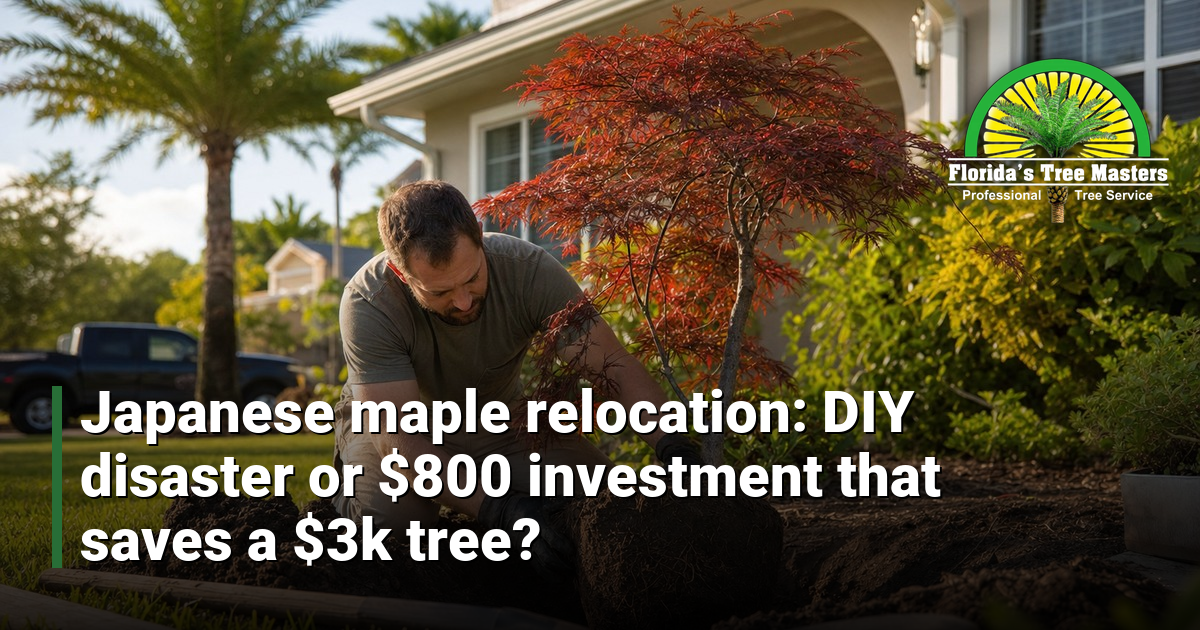
Florida’s Tree Masters gets calls about Japanese maples a few times a month. The question is usually the same: the tree is in the wrong spot, a project is moving it, or it’s getting choked out by something bigger. People want to know if a Japanese maple needs to be dug up and replanted without killing it. The short answer is yes, but you have to get a few things right or the tree won’t survive the move.
Table of Contents
ToggleWhy Japanese Maples Are Worth Saving
A Japanese maple that’s been in the ground for several years is a real investment. These trees grow slowly. A six-foot specimen with a full spread might be ten or fifteen years old. You don’t replace that with a trip to the nursery. Getting it moved correctly is almost always worth the effort, assuming the tree is healthy and the new location suits it.
Here in northeast Florida, Japanese maples can struggle. They don’t love our heat, and they don’t love afternoon sun in July and August. A bad location, too much direct sun, poor drainage, sandy soil with no organic matter, will stress the tree whether it’s been transplanted or not. If the current spot is killing it slowly, moving it to a better one could be the thing that saves it. If the current spot is fine and you’re relocating for landscaping reasons, that’s straightforward tree work too.
What Makes a Transplant Succeed or Fail
Transplant shock is real. When you dig up a tree, you cut a lot of the fine feeder roots it depends on for water and nutrients. The tree has to rebuild that root system in a new location. The faster it can do that, the better its chances.
There are four things that make the biggest difference:
- Timing. Late fall through early spring is the window. The tree should be dormant or close to it. In Volusia, Flagler, and St. Johns counties, that usually means late November through February. Moving a Japanese maple in the middle of July, when it’s 95 degrees and the tree is in full leaf, is a gamble you’ll likely lose.
- Root ball size. The root ball needs to match the tree. Too small and you’re leaving most of the feeder roots behind. A general rule is ten to twelve inches of root ball diameter for every inch of trunk diameter, but that’s a starting point. Our crew looks at each tree and makes a call based on what we find.
- Immediate replanting. The root ball should not sit exposed for days. Move the tree and get it in the ground the same day if possible. If there’s a delay, keep the root ball moist and in the shade.
- The new hole. Wide and shallow. Japanese maples don’t like to be planted deep. The root flare, where the trunk widens at the base, should sit at or just above the soil line. A hole that’s two to three times as wide as the root ball gives the new roots room to spread into loose soil.
We’ve handled a lot of japanese maple transplanting jobs across our service area. The jobs that go wrong are almost always about timing or root ball size. Do those two things right and the tree has a real shot.
How Big Is Too Big to Move?
This is where people get surprised. A Japanese maple with a trunk diameter of three inches or less is a manageable dig. Two people, the right shovels, and some burlap can handle it. Once you get to four, five, six inches of trunk diameter, you’re talking about a root ball that can weigh several hundred pounds. That’s a different job.
For larger specimens, we bring equipment. Our Bobcat skid steer with the right attachment can handle root balls that would wreck your back by hand. It also lets us lower the root ball into the new hole with control instead of dropping it, which protects the roots.
When a Tree Is Too Big to Save
Sometimes moving the tree doesn’t make sense. If the tree is already stressed, has significant root damage, or is so large that equipment and labor costs outweigh the replacement value, we’ll tell you that straight. Sometimes the right call is tree removal and planting a new Japanese maple in the better location. We’d rather give you that honest answer on the driveway than charge you for a transplant that won’t take.
What the Job Actually Looks Like
Here’s what happens when our crew does a japanese maple relocation. We come out, look at the tree, measure the trunk, check the root zone, and look at where it’s going. We make sure the new spot has the right conditions: partial shade, decent drainage, room for the canopy to grow without getting crowded. We talk through timing with you.
On dig day, we root prune around the tree carefully. The goal is a clean cut on the roots, not tearing. Torn roots are slower to heal and more likely to introduce disease. We wrap the root ball in burlap to keep it intact during the move. If the tree is heavy enough to need the Bobcat, we have it on site.
The new hole gets dug first, before we ever touch the tree. You don’t want the tree sitting out while you’re digging. We amend the backfill soil if the native soil is too sandy, and in most of northeast Florida, it is. A mix of native soil and compost gives the feeder roots something to work with while they re-establish.
Once the tree is set and backfilled, we water it in thoroughly. We set the grade so the root flare sits slightly above the surrounding soil. That prevents water from pooling at the base, which causes rot. We’ll walk you through the watering schedule for the first season, because the number one thing that kills a transplanted Japanese maple after the move isn’t drought or shock. It’s inconsistent watering in the first few months.
Mulching After the Move
Mulch matters more than people think. A three-inch ring of mulch around the base, kept away from the trunk itself, holds moisture, keeps the soil temperature stable, and cuts down on competition from grass and weeds. In Florida summers, that moisture retention is the difference between a tree that thrives and one that struggles. Use wood chip mulch, not rubber mulch. Keep it a couple inches away from the trunk so it doesn’t hold moisture against the bark.
Signs the Transplant Took, and Signs It Didn’t
In the first spring after the move, you want to see new bud break on all the branches. Some leaf scorch in the first summer is normal. The tree is still rebuilding its root system and may not keep up with water demand on the hottest days. That’s okay as long as the scorched leaves drop and new growth comes in.
What’s not okay: no bud break at all, bark that starts peeling away from the trunk, branches that are brittle and snap without bending. Those are signs the tree didn’t make it through the move. If you’re seeing those things, call us. Sometimes there’s something we can do, and sometimes there isn’t, but we’ll give you a straight answer either way.
One thing we tell every customer after a transplant: water deeply and consistently, especially in the first spring and summer. A slow soak twice a week beats a quick spray every day. You want the water to get down into the root zone, not just wet the surface. A soaker hose set around the drip line of the canopy is about as good as it gets for this kind of aftercare.
Get a Free Look Before You Dig Anything
If you’re thinking about how to move a japanese maple, don’t start digging until you know what you’re working with. The wrong timing or a root ball that’s too small can cost you a tree that took years to grow. We’ll come out, look at the tree and the new location, and give you an honest read on whether the move makes sense, what it will take, and what it will cost.
A tree transplant volusia county homeowners request most often falls in the few-hundred-dollar range, but larger jobs can run over a thousand depending on tree size, access, and what the new site needs. Every tree is different. Final price depends on size, location, access, and disposal if there’s anything to haul. We don’t quote over the phone without seeing the tree, and we don’t charge for the look.
Call us at (386) 320-3169. Our crew covers Volusia, Flagler, St. Johns, Duval, Clay, Putnam, Seminole, and Orange counties. We’re based in Port Orange and we’ve been doing this since 2018. For tree transplanting northeast florida homeowners and landscapers trust, and for anyone who needs to transplant japanese maple florida properties the right way, we’ll tell you exactly how to get it done.