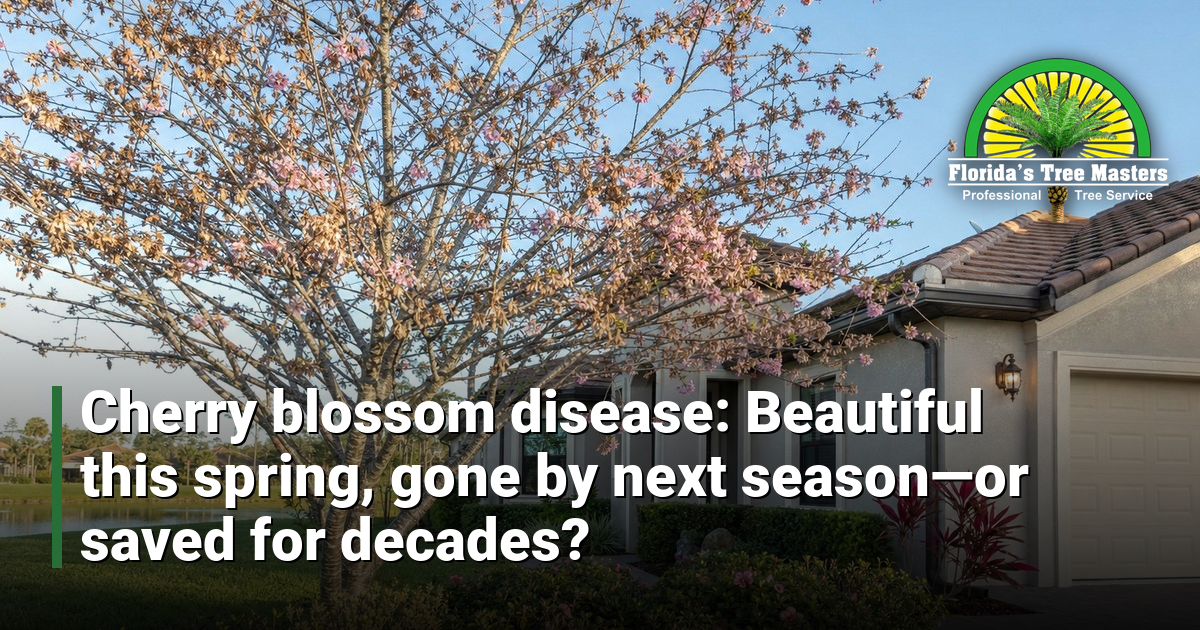
Florida’s Tree Masters gets calls every spring and summer about ornamental cherry trees that suddenly look wrong. Leaves turning yellow, spots appearing, branches dying back from the tips. Homeowners see it and assume the worst. Sometimes it’s serious. Sometimes it’s fixable. Either way, you need to know what you’re dealing with before the problem spreads or the tree comes down on something it shouldn’t.
Cherry blossom trees aren’t a native Florida species, but plenty of folks plant them for the flowers. They grow in Volusia, St. Johns, and Flagler counties and across the rest of our service area. The problem is Florida’s climate. The humidity, the sandy soil, the back-to-back rainy seasons. It’s hard on ornamental cherries. They’re not built for it. That makes ornamental cherry tree disease florida more common than it would be up north, and it means you need to catch problems early.
Table of Contents
ToggleCommon Diseases We See on Cherry Blossom Trees in Florida
Our crew has looked at a lot of sick trees. Here’s what shows up most often on ornamental cherries in this region.
Leaf Spot Diseases
This is the most common complaint. You’ll see brown or black spots on the leaves, often with a yellow ring around the edge. In bad cases, the leaves drop early and the canopy thins out fast. Several fungal pathogens cause cherry tree leaf spot, Blumeriella jaapii is one of the main culprits. Florida’s wet summers make fungal spread almost unavoidable if the tree isn’t getting good airflow.
Leaf spot usually won’t kill a mature tree outright. But repeated infections season after season weaken it. A weakened tree becomes a target for borers and rot. So don’t ignore it just because the tree is still standing.
Fire Blight
Fire blight is bacterial, not fungal, and it looks exactly like the name suggests. Branch tips die back and curl, turning brown or black. The dead growth hangs there like it got scorched. It spreads fast in warm, wet weather, which describes most of Florida from April through September. Pruning during wet weather can spread it further if the cuts aren’t handled right.
Cytospora Canker
Cherry tree canker shows up as sunken, discolored patches on the bark. The wood underneath is usually brown or reddish when you peel back the bark. This fungal infection moves into the tree through wounds, pruning cuts, storm damage, spots where branches rubbed against each other. Once a canker is established, it cuts off water and nutrients to anything beyond it. Limbs die. Sometimes whole sections of the tree go.
Powdery Mildew
Powdery mildew looks like someone dusted white powder on the leaves. It’s common on ornamental cherries, especially in shaded spots with poor air circulation. Rarely fatal, but it stresses the tree and makes it look rough. In Florida it tends to flare up in spring when temperatures are still mild and mornings are damp.
Signs That Go Beyond Disease, What Could Be Something Worse
Disease isn’t the only thing that makes a cherry blossom tree look sick. Some of what homeowners call cherry blossom tree disease is structural failure or pest damage. Here’s how to tell the difference.
If branches are dying back but the bark looks clean with no spotting or discoloration, check for borers. Peach tree borers attack ornamental cherries too. Look for small holes in the bark, sawdust-like material called frass at the base, and gummy sap oozing from the trunk. That’s not disease, that’s an insect problem, and the treatment is different.
If the whole tree is wilting despite normal rainfall, check the roots. Florida’s sandy soil drains fast. Over-watering and under-watering can both cause stress that mimics disease. But sudden, full-tree wilting can also signal root rot, especially where water pools after rain. Root rot is serious. A tree with compromised roots is a structural risk, not just a health problem.
If you’re seeing cracks in the trunk, included bark where two main limbs join tightly, or a lean that wasn’t there last year, that’s a safety issue. Don’t wait on that. A cracked trunk can fail without much warning. Call us and we’ll come take a look.
What You Can Do Right Now
There are a few things you can do while you’re deciding whether to call a professional.
- Clean up fallen leaves. Fungal spores overwinter in leaf litter. Rake and bag the leaves, don’t compost them. This won’t cure what’s already there, but it slows the spread.
- Stop overhead watering. If you’re watering with a sprinkler that hits the leaves, switch to drip or soaker hose at the base. Wet foliage is a fungal paradise, especially overnight.
- Improve airflow. If the tree is crowded by other plants or shrubs, clear some space. Our crew can selectively prune to open up the canopy without harming the tree’s structure.
- Don’t top the tree. We see this all the time. Someone tries to fix a sick tree by cutting it back hard. Topping stresses the tree further, creates large open wounds, and invites more disease and decay. No topping, ever.
- Watch and document. Take photos of the affected areas. Note when it started, whether it’s spreading, and whether it got worse after rain. That information helps when an ISA-trained arborist comes out to assess it.
Fungicide treatments can help with some fungal diseases when caught early. But not every product works on every pathogen, and timing matters. Applying the wrong treatment, or the right treatment at the wrong time, can waste your money or add stress to an already struggling tree. This is where getting eyes on the tree in person makes a real difference.
When to Call a Tree Service Instead of Treating It Yourself
There’s a line between a tree that’s sick and a tree that’s becoming a hazard. Knowing when you’ve crossed it matters, especially during Florida storm season, which runs June 1 through November 30.
Call us if you’re seeing any of these:
- Dead or dying branches over a roof, fence, vehicle, or walkway
- A lean that has gotten worse over a short period of time
- Cracks or splits in the main trunk
- Large sections of bark falling away
- The tree is in rapid decline and you can’t identify a cause
- You’ve already tried a treatment and it’s getting worse
A diseased tree that’s also structurally compromised is a real risk. We’ve pulled trees off rooftops in Clay County and St. Johns County after storms hit trees that were already weakened by rot or disease. The storm gets the blame, but the decay was the real problem. Don’t let it get to that point.
If the tree can be saved with pruning and treatment, we’ll tell you that. If it can’t, we’ll tell you that too. We don’t talk people into tree removal they don’t need. But we won’t tell you a tree is fine when it isn’t.
What We’ll Do When We Come Out
Our ISA-trained arborist will walk the tree top to bottom. We look at the canopy, the bark, the root flare, and the soil conditions. We check for structural issues alongside any disease symptoms. You get a straight answer about what’s going on and what your options are.
Good tree disease diagnosis florida starts with an in-person look, not a guess from a photo. If pruning is the right move, our crew has the equipment to do it safely. Bucket truck for taller ornamental trees, hand tools for precision cuts, cleanup when we’re done. We don’t leave brush piles in your yard. If the tree needs to come out, we bring the Volusia County crew, the Bobcat skid steer for moving debris, and the Vermeer stump grinder to finish the job clean.
Pricing depends on what the job involves. A single diseased limb removal is a different scope than a full removal with stump grinding. Most pruning jobs in our service area run somewhere in the range of $200 to $800 depending on size and access. Full removal on an ornamental cherry is typically $400 to $1,500 depending on location and how much space we have to work. Every tree is different. Final price depends on size, location, access, and disposal.
We offer free quotes. We’re licensed, insured, and we clean up after ourselves. If you’ve got a sick cherry tree florida and you’re not sure how serious it is, or your Cherry blossom tree showing signs of disease? give us a call at (386) 320-3169. We’ll come out, take a look, and give you a straight answer. No pressure, no guessing, no sending you a number without seeing the tree first.