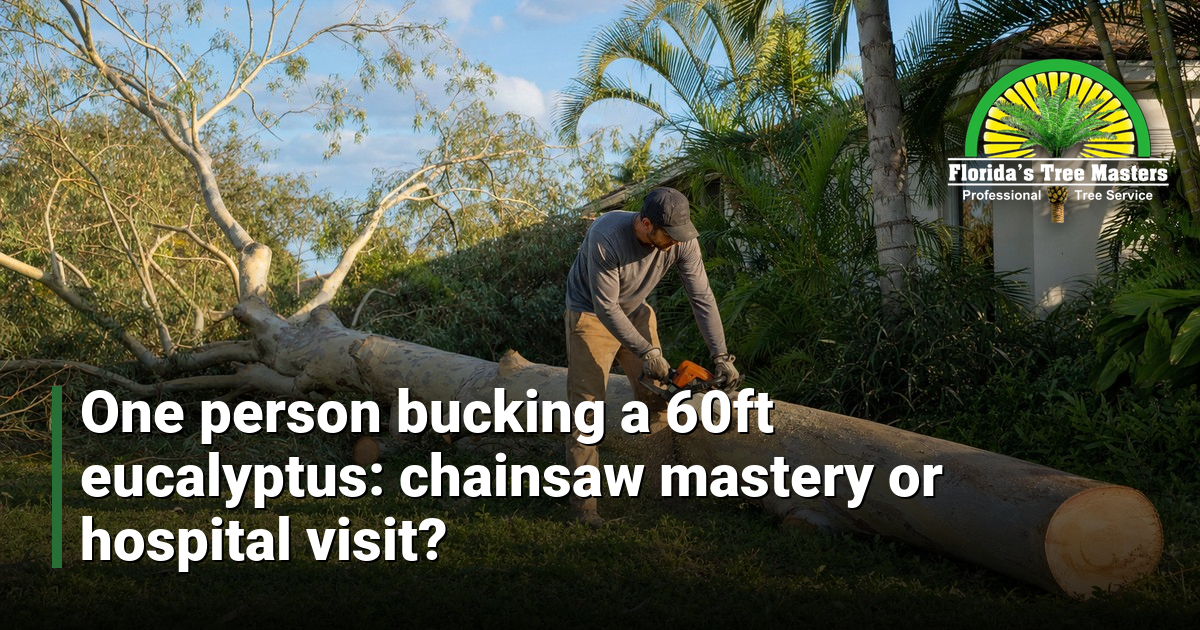
Florida’s Tree Masters gets questions like this one more than you’d think. Someone’s got a 60-foot eucalyptus on the ground and they want to know if one person can work through it alone. Short answer: yes, with the right setup. Long answer: eucalyptus is a different beast than oak or pine, and if you’ve never bucked one before, there are a few things you need to know before you fire up your saw.
Table of Contents
ToggleUnderstand What You’re Dealing With First
Eucalyptus is not a Florida native, but it grows here fast, especially in Volusia, Flagler, and St. Johns counties where people planted it for shade or privacy. When it falls, it doesn’t behave like a water oak or a slash pine. The wood is dense, stringy, and full of tension even after it hits the ground. Limbs can be bent hard against the trunk. The bark peels and gets slick when wet. And the whole tree can shift on you mid-cut if it’s not resting evenly.
Before you touch it with a saw, walk the whole length. Figure out where it’s supported and where it’s suspended. Look for limbs that are pinned under the main trunk. Those are spring-loaded. One wrong cut and the trunk rolls or a limb kicks up fast. That’s how people get hurt. Know your contact points first, then plan your cuts around them.
The Solo Bucking Process, Step by Step
Bucking eucalyptus tree solo is slower than doing it with a crew, but it’s manageable if you work smart. Here’s how our guys would approach a 60-footer on the ground.
Clear the Limbs First
Don’t try to buck the main stem until the limbs are off. Work from the base toward the top. Cut limbs on the underside first if they’re pinned. A release cut from the bottom prevents the saw from getting pinched. Then finish from the top. Keep your footing clean. Eucalyptus bark and wet grass are a bad combination, especially on sloped ground.
Get the whole trunk exposed before you start crosscutting sections. This lets you see every tension point and plan your bucking cuts properly.
Bucking the Main Trunk
Here’s where it gets technical. Knowing how to buck a downed eucalyptus correctly comes down to reading how the trunk is supported. A 60-foot trunk is not going to be uniformly supported along its length. Some sections will be end-supported, some side-supported, some lying flat. Each scenario changes where you make your cut and from which direction.
- End-supported (trunk ends resting on ground, belly sagging): Cut from the bottom up first, about one-third of the diameter. Then finish from the top. This prevents the trunk from pinching your bar as the wood compresses.
- Side-supported (trunk resting on a limb or log midway): The wood above the support point is in tension on top. Cut from the top down about one-third, then finish from the bottom. Opposite of end-supported.
- Flat on the ground: This is the easiest. Cut straight down. Use a bar tip if you have to work close to the soil, and be ready to pull the chain off the ground fast to avoid hitting dirt.
Work in sections you can move. A 16-inch diameter eucalyptus section two feet long is going to weigh over 150 pounds. Don’t cut rounds you can’t roll or lever out of the way. Keep a peavey or a cant hook nearby if you have one. It’s worth it on a big tree like this.
Watch the Lean and the Roll
As you remove sections, the remaining trunk can shift. Eucalyptus is round and smooth. On sandy Florida soil, it rolls easy. After every few cuts, check that the trunk hasn’t moved. Set a round piece behind it to chock the log if you’re working on a slope. This is a solo operation, so you don’t have someone watching your back. Build that awareness in yourself.
Equipment and Tree Bucking Tips That Make This Easier
You don’t need a full crew setup, but you do need the right tools. A saw with enough bar length for the diameter is non-negotiable. For a 60-foot eucalyptus, you’re likely looking at a 16 to 24-inch diameter trunk at the base. A 20-inch bar minimum. Sharp chain, too. Eucalyptus is hard on chains and will dull one fast. Bring a file and touch the chain up every hour or so.
Beyond the saw, a good peavey helps you rotate and position rounds without wrecking your back. Wedges matter too. If you’re cutting a tension section and your bar starts to pinch, a plastic or aluminum bucking wedge tapped in behind the bar can save your saw and keep you from getting stuck. Keep two or three on your belt.
Work gloves, chainsaw chaps, a helmet with face shield, and hearing protection are not optional. We say it because we’ve seen what happens when guys skip the chaps on a dense wood like this and the saw kicks. It’s not a good day.
If you’ve got access to a Bobcat skid steer with a grapple bucket, it changes the whole job. You can move sections out of the way as you go, keep the work area clear, and pick up rounds without blowing your back out. On a big tree like a 60-foot eucalyptus, that kind of equipment cuts the time in half. Our crew uses exactly that setup when we’re working a large downed tree on a property with access.
When a Solo Bucking Job Becomes a Two-Person or Crew Job
There’s a line where solo work stops being practical and starts being dangerous. Here’s where that line usually is on a tree this size.
- The tree fell on a structure, fence, or another tree. Pinned trees have unpredictable tension. That’s a two-person job at minimum, and usually a crew job with rigging.
- The trunk is larger than 24 inches in diameter at the base. Bucking sections that big alone means you’re moving wood that could crush a foot or roll onto you with no one around.
- You’re working on a slope and can’t chock the log reliably. Logs rolling downhill are fast and they don’t stop.
- The tree is near a structure, driveway, or utility line. Even on the ground, a section that kicks or rolls can do damage. A second set of eyes matters here.
We’re not saying don’t do it yourself. We’re saying know when the job has outgrown the solo setup. There’s no shame in calling a crew for the risky part and handling the smaller stuff yourself afterward.
If You’d Rather Just Have Us Handle It
A downed 60-foot eucalyptus is a full day of work for one person. For our crew, it’s a half-day or less depending on access and what you want done with the wood. We can drop in with the bucket truck if there are still standing sections, run the Bobcat skid steer to clear sections as we cut, and finish with the Vermeer stump grinder if you want the stump gone too.
We handle eucalyptus tree removal and downed tree removal florida-wide across all eight counties: Volusia, Flagler, Seminole, Orange, St. Johns, Duval, Clay, and Putnam. If you’re in one of those areas and want a second opinion on whether this is a safe solo job or something that needs a crew, we’ll come out and take a look for free.
Pricing on a job like this depends on the size of the trunk, how much of the wood needs to be hauled off, and whether there’s a stump to grind. Generally you’re looking at $500 to $2,000 for a downed tree this size, depending on access and disposal. Every tree is different. Final price depends on what we see when we get there.
A lot of folks searching “How can 1 person buck a 60ft eucalyptus on the ground question.” end up calling us after they get a look at what’s involved. That’s fine. We’re not here to sell you something you don’t need, but we are here if the job gets bigger than expected.
For downed tree cleanup volusia county and the surrounding areas, we’re usually able to get out fast. Give us a call at (386) 320-3169. We’re ISA-trained, licensed, and insured, and our crew cleans up after the job. Free quote, no pressure. If you’re in Volusia County or anywhere nearby, we’ll take a look and tell you straight what it needs.