Florida’s Tree Masters gets this question a lot, usually right after a storm when someone’s standing in their yard staring at a pine or oak that came through their fence or roofline. You want to know whose insurance pays. It’s a fair question, and the answer is more straightforward than most people expect. It does depend on a few things, so let’s walk through it the way we’d explain it on your driveway.
Table of Contents
ToggleThe Short Answer: It’s Usually Your Homeowner’s Insurance
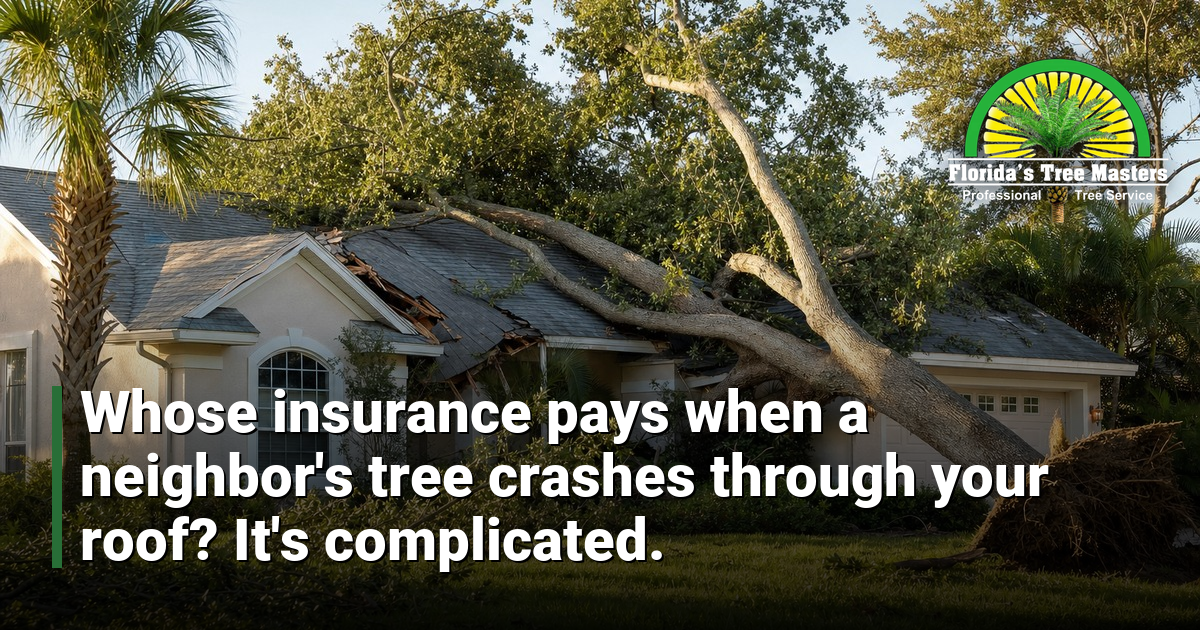
Most Florida homeowners don’t want to hear this, but it’s true. If a neighbor tree fell on my house, my own homeowner’s insurance policy is typically the one that covers the damage. That’s how Florida law generally works. The fact that the tree came from next door doesn’t automatically make your neighbor responsible.
Florida follows a negligence standard. Your neighbor is only liable if they knew the tree was a problem, dead, visibly diseased, severely leaning, previously flagged by a certified arborist, and they didn’t do anything about it. If the tree looked healthy and a storm knocked it over, that’s treated as an act of nature. Your policy pays. Theirs doesn’t get involved.
We’re not attorneys and this isn’t legal advice. But we’ve worked hundreds of these jobs in Volusia County and across our full 8-county area, and this is the pattern we see play out again and again. Talk to your insurance adjuster and a local attorney if you need case-specific guidance. What we can tell you is what to expect on the ground.
When the Neighbor Might Actually Be Liable
There are situations where neighbor tree damage florida claims do land on the neighbor’s policy. If you warned them about the tree in writing, a letter, a text, an email, and they ignored it, that paper trail matters. It shows they had notice of a hazardous condition and chose not to act. That’s the definition of negligence under Florida law.
Same goes if the tree was visibly dead, rotted through, or had a severe lean toward your property and your neighbor knew about it. A cracked trunk, mushrooms at the base, bark falling off, these are signs a tree is failing. If a neighbor had reason to know their tree was a risk and it fell and damaged your house, their liability exposure goes up significantly.
Here’s a practical tip. If you have a tree next door that worries you, send your neighbor a certified letter. Keep a copy. Let them know you’re concerned about the tree’s condition and ask them to have it looked at. If they don’t act and that tree eventually falls on your house, you’ve got documentation. That changes the conversation with the insurance companies.
What If the Tree Was Already Dead?
A dead tree is a different situation than a storm-toppled healthy one. Questions about fallen tree liability florida get a lot more interesting when the tree was clearly dead before it fell, no leaves, brittle limbs, hollow at the base. That’s harder for a neighbor to claim they had no idea. Our crew has been called out to assess trees after falls, and a dead tree tells a story. An ISA-trained arborist can document whether the failure was due to prior decay versus acute storm damage. That kind of documentation can matter in an insurance dispute.
What Happens to the Tree and Debris After It Falls
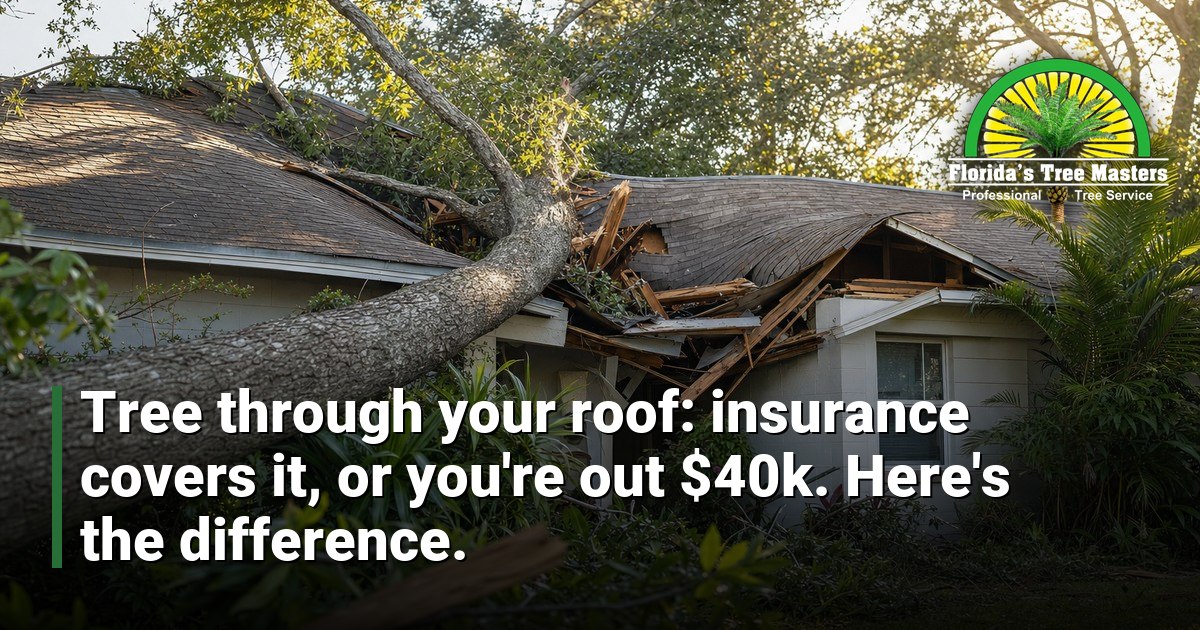
This is where things get complicated fast. The tree is lying across your roof, your fence, your HVAC unit. Who moves it? Who pays for that?
Your homeowner’s policy typically covers debris removal when there’s structural damage to your property. Most standard HO-3 policies in Florida include some amount for tree removal after storm florida if the tree damages a covered structure, your roof, your fence, your garage. If the tree falls in your yard and doesn’t hit anything, coverage for removal is limited or sometimes not there at all. Read your policy or call your agent before you assume you’re covered.
What we handle on our end is the physical work, cutting the tree out of wherever it landed, removing the debris, and grinding the stump if needed. Our bucket truck, Bobcat skid steer, and Vermeer stump grinder get deployed based on the situation. Some of these jobs are tight-access nightmare scenarios. A big water oak jammed into a roofline with no driveway access on either side is a real thing we deal with in older neighborhoods around Flagler and St. Johns County. Our guys are trained for that. We document the work, and we can provide detailed invoices that your insurance adjuster can use for the claim.
Can You Bill Your Neighbor Directly?
You can try. If you paid out of pocket for emergency tree removal and your neighbor is clearly at fault, they ignored warnings, the tree was dead, you may be able to pursue them in small claims court. But most of the time, people want the tree off their house now, not six months later after a legal process. That’s why your own insurance is the practical first call, even if you think the neighbor is liable. Settle the claim, then sort out liability later if it’s worth pursuing.
How to Protect Yourself Before a Tree Falls
Storm season in Florida runs June 1 through November 30. Five months of potential trouble. If you’ve got a neighbor’s tree that concerns you, act before hurricane season, not after.
Start by looking at the tree yourself. Is it leaning toward your house? Are there large dead limbs hanging over your roof? Is the base soft, funky-colored, or sprouting mushrooms? Any of these are reason to have it assessed. We offer free quotes, and part of that assessment is telling you whether a tree is a real risk or just looks scary.
If the neighbor owns the tree but the branches hang over your property line, Florida law generally allows you to trim those branches back to the property line at your own expense. But cutting major limbs wrong can hurt the tree and create new hazards. The cleaner move is to have a professional do it and do it right.
We’ve seen trees that looked perfectly fine drop a major limb in a light afternoon storm because the inside was rotted out. Sandy soil here in northeast Florida doesn’t hold root systems the way clay does further north. A tree that seems anchored can fail faster than you expect when the ground saturates during a heavy rain event. That’s not a scare tactic. It’s just the reality of working in this soil and this climate for years.
If you’ve had prior conversations with a neighbor about a concerning tree and nothing has happened, document it. Write it down. Date it. It may never matter, but if that tree falls on your house next August, you’ll be glad you have it.
Call Us After the Tree Falls, or Before
The most common search we see people run from their phones in the middle of a storm is “Whose insurance pays if a neighbor tree falls on my house near?” If that’s what you just typed, here’s your answer: call us first, then call your adjuster. We run a 24/7 emergency line. Day, night, weekends, holidays, our crew picks up. We’ll get out there, assess the situation, and get the tree off your structure safely. We carry full liability insurance, and we can provide documentation that your insurance adjuster needs to process your claim.
The question of whose insurance pays for fallen tree damage is one your adjuster will sort out. Our job is getting the tree off your house and giving you paperwork that makes that conversation easier.
If the tree hasn’t fallen yet but you’re worried about one on your property or your neighbor’s, we’ll come out, take a look, and give you a free quote. No obligation. When a tree fell on house insurance claim starts, adjusters want fast, documented cleanup. We handle that. We serve all of Volusia, Flagler, Seminole, Orange, St. Johns, Duval, Clay, and Putnam counties. Pricing on tree removal varies based on size, location, and access, most residential jobs land somewhere between $400 and $2,500, but every tree is different. We’ll give you a straight number after we see it.
Call (386) 320-3169. We’ll take a look and tell you exactly what you’re dealing with. No runaround, no upsell. Just a straight answer and a fair quote from a crew that’s been doing this work across northeast Florida since 2018.