Florida’s Tree Masters gets calls about this every week, and the question is almost always the same: “My neighbor’s tree fell on my fence, who pays for it?” It’s one of the most searched tree questions in Florida, and if you’ve ever typed neighbor tree on my property reddit, you know the answers are all over the place. Some are right. A lot are wrong. Here’s what actually happens under Florida law and what our crew sees on the ground in Volusia, St. Johns, Clay, and the rest of our eight-county service area.
Table of Contents
ToggleWho Is Responsible for Neighbor Tree Damage?
Florida follows what’s called the “Massachusetts Rule” in most courts. That means the tree owner is generally not liable for damage caused by a falling tree, unless they were negligent. In plain terms: if the tree looked fine and a storm knocked it over, your neighbor probably isn’t on the hook. Your homeowner’s insurance handles it. If the tree was dead, leaning badly, or visibly rotted, and your neighbor knew about it and did nothing, that changes the conversation.
The word “negligence” is doing a lot of work there. Courts look at whether the owner knew or should have known the tree was a hazard. A healthy oak that blows over in a tropical storm is different from a half-dead water oak your neighbor ignored for two years after you complained about it. So when people ask who is responsible for neighbor tree damage, the honest answer is: it depends on what the owner knew and when they knew it.
None of this is legal advice. For that, you need a property attorney. But this is what we see play out on properties all the time.
The Overhanging Branch Situation
A lot of calls we get aren’t about a fallen tree. They’re about an overhanging neighbor tree florida homeowners are tired of dealing with. Branches hanging over a fence, roots lifting a driveway, limbs sitting above a roof. Florida law generally gives you the right to trim branches and roots that cross the property line, up to the line. You pay for that trim. Your neighbor doesn’t have to do it for you.
That sounds simple. In practice, there are a few things to watch:
- You can trim up to the property line. You can’t go onto your neighbor’s property without permission.
- If your trimming kills the tree, you could be liable for the tree’s value. This is where topping comes in. We don’t top trees, and neither should whoever you hire. Topping a live tree causes long-term decay and can create a liability of its own.
- If a branch is overhanging your roof or power line, get eyes on it fast. A branch that’s cracked at the union can come down without warning.
Our ISA-trained crew can assess whether a branch is structurally sound or already failing. That assessment can also matter if you’re trying to document a hazard to your neighbor.
Documenting a Hazardous Neighbor Tree
If you think your neighbor has a dangerous tree that could fall on your house, document it. Take photos. Date them. Put your concern in writing to your neighbor. Text or email works fine because there’s a timestamp. If they ignore it and the tree later damages your property, that paper trail matters.
Some homeowners go the certified letter route. Not a bad idea for a serious hazard. We’ve seen cases where a documented written notice made a real difference in how insurance companies and attorneys handled the claim.
We can also come out and give you a written assessment of the tree in question. That gives you something factual to hand to your neighbor or your insurance adjuster. We’ll tell you plainly whether we think the tree is a hazard. We won’t inflate the risk to sell you a removal job.
What to Do After a Tree Has Already Fallen
If you’re dealing with a tree fell on property florida situation, here’s the order of operations we recommend:
- Safety first. If there are downed power lines anywhere near the tree, keep everyone away and call 911 or your utility provider before anything else.
- Document the damage. Take photos before anything is moved. Your insurance company will want them.
- Call your homeowner’s insurance. Even if you think your neighbor is liable, your policy likely covers debris removal and structural damage. File the claim. Your insurer can pursue the neighbor’s insurer if they have grounds, that’s called subrogation.
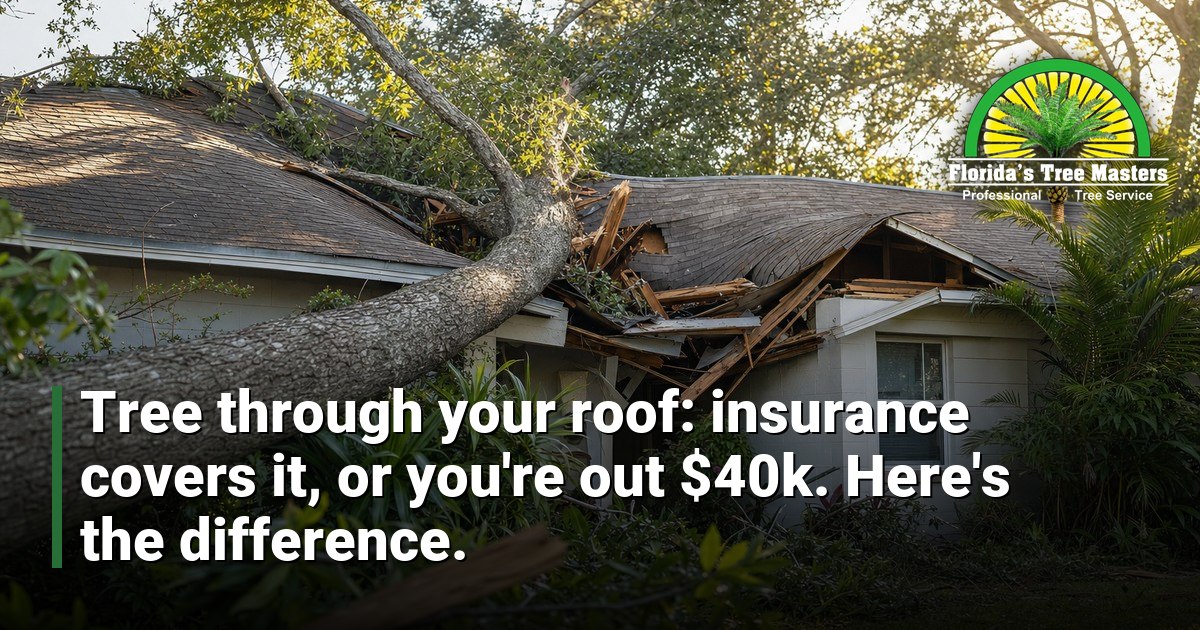
- Get the debris removed safely. A tree on a roof or fence needs to come off carefully so it doesn’t cause more damage on the way down. This isn’t a chainsaw-and-hope situation.
Our crew handles storm-damaged tree removal all the time. We work around structures, we know how to rig and lower sections safely, and we bring a Bobcat skid steer to clear debris from tight spaces. We haul everything off too. We don’t leave you with a pile of wood on the lawn.
If you’re dealing with emergency damage after a storm, our line is answered 24 hours a day. Nights, weekends, holidays, call 386-320-3169.
HOA and Municipal Tree Rules in Florida
If you’re in an HOA community, there’s often another layer. Some HOAs maintain trees in common areas or even on individual lots. If the problem tree is on common-area property, the HOA is the responsible party, not your neighbor. Check your CC&Rs before assuming.
Municipalities have their own rules about street trees, the ones between the sidewalk and the road. In most Florida cities and counties, the city or county owns those trees and is responsible for them. If a city-owned tree damages your property, the claim runs through the local government, not a neighbor.
This gets complicated fast. A property attorney is the right call for contested liability. What we can do is remove the tree safely and give you documentation of the work, which supports any claim you’re making.
A Note on Live Oaks and Protected Trees
Several counties in our service area have ordinances protecting certain tree species, especially live oaks and old-growth trees above a set diameter. In Volusia County, for example, removing a protected tree without a permit can result in fines. Even if you have a neighbor tree on my property situation where the tree is clearly yours to deal with, you may still need a permit before anyone touches it.
We pull permits. Our crew knows the local rules in Volusia County and across the other seven counties we work in. If a permit is required, we handle that before the first cut is made. You won’t be left scrambling.
Boundary Trees: What Happens When a Tree Straddles the Property Line
Boundary trees, trees whose trunk sits on the property line, are technically owned by both neighbors. Neither owner can remove the whole tree without the other’s consent. Neither can damage it in a way that harms the other’s interest. If you’re dealing with a boundary tree, talk to your neighbor before making any moves. Getting that wrong can turn into a lawsuit faster than a storm damage claim.
Get Eyes on It Before It Gets Worse
Most of these situations, whether it’s an overhanging neighbor tree florida issue, a question about neighbor tree removal florida, or post-storm damage from a neighbor tree fell on my property florida, get simpler once someone who knows what they’re looking at actually looks at the tree. We’ve handled hundreds of these calls across Volusia, Duval, St. Johns, Clay, Flagler, Putnam, Seminole, and Orange counties since 2018. We can tell you whether a tree is a real hazard or a minor nuisance, document it for you, and if it needs to come down, we’ll do the tree removal right. Licensed, insured, with cleanup included.
Call us for a free quote: 386-320-3169. We’ll come out, take a look, and give you straight answers. No pressure, no upsell. Just an honest assessment of what’s sitting on or over your property line.