Florida’s Tree Masters gets this call a lot. A tree on your neighbor’s side of the fence is dropping limbs on your roof, leaning toward your house, or the roots are cracking your driveway. You’re not sure who’s responsible, you don’t want a fight with the people next door, and you just want to know what to do. We’ve handled these situations across Volusia, St. Johns, Duval, and the rest of our service area. Here’s a straight answer.
Table of Contents
ToggleWho Owns the Tree, and Who’s Responsible?
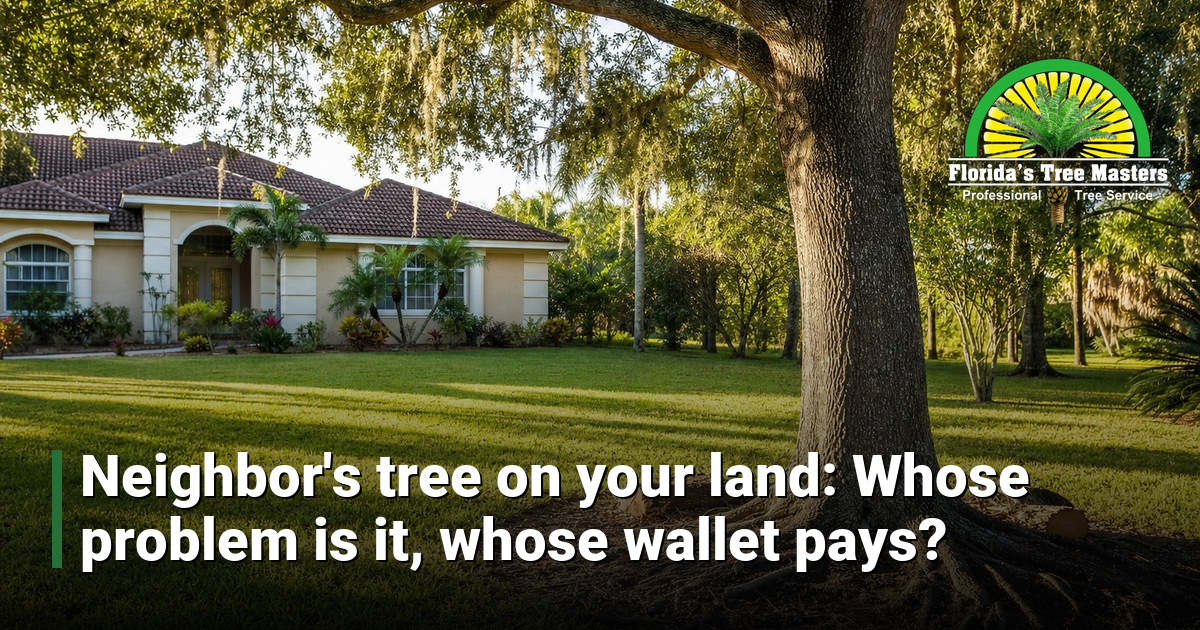
Generally, the tree belongs to whoever owns the land where the trunk is rooted. If the trunk is in your neighbor’s yard, it’s their tree. But here’s where it gets complicated: branches and roots that cross the property line onto your land are generally yours to deal with. This is often called “self-help.” That means you can typically trim branches or roots up to the property line, at your own expense.
Trimming is one thing. Removal is another. You can’t go onto your neighbor’s property and cut down their tree without permission. And you shouldn’t try to top it from your side either. Topping damages the tree and creates more hazards. No topping, ever. That’s a hard rule for our crew and it should be one for any homeowner too.
If the tree is clearly dead, diseased, or visibly leaning toward your structure, responsibility can shift more toward the tree’s owner. A neighbor who ignores a known hazard tree neighbor situation can be held liable for damages. That doesn’t help you when the limb is already through your roof, but it matters when you’re trying to get them to act before something happens.
Is the Tree Actually Dangerous?
Not every tree hanging over a fence line is a real risk. But some are. Here are the signs we look for when our crew shows up to assess a neighbor tree on my property situation.
- Dead branches or a dead crown, dry, brittle limbs with no leaves when the rest of the tree is green. These can fall without warning.
- A visible lean toward your house, especially if the lean has gotten worse after a storm. A slow lean over time in sandy Florida soil can mean the root plate is compromised.
- Fungal growth at the base, mushrooms or shelf fungus near the trunk almost always means internal rot. The tree can look fine from the outside and be hollow inside.
- Cracks in the trunk, a cracked trunk can fail without warning, especially in high wind. We see this a lot with water oaks after a wet season followed by drought.
- Root damage from construction or paving, if a driveway or sidewalk went in close to the tree in the last few years, the root system may be compromised. The tree can look healthy and still be unstable.
If you’re seeing any of these signs on a tree that’s near your house, don’t wait for your neighbor to act first. Document it. Take photos with timestamps. That documentation matters if the tree comes down and there’s a dispute about whether the risk was known.
Talking to Your Neighbor First
We know this is the part nobody wants to deal with. But in most cases, a calm conversation goes further than a certified letter. Most neighbors don’t know their tree is a problem. They’re not looking at it from your side of the fence every day. A simple heads-up, “hey, I noticed that big limb is hanging right over my carport, can we talk about it?”, works more often than you’d think.
If you want something more formal, send a written notice via certified mail. Keep a copy. That creates a paper trail showing they were informed of the hazard. If the tree later causes damage, that paper trail can matter for your insurance claim and for any legal action.
We’re not attorneys and this isn’t legal advice. Every situation is different. But getting a professional assessment of the tree, a written opinion from an ISA-trained arborist about the condition and risk, gives you solid ground to stand on when you approach your neighbor or your insurance company.
What Our Crew Can Actually Do
Here’s where we come in. There are a few different ways we can help depending on where things stand with your neighbor.
Tree Trimming the Property Line
If branches are crossing onto your property, we can handle tree trimming property line work back to your boundary. We use our bucket truck to get up into the canopy safely and make clean cuts that won’t damage the tree any more than necessary. We haul everything off and clean up. Cost depends on how many limbs we’re talking about and how close to structures we’re working, and every job is different. Final price depends on size, access, and what we find when we get up there. We’ll give you a free quote on tree trimming before any work starts.
Full Removal, With Your Neighbor’s Agreement
If a tree removal neighbor dispute gets resolved and both sides agree the tree needs to come down, we can handle the full removal. This is the cleanest outcome. We bring the Bobcat skid steer, the bucket truck, and a full crew. We section the tree down safely, chip the debris, and grind the stump if that’s part of the scope. Tree removal cost depends on size, location, and how much room we have to work. We’ll come out, look at it, and give you a free quote. No commitment required.
Assessment and Documentation
Sometimes what you need most is a written professional opinion. Our ISA-trained crew can assess the tree, document what we find, and give you something in writing that you can take to your neighbor or your insurance company. If a tree looks dangerous to us, we’ll say so plainly. We won’t sugarcoat it to keep the peace.
Storm Season Makes This More Urgent
Florida storm season runs June 1 through November 30. That’s the window where a questionable tree becomes a real threat. Wind, rain, and saturated sandy soil are a bad combination for a tree that’s already leaning or already rotting. We see it every year. Trees that looked fine in May are through someone’s living room by September.
If you’ve got a neighbor tree on my property near me situation and that tree is already showing warning signs, don’t wait until a named storm is 48 hours out to start making calls. Emergency tree work after a storm costs more, takes longer, and puts our crew in more difficult conditions. If there’s a limb over your roof right now, that’s a real risk. Don’t wait.
We handle storm-damage and emergency tree work across all eight counties we serve: Volusia, Flagler, Seminole, Orange, St. Johns, Duval, Clay, and Putnam. If something comes down, call us.
Florida Property Line Rules and Neighbor Tree Liability
Before you take action, it helps to understand neighbor tree liability florida basics and the rules around a tree hanging over property line florida. The short version: if your neighbor knows about a hazard and ignores it, they can be on the hook for damages. But you still can’t go onto their property without permission, and you can’t make cuts that kill the tree. Document everything, talk to your neighbor, and get a professional opinion in writing. That puts you in the strongest possible position if things escalate.
Get a Free Quote, We’ll Come Take a Look
You don’t have to figure this out on your own. We know how to assess the risk, give you honest information, and do the work right. Licensed, insured, ISA-trained. Full cleanup included on every job. We leave the property like the tree was never there.
Call us at (386) 320-3169. We’ll come out, look at the tree, and give you a straight answer and a free quote. No pressure, no runaround. Just honest tree work from a crew that’s based right here in Port Orange and has seen every version of this problem you can imagine.