Florida’s Tree Masters gets this question all the time, and the honest answer is: it depends. “Will insurance pay for tree removal after a storm?” is usually the first thing people ask us when they call. Insurance companies don’t write a single clean rule for storm tree removal. What they cover, and what they won’t, comes down to where the tree landed, what it hit, and what your specific policy says. We’re not insurance adjusters, but we work storm jobs across Volusia, Flagler, St. Johns, Duval, and the rest of our eight-county area. We know what customers typically run into when they file a claim. Here’s what we’ve seen.
Table of Contents
ToggleThe Short Answer: Coverage Depends on Where the Tree Landed
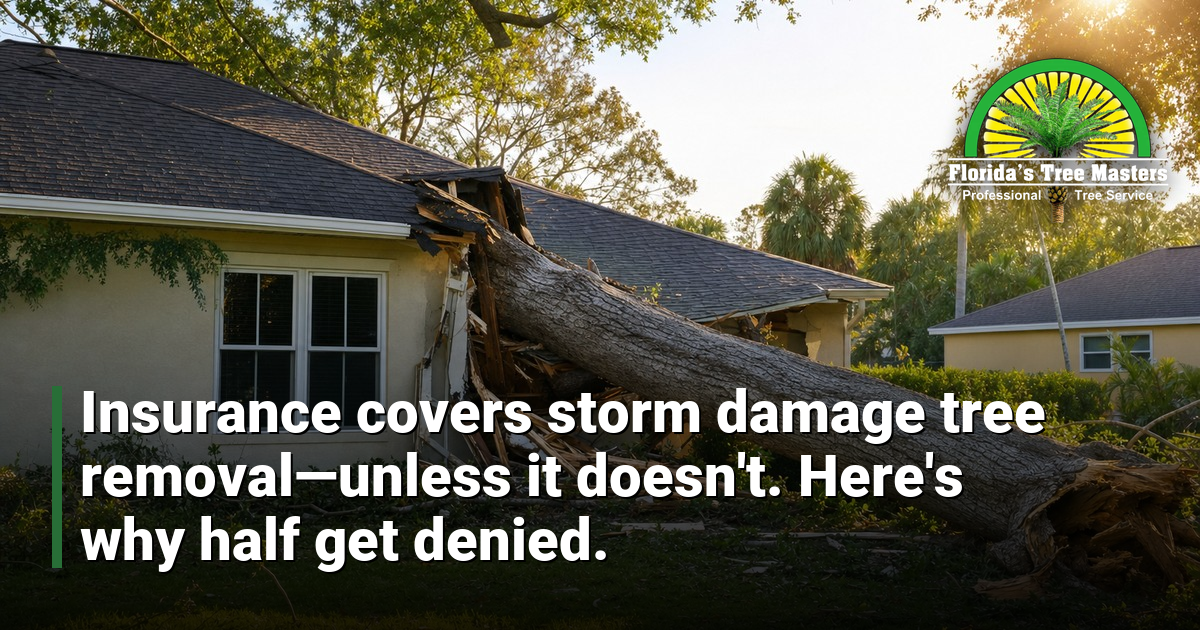
If a tree falls and hits your house, your detached garage, your fence, or another structure, most standard homeowner insurance tree damage policies will cover the removal cost and the structural damage. The tree did damage, your policy covers the damage, and removal is part of that claim.
If the tree fell in your yard and missed everything, no structure, no vehicle, no real property damage, most policies won’t pay a dime for removal. The tree is just sitting there. To your insurance company, that’s a yard cleanup problem, not a covered loss. Frustrating? Yes. But that’s how the language typically reads.
There are limits too. Even when removal is covered, most policies cap the payout for removal costs alone. That cap may not cover the full job, especially for a big water oak or a large pine that needs a bucket truck and a crew for a full day. You may still owe the difference out of pocket after your deductible.
Three Scenarios We See After Every Storm
Scenario 1: Tree Hit the House or a Structure
This is the clearest path to coverage. File the claim, get an adjuster out, and get a written estimate from a licensed tree service, that’s us. We document the job thoroughly so you have what you need for your claim. Make sure the estimate breaks out removal from any structural repair work, because those often get handled by different parts of your policy.
One thing to watch: some adjusters will push back on removal costs if the limb or tree is still partially holding up your roof or a wall. Don’t let that sit. A cracked trunk or a tree leaning against your structure can shift without warning. If that’s your situation, call us first and let us make it safe, then deal with the paperwork.
Scenario 2: Tree Landed on Your Car
Your homeowner’s policy usually won’t cover your car. That falls under your auto insurance, specifically comprehensive coverage. If you have it, file with your auto insurer for the vehicle damage. The tree removal itself may still fall to your homeowner’s policy if the tree also hit a structure, or you may be paying out of pocket for the removal portion. Your adjuster can walk you through which policy applies where.
Scenario 3: Tree Down but No Structure Hit
This is where most people get surprised. The storm knocked a big pine across your backyard. Nothing got damaged. You just need it gone. So if you’re wondering will insurance pay for tree removal in this situation, the answer is usually no. Most policies don’t cover that removal. You’ll be paying out of pocket. The cost for a downed tree depends on size, species, access, and how much of it needs to be hauled away. Call us for a free quote and we’ll give you a real number after we take a look.
What Your Policy Actually Says, and How to Read It
Pull out your declarations page and look for these terms: “debris removal,” “additional coverages,” and “fallen tree.” Some policies bundle tree removal into debris removal with a sub-limit. Others treat it separately. A few policies, usually higher-end ones, have broader language that covers removal even when no structure was hit, if the tree is blocking a driveway or a ramp needed for accessibility.
Don’t assume. Read the actual policy language or call your agent directly. Ask these three questions:
- Does my policy insurance cover fallen tree damage to a covered structure?
- Is there a per-tree or per-occurrence dollar cap on removal?
- Is removal covered if no structure was damaged but access is blocked?
Write down what they tell you. If it matters later, you want that conversation on record.
How to Handle the Process After a Storm
Here’s the order of operations that tends to go smoothest. First, make sure the situation is safe. If a tree is on your roof or leaning against your house, don’t go poking around underneath it. Call us. We’ll come out and assess whether it’s actively dangerous and what needs to happen first.
Second, document everything before anything gets moved. Take photos and video of the tree, the damage, your property lines, and anything the tree hit. Do this from multiple angles. Your adjuster will want this, and so will we when we write the estimate.
Third, call your insurance company and open a claim. Don’t wait on this. Most policies have a window for reporting storm damage, and missing it can complicate things. Your adjuster will schedule a visit. In the meantime, you can authorize temporary protective measures, tarping a roof for example, without it affecting your claim.
Fourth, get a written estimate from a licensed, insured tree service. That’s where we come in. We’ll document the job, break out the line items, and give you paperwork that works with your adjuster’s process. Some insurance companies want two estimates. We can help you understand what’s normal.
One thing to avoid: don’t let anyone pressure you into signing over your claim rights to a contractor before you understand what you’re agreeing to. That’s called an assignment of benefits, and it can get complicated fast. We don’t operate that way. We write you an estimate, you pay for the work, and you handle your claim separately.
What We Handle After a Storm
Our crew handles storm damage tree removal across all eight counties we serve. Trees don’t fall on a schedule, so call us when one comes down. After a major storm, we work through the call list as fast as we can get to everyone safely, with a bucket truck, Bobcat skid steer, and chainsaws.
We’re licensed, insured, and ISA-trained. That matters when you’re filing a claim, because your insurance company may ask for proof that the crew who did the work was covered. Some adjusters will flag jobs done by unlicensed crews, and that can complicate reimbursement.
The Vermeer stump grinder is available if you want the stump gone too. We haul debris off the property, we don’t leave it piled at the curb and call it done.
If you need tree removal after storm florida weather throws at you, whether you’re in Volusia County or anywhere else in our service area, call us before the situation gets worse. We’ll come out, take a look, and tell you exactly what needs to happen and what it’ll cost. No pressure, no guessing.
Questions about storm tree removal insurance come up on every job, and we can give you a straight answer on what’s realistic. Storm job costs vary with size, access, and how tangled up things are. Call (386) 320-3169 for a free quote.