Hurricane season officially starts June 1, and if you’re a homeowner in Volusia County, your trees are either your best defense or your biggest liability. The difference? Preparation.
We’ve been doing tree work in Volusia, Flagler, and Seminole Counties since 2018. Every hurricane season, we see the same thing: homeowners who prepped their trees ride out the storm with minimal damage. Those who didn’t are calling us at 3 AM with a tree through their roof.
Here are the 10 things you should do before June 1 to protect your property this hurricane season.
Table of Contents
1. Walk Your Property and Look Up
Grab a cup of coffee and take 20 minutes to actually look at your trees. You see them every day, which means you’ve stopped noticing them. Look for:
- Dead branches (no leaves, peeling bark)
- Branches touching or overhanging your roof
- Trees leaning toward your house, pool cage, or car
- Mushrooms growing at the base of any tree (sign of root rot)
- Cracks or splits in trunks
- V-shaped forks where two trunks meet (weak attachment point)
If you spot any of these, that tree needs professional attention before storm season.
2. Know Your Danger Trees
Some tree species in Central Florida are just more dangerous in hurricanes than others:
- Laurel oaks — They look healthy but rot from the inside. If yours is over 30 years old, get it inspected. They’re the #1 surprise failure in Volusia County storms.
- Slash pines — Tall and top-heavy with shallow roots. They snap or uproot first in high winds.
- Water oaks — Fast-growing but weak wood. They split apart under sustained wind.
- Australian pines — Invasive and extremely brittle. If you have one near your house, remove it now.
On the other hand, live oaks and palms are generally your safest trees in a storm (when properly maintained).
3. Get Dead Wood Out of Your Canopy
Every dead branch in your trees is a projectile waiting for a strong gust. Dead wood snaps off at surprisingly low wind speeds — you don’t need a hurricane, just a good thunderstorm. A dead branch through your car windshield, pool cage, or neighbor’s window is damage (and liability) you can prevent today.
A professional crown cleaning removes all dead, dying, and broken branches. It’s the single most important maintenance for any tree.
4. Thin Your Tree Canopies
Think of a sail vs. a screen door. A dense canopy catches wind like a sail — the tree either rips apart or falls over. A properly thinned canopy lets wind pass through like a screen door.
Crown thinning reduces wind load by 20-30%. It’s the most effective storm prep you can do for a healthy tree you want to keep. An arborist selectively removes interior branches while maintaining the tree’s natural shape.
Important: This is NOT topping. Never let anyone top your trees. Topping creates weak regrowth that’s actually MORE likely to fail in future storms. If a company suggests topping, find a different company.
5. Clear 10 Feet Around Your Roof
Any branch within 10 feet of your roof is a roof damage risk in a storm. Period. Branches touching your roof are grinding away at shingles every time the wind blows, even in normal weather.
Get branches cut back to provide at least 10 feet of clearance from your roof, pool cage, and any other structure. For large trees (60+ feet tall), the trunk should ideally be at least 20 feet from your home.
6. Trim Your Palms
Florida palms are hurricane champions — they bend, they flex, they survive. But dead fronds are a different story. Brown, hanging palm fronds rip off in high winds and become projectiles. They can smash windows, damage cars, and injure people.
Get your palms trimmed before June 1. Remove only dead and dying fronds — never green fronds. The “hurricane cut” that strips palms down to a pineapple top actually weakens the palm and makes it more vulnerable.
7. Deal With That Tree You’ve Been Ignoring
You know the one. The dead pine in the back corner. The laurel oak that dropped a branch last year. The tree your neighbor has been complaining about.
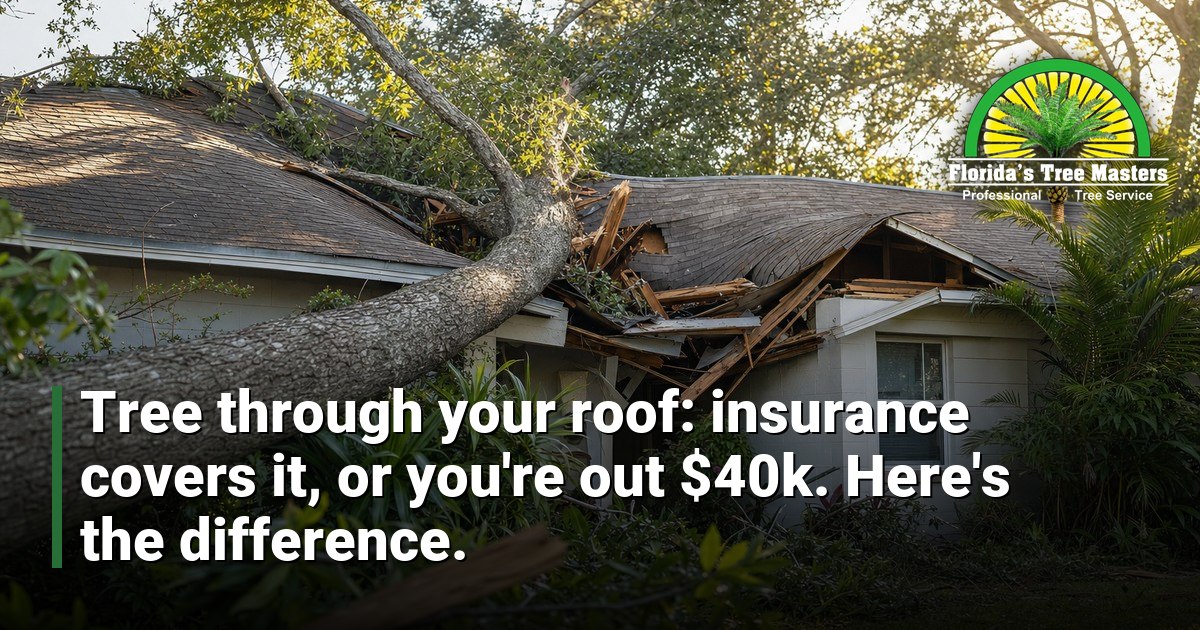
The average cost to remove a residential tree is $500-$1,500. The average cost of a tree falling on a house during a hurricane? $10,000-$50,000+. That’s before the weeks of dealing with insurance, contractors, and living with a tarp on your roof.
Get it taken care of now while it’s on your terms, not during an emergency at 3x the price.
Schedule your FREE pre-hurricane tree inspection today
We’ll assess every tree on your property and tell you exactly what needs attention.
8. Document Your Trees (For Insurance)
Before storm season, walk your property and take photos of every tree near your home. Get wide shots showing the whole tree and close-ups of the trunk and canopy. Date-stamped photos.
Why? If a tree falls on your house, your insurance company will want to know the tree’s condition before the storm. Photos showing a healthy, maintained tree support your claim. Photos of a dead, neglected tree might give your adjuster reason to argue pre-existing neglect.
Also keep receipts from any tree work you have done. Documentation of professional maintenance strengthens your claim and shows you weren’t negligent.
9. Check Your Homeowners Insurance
Do you know what your hurricane deductible is? In Florida, it’s often a percentage of your home’s value (typically 2-5%), not a flat dollar amount. On a $300,000 home, a 2% hurricane deductible means you’re paying the first $6,000 out of pocket.
Key things to know:
- Your policy typically covers tree removal when the tree falls on an insured structure (house, garage, fence)
- Trees that fall in your yard WITHOUT hitting a structure usually have very limited coverage ($500-$1,000 per tree)
- Your neighbor’s tree falls on your house? YOUR insurance covers it, not theirs
- Flood damage from storm surge is NOT covered by homeowners insurance — you need a separate flood policy
10. Schedule Professional Tree Work NOW — Not in May
Here’s the reality: by mid-May, every tree company in Volusia County is booked solid with hurricane prep work. The best crews are scheduled weeks out. If you wait until a storm is in the forecast, forget about it — everyone is either fully booked or has tripled their prices.
The window is RIGHT NOW through mid-May. Call today, get your estimate this week, get the work done next week. Done. One less thing to worry about when the first tropical storm forms.
The Bottom Line
Hurricane preparedness isn’t just plywood on windows and water bottles in the pantry. Your trees are either protecting your property or threatening it. A few hundred dollars in professional tree maintenance now can prevent tens of thousands in storm damage later.
Florida’s Tree Masters has been keeping Volusia County properties safe through hurricane season since 2018. We’re licensed, insured, and we do the work right — ISA-standard pruning, no topping, no shortcuts.
Call (386) 320-3169 for your free pre-hurricane tree inspection. We’ll walk your property, assess every tree, and give you a clear plan for what needs attention before June 1.
For more details on our hurricane prep services, visit our Hurricane Tree Preparation page. If you’re dealing with storm damage right now, see our Storm Damage Tree Removal page for emergency service.
Florida’s Tree Masters serves Daytona Beach, Port Orange, DeLand, Ormond Beach, New Smyrna Beach, Palm Coast, Deltona, Sanford, and all surrounding areas in Volusia, Flagler, Seminole, and St. Johns Counties.