Table of Contents
ToggleHurricane Milton Tree Damage: What Volusia County Learned
In October 2024, Hurricane Milton tore across Central Florida and left a wake of tree destruction. Here’s what happened in Volusia and Flagler Counties, what patterns emerged, and how homeowners can prevent a repeat in the 2026 hurricane season.
During & After Milton
of Trees Removed Post-Milton
& Fully Insured
Port Orange Based
Hurricane Milton: By the Numbers
Hurricane Milton made landfall near Siesta Key on October 9, 2024, as a Category 3 hurricane. While Volusia County wasn’t at the center of the cone, the storm maintained tropical storm to Category 1 strength as it crossed the peninsula, delivering sustained winds of 60–80 mph with higher gusts throughout the county.
That doesn’t sound as dramatic as a direct Category 4 hit. But for Volusia County’s trees, Milton was devastating — and the reasons why reveal important lessons for every homeowner in the area heading into the 2026 season.
Why Milton Was So Destructive to Trees — Even Without a Direct Hit
Three factors combined to make Hurricane Milton one of the worst tree-damage events in Volusia County’s recent history:
1. Saturated Soil from Pre-Storm Rainfall
In the days before Milton, Volusia County received 4–8 inches of rain from outer bands and a separate weather system. By the time hurricane-force gusts arrived, the soil was a saturated sponge. Tree roots anchored in sandy Florida soil rely on friction between root surfaces and soil particles. When that soil is waterlogged, friction drops dramatically — and so do the trees.
This is why so many trees uprooted completely during Milton rather than snapping. The root balls came out of the ground intact because the soil simply couldn’t hold them. Neighborhoods along the Halifax River, near Spruce Creek, and in low-lying areas of South Daytona and Holly Hill saw the worst of this pattern.
2. Cumulative Storm Stress
Milton didn’t hit trees that were in pristine condition. Many trees in Volusia County had already been stressed by:
- Hurricane Ian (September 2022) — which brought tropical storm winds and heavy flooding to the area
- Hurricane Nicole (November 2022) — a rare November storm that hit just weeks after Ian, catching many trees mid-recovery
- The 2023 drought — extended dry conditions weakened root systems already compromised by 2022’s back-to-back storms
Trees that survived Ian and Nicole with cracked root systems, damaged canopies, or internal stress fractures finally failed during Milton. This “cumulative storm stress” effect is something arborists track carefully. A tree that leans 2 degrees after one storm, then 5 degrees after the next, will eventually reach its tipping point — and Milton was that tipping point for thousands of trees across the county.
3. Deferred Maintenance
This is the uncomfortable truth: much of Milton’s tree damage was preventable. In the months and years leading up to the storm, many homeowners delayed tree maintenance due to cost, insurance fatigue, or the false assumption that “the tree survived the last storm, it’ll be fine.” Trees that should have been pruned, cabled, or removed were left as-is.
After Milton, we removed trees that had obvious warning signs — dead limbs, trunk cavities, visible root damage from previous storms, fungal conks at the base — that had been ignored for years. Each of those trees was a ticking clock, and Milton set them all off at once.
Damage Patterns: Area by Area
Not every part of Volusia and Flagler Counties experienced the same type of tree damage. Here’s what we saw on the ground in the days and weeks following Milton:
Palm Coast and Flagler County
Palm Coast took some of the hardest hits. The $19 million damage figure reported by the city was largely tree-driven — fallen trees on homes, crushed fences and pool cages, blocked roads, and downed power lines.
Grand Haven — This gated community on Colbert Lane lost dozens of large oaks. The mature canopy that makes Grand Haven one of the most desirable neighborhoods in Palm Coast became a liability during Milton. Water oaks and laurel oaks, many planted when the community was built in the early 2000s, are now reaching the age where internal decay becomes common. Homeowners here need aggressive assessment programs going forward.
Pine Lakes and Seminole Woods — Sand pines dominated the damage in these neighborhoods. Clusters of pines snapped and fell in domino-like sequences, taking out fences, vehicles, and portions of homes.
Port Orange
Spruce Creek and Spruce Creek Fly-In — This area’s signature live oaks largely survived, but the numerous water oaks mixed among them did not. The contrast was striking: massive live oaks standing firm with minimal branch loss, while water oaks of similar size lay uprooted beside them. Several homes along Spruce Creek Boulevard sustained tree-on-structure damage.
Cypress Head — A younger community with a mix of planted ornamentals and remaining native trees. Bradford pears split apart, and several sand pines at lot edges failed. The community’s younger live oaks, properly maintained by the HOA, held up well — a testament to good species selection.
Daytona Beach and South Daytona
Older neighborhoods in Daytona Beach, particularly along Ridgewood Avenue and the streets between the Halifax River and the beach, lost mature laurel oaks that had been declining for years. Many of these trees had visible decay symptoms that went unaddressed.
South Daytona saw significant water oak failures in neighborhoods along Big Tree Road — ironically named for the nearby Senator cypress, which has survived centuries of hurricanes. The water oaks, planted in the 1960s and 70s, didn’t fare as well at 50–60 years old.
DeLand and DeBary
Western Volusia County’s sand pine flatwoods took a beating. The Enterprise and DeBary areas, where sand pines are abundant, saw widespread snapping failures. DeLand’s historic downtown, with its mature live oaks, held up remarkably well — further proof that species selection matters more than almost any other factor.
Ormond Beach and Ormond-by-the-Sea
Coastal wind exposure made Ormond Beach one of the harder-hit areas. Australian pines along the barrier island shattered, and several large water oaks in Breakaway Trails and Tomoka Oaks failed. The Tomoka River corridor saw significant tree loss along its banks, with undermined root systems giving way in the storm surge and flooding.
Don’t Let 2026 Be a Repeat of 2024
Schedule your free hurricane tree assessment now — before the rush begins. We serve Volusia, Flagler, Seminole, and St. Johns Counties.
Florida’s Tree Masters | Port Orange, FL | Licensed & Insured
7 Lessons Volusia County Learned from Hurricane Milton
1. “It Survived the Last Storm” Is Not a Risk Assessment
This was the most common phrase we heard from homeowners looking at a tree on their roof. The reality is that every storm weakens vulnerable trees further. A water oak that survived Ian with hidden root damage was already compromised going into Milton. Trees don’t heal like humans — damage accumulates, and each storm moves the tree closer to failure.
2. Pre-Storm Pruning Is Not Optional
Homes with professionally pruned trees sustained dramatically less damage than those with unpruned trees of the same species. UF/IFAS research confirms this: proper crown thinning reduces wind resistance (what arborists call “wind sail”) by 20–40%, which can be the difference between a tree surviving 80 mph gusts and being on the ground.
The keyword is “proper.” Topping — the practice of cutting all major limbs back to stubs — is not proper pruning. It’s the worst thing you can do. Topped trees regrow with dense, weakly attached sprouts that are even more likely to fail in wind. We saw numerous topped trees fail during Milton that likely would have survived if they’d been properly thinned instead. Learn about proper hurricane pruning techniques.
3. Species Selection at Planting Time Matters for Decades
The neighborhoods that fared best during Milton were those planted with hurricane-resistant species: live oaks, sabal palms, slash pines, and bald cypress. The neighborhoods that suffered most had canopies dominated by water oaks, laurel oaks, and sand pines.
If you’re planting trees today, think 30 years ahead. That cute Bradford pear sapling will be a split-apart liability in 20 years. A live oak sapling planted today will be a magnificent, wind-resistant shade tree that your home benefits from for generations. See our full guide on hurricane-vulnerable vs. hurricane-resistant tree species.
4. Power Restoration Depends on Tree Management
Over 200,000 FPL customers in Volusia and Flagler Counties lost power during Milton, and the primary cause was trees on power lines. Restoration took days in some areas and over a week in others. Homeowners who had maintained clearance between their trees and overhead utility lines restored power faster — both because line crews could access the damage more easily and because there was less damage to repair.
FPL has a right-of-way vegetation management program, but it only addresses trees directly in or near the utility corridor. Trees on your property that could fall onto service lines running to your house are your responsibility.
5. Insurance Doesn’t Make You Whole — Prevention Does
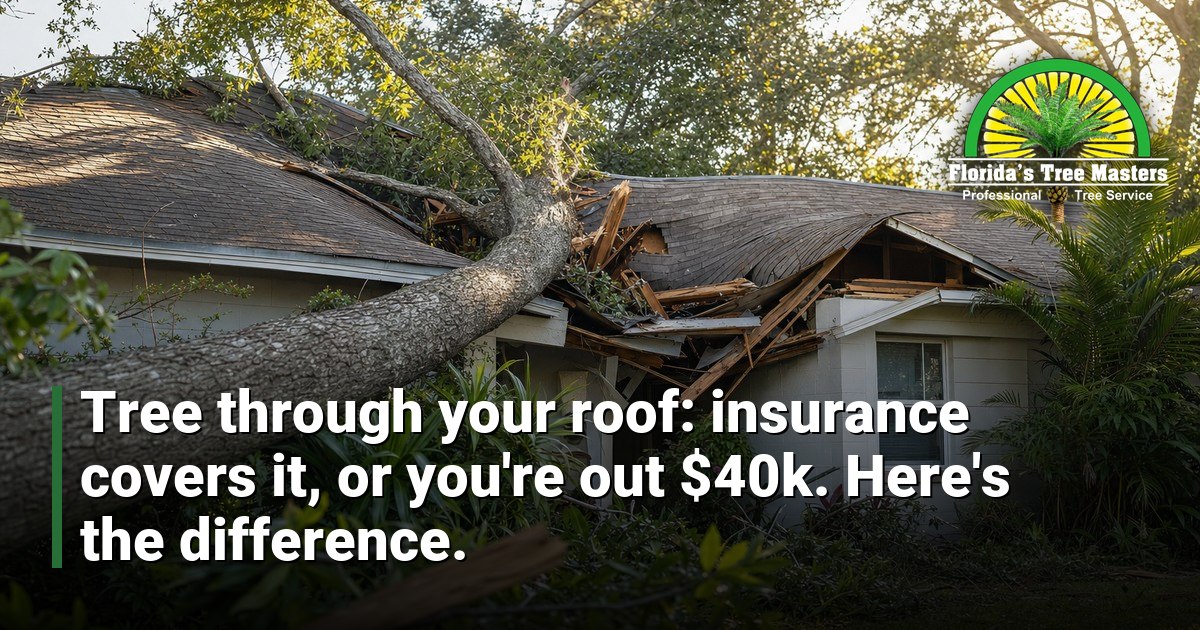
Even with a successful insurance claim, Milton’s tree damage left homeowners with massive out-of-pocket costs. Percentage-based hurricane deductibles (2%–5% of dwelling coverage) meant homeowners were paying $5,000–$20,000 before insurance kicked in. Add in the cost of temporary housing, time off work, and the emotional toll, and the true cost of a tree on your house far exceeds what insurance covers.
A pre-season tree removal that costs $1,500–$3,000 is a fraction of the financial and personal impact of a tree through your roof. Learn about our tree removal services and pricing.
6. Emergency Services Are Overwhelmed After a Major Storm
After Milton, tree removal companies were booked out for weeks. Unlicensed storm chasers from other states flooded in, offering quick removal at inflated prices — and often doing substandard or dangerous work. Homeowners with pre-existing relationships with local, licensed tree services got faster, safer service because they were already in the system.
7. Community-Level Tree Management Works
HOAs and communities that had proactive tree management programs before Milton — regular inspections, planned removals of declining trees, species replacement programs — recovered faster and had less overall damage. Cypress Head’s managed canopy held up better than nearby areas with unmanaged trees. Grand Haven’s post-Milton assessment is now driving a community-wide tree health program.
If you’re on an HOA board or community management team, now is the time to implement a tree management plan for your community. One assessment now can prevent millions in damage later.
Your 2026 Hurricane Season Tree Action Plan
It’s April 2026. Hurricane season starts June 1. Here’s exactly what to do right now based on what Milton taught us:
This Month (April): Assess
- Walk your property and look at every tree within striking distance of your home, garage, fence, vehicles, and power lines. “Striking distance” means the height of the tree plus 10 feet.
- Look for warning signs: leaning (especially if it’s new since Milton), dead branches, fungal growth at the base, cracks in the trunk, exposed or heaving roots, sparse canopy compared to previous years.
- Identify species. If you have water oaks, laurel oaks, sand pines, Australian pines, or Bradford pears near structures, they should be assessed by a professional. Use our species identification guide.
- Schedule a professional assessment. A certified arborist can identify hazards invisible to homeowners — internal decay, root system compromise, structural weaknesses hidden by bark.
Next Month (May): Act
- Remove trees identified as high-risk. Don’t wait until June. Tree service schedules fill up fast approaching hurricane season.
- Prune remaining trees. Crown thinning to reduce wind sail is the single most effective mitigation for trees you’re keeping. Focus on removing deadwood, crossing branches, and reducing canopy density by 15–25%.
- Address utility line clearance. Trim branches within 10 feet of power lines serving your property. (Note: only licensed line-clearance arborists should work near active power lines.)
- Document everything. Photograph your trees and any work done. This documentation helps with insurance claims if a maintained tree still fails during a storm — it shows you acted responsibly.
June 1 and Beyond: Monitor
- Re-inspect after every significant weather event — tropical storms, strong thunderstorms, heavy rain events. Look for new lean, broken branches caught in the canopy, root movement.
- Keep your tree service’s number accessible. If a named storm threatens, your tree company should be one of your first calls for emergency response.
- Review your insurance policy. Know your deductible, your coverage limits for tree removal, and your Additional Living Expenses coverage. If it’s inadequate, talk to your agent before a storm forces you to find out the hard way.
For a detailed month-by-month approach, see our complete hurricane season tree prep checklist.
Get Your Free Hurricane Tree Assessment
We learned a lot from Milton. Let us put that knowledge to work for your property before the 2026 season.
Frequently Asked Questions
How much tree damage did Hurricane Milton cause in Volusia County?
Hurricane Milton caused extensive tree damage across Volusia County in October 2024. Palm Coast alone reported $19 million in damage, much of it tree-related. Tens of thousands of trees were downed or damaged across the county, with debris cleanup taking weeks to months in many areas. Power outages from fallen trees affected over 200,000 FPL customers in Volusia and Flagler Counties combined.
What areas of Volusia County had the worst tree damage from Hurricane Milton?
The worst tree damage from Milton concentrated in areas with mature tree canopies and saturated soil. Grand Haven and other Palm Coast communities saw severe damage due to their dense oak canopies. Port Orange neighborhoods like Spruce Creek and Cypress Head experienced significant tree failures. DeLand and DeBary had widespread sand pine failures. Coastal communities from Ormond Beach to New Smyrna Beach saw extensive Australian pine and water oak damage.
Why did Hurricane Milton cause so much tree damage when it wasn’t a direct hit?
Milton made landfall near Siesta Key as a Category 3 but maintained tropical storm to Category 1 winds as it crossed the state. What made it devastating for trees in Volusia County was the combination of sustained winds (60–80 mph), heavy rainfall that saturated soil and loosened root systems, and the fact that many trees were already stressed from previous storms (Hurricane Ian in 2022, Hurricane Nicole in 2022). Trees that survived previous storms with compromised root systems or hidden damage finally gave out during Milton.
Is it too late to prepare my trees for the 2026 hurricane season?
If it’s before May, no — there’s still time. The ideal window for major tree work is January through April, before hurricane season begins June 1. However, even pruning and assessments done in April and May provide significant benefit. The worst time to think about tree preparation is during a hurricane watch. Call a licensed tree service now to schedule an assessment while scheduling is still available.
Will FEMA pay for tree removal after a hurricane in Florida?
FEMA may provide assistance for tree removal under certain conditions: the tree must pose an immediate threat to health and safety, the removal must be necessary to access your home, or local government must have authorized debris removal operations. FEMA typically does not pay for routine tree removal from private property. After Milton, FEMA’s Individual Assistance program helped some Volusia County residents, but coverage was limited and required documentation of the hazard. Your homeowner’s insurance is usually the primary source for tree removal on private property.