Table of Contents
ToggleWhat to Do When a Tree Falls on Your House in Florida
A step-by-step emergency guide for Volusia County and Central Florida homeowners — from the moment of impact through insurance claims and professional removal.
Emergency Response
& Fully Insured
Port Orange Based
Storm Experience
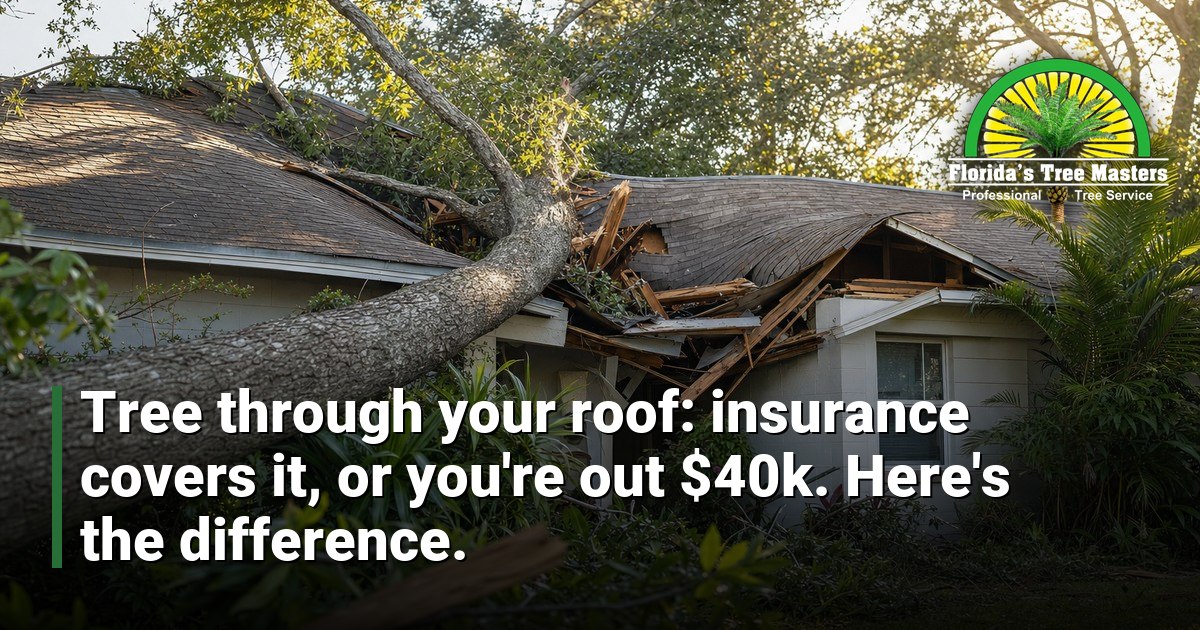
It’s 2 AM. The wind is screaming outside. Then you hear it — a deafening crack followed by the sound of your ceiling caving in. A tree just landed on your house.
If you live in Volusia, Flagler, Seminole, or St. Johns County, this scenario isn’t hypothetical. After Hurricane Milton tore through Central Florida in October 2024, thousands of homeowners found themselves staring at a tree where their roof used to be. During Hurricane Ian in 2022, Volusia County alone processed over 4,000 tree-related damage reports.
What you do in the first hours and days after a tree strikes your home determines everything — from your family’s safety to whether your insurance claim gets paid. This guide walks you through the exact steps, in order, with Florida-specific details that generic advice won’t give you.
Step 1: Get Everyone Safe (First 5 Minutes)
Your first priority is accounting for every person and pet in the home. Even if the tree only hit one room, structural damage can spread. Here’s what to do immediately:
- Evacuate the affected area. Move everyone to the opposite side of the house or outside if it’s safe. If it’s during an active hurricane, move to an interior room away from the damage — do NOT go outside.
- Check for injuries. Falling debris, broken glass, and exposed nails are the biggest risks. Even minor cuts need attention since contaminated tree bark and insulation can cause infections.
- Listen and watch for secondary dangers. Hissing gas, sparking wires, or the smell of natural gas mean immediate evacuation. If you smell gas, don’t flip any switches — just leave.
- Turn off electricity to the damaged area if you can safely reach your breaker panel. In Florida homes, the panel is often in the garage or on an exterior wall. If the panel is in the damaged zone, leave it alone and call FPL at 1-800-4OUTAGE (1-800-468-8243).
Step 2: Document the Damage (First 1–2 Hours)
Once everyone is safe and the immediate danger is controlled, documentation becomes your most important task. Florida insurance claims live and die by photographic evidence, and in the post-Assignment of Benefits (AOB) reform landscape, your documentation matters more than ever.
What to Photograph and Video
- Wide shots showing the full tree and the full house — this establishes scale and impact zone
- Close-ups of where the tree contacts the roof, walls, windows, gutters, and any other structure
- Interior damage — ceiling holes, water intrusion, broken drywall, damaged furniture and belongings
- The tree’s root ball — if it uprooted, photograph the root system and the hole. This can prove whether the tree was healthy or had root rot (which matters for liability)
- Any pre-existing tree conditions — fungal growth, hollow trunks, dead branches visible from the break point
- Neighboring property damage — if the tree also hit a fence, car, shed, or neighbor’s property
- Water marks on interior walls — mark the high point with tape and photograph it. Water damage spreads fast in Florida’s humidity, and you need proof of the initial extent
Create a Written Record
Open the notes app on your phone and write down:
- Exact time you first noticed the tree strike
- Weather conditions (during a named storm, after a thunderstorm, during calm weather — this matters for your claim)
- Which rooms are affected
- Any belongings damaged (electronics, furniture, clothing)
- Names and contact info of anyone who witnessed it
Step 3: Who to Call and in What Order
The order matters. Here’s the exact call sequence for Volusia County homeowners:
Call #1: 911 (If Applicable)
Only if someone is injured, trapped, or if you have downed power lines or a gas leak. After a major hurricane, 911 may be overwhelmed — be prepared to wait or call the non-emergency line for Volusia County Sheriff at (386) 248-1777.
Call #2: Your Insurance Company
File the claim as soon as possible. Florida law (under the 2022 tort reform, SB 2-A) requires you to report property damage to your insurer promptly. While there’s no strict 24-hour deadline, delays can be used against you.
When you call, have ready:
- Your policy number
- Date and time of the incident
- Description of the damage
- Whether the home is habitable
- Photos (you can email or upload to their app)
Call #3: A Licensed, Insured Tree Removal Company
This is where many homeowners make a costly mistake. After a hurricane, unlicensed “storm chasers” flood into Volusia and Flagler Counties offering cheap tree removal. These crews often:
- Have no liability insurance — if they damage your home further, you pay
- Aren’t licensed in Florida — making your insurance claim more complicated
- Do sloppy work that leaves your property more vulnerable to the next storm
- Disappear before finishing, leaving you with a half-removed tree and a bigger problem
Florida’s Tree Masters provides 24/7 emergency tree removal throughout Volusia, Flagler, Seminole, and St. Johns Counties. We’re locally based in Port Orange, licensed, and fully insured — and we’ve been here through Irma, Ian, Nicole, and Milton. We don’t disappear when the job gets hard.
Call #4: A Roofer or General Contractor
You’ll need a tarp or temporary cover on the roof once the tree is removed. Many tree removal companies (including us) can coordinate this, but you’ll eventually need a licensed roofer for permanent repairs. Get at least three quotes.
Call #5: Your Mortgage Company
If you have a mortgage, your lender needs to know about significant structural damage. Insurance checks over a certain amount are often co-payable to your mortgage company, and they may have specific requirements about repairs.
Tree on Your House Right Now?
Don’t wait — call Florida’s Tree Masters for emergency tree removal in Volusia, Flagler, Seminole, and St. Johns Counties.
Licensed & insured. Locally owned. Port Orange, FL.
Florida Insurance: What’s Covered and What’s Not
Florida’s property insurance market is unlike anywhere else in the country. After years of insurer exits and rate hikes, understanding your coverage before a tree hits your house is critical. Here’s what most Volusia County homeowners’ policies cover:
Typically Covered
- Structural damage to your home — roof, walls, windows, interior damage from a tree impact
- Tree removal when it hits a covered structure — most policies cover $500–$1,000 per tree for removal
- Additional living expenses (ALE) — if your home is uninhabitable, your policy may cover hotel, meals, and temporary housing. In areas like Breakaway Trails or Grand Haven, where homes often sustain significant canopy damage, this coverage is frequently triggered
- Personal property damage — furniture, electronics, clothing destroyed by the tree or resulting water intrusion
- Fence and detached structure damage — if the tree also hit your shed, pool cage, or fence
Typically NOT Covered
- Tree removal when no structure is damaged — if a tree falls in your yard but misses everything, most policies won’t pay for removal (unless it blocks your driveway or accessible pathway)
- Landscaping replacement — your policy won’t pay to replant trees or repair your lawn
- Preventive tree work — insurance doesn’t reimburse you for pre-storm pruning or removal. However, proactive tree preparation can save you tens of thousands in avoided damage
- Flood damage that follows — if the tree opens your roof and rain floods your home during a hurricane, your homeowner’s policy covers wind damage but a separate flood policy covers rising water. This distinction bankrupts people. If you’re in a flood zone near the Intracoastal or the Halifax River, you need both.
Trees Most Likely to Fall on Homes in Volusia County
Not all trees are equally dangerous. After two decades of storm response in Central Florida, we see the same species causing structural damage over and over:
- Water Oaks (Quercus nigra) — The #1 offender. Water oaks are everywhere in Port Orange, Ormond Beach, and DeLand. They grow fast, develop internal decay by age 50–60, and their shallow root systems fail in saturated soil. If you have a mature water oak within striking distance of your home, get it assessed. Learn about our tree removal services.
- Laurel Oaks (Quercus laurifolia) — Similar problems to water oaks. Common in older Daytona Beach and South Daytona neighborhoods. They hide internal rot behind healthy-looking bark.
- Sand Pines (Pinus clausa) — Brittle, shallow-rooted, and prone to snapping mid-trunk. Abundant in the pine flatwoods around Deltona and DeBary.
- Australian Pines (Casuarina) — Technically not pines at all, these invasive trees have extremely brittle wood and shallow roots. They’re among the first to topple in tropical storm winds. Volusia County doesn’t protect them — removal is straightforward.
- Bradford Pears (Pyrus calleryana) — Weak branch unions cause them to split apart in moderate winds. Common in newer subdivisions.
By contrast, properly maintained live oaks (Quercus virginiana) are remarkably wind-resistant. Their spreading canopy and dense wood make them one of Florida’s most hurricane-proof trees — but only if they’ve been professionally pruned to reduce wind sail. Read our full guide on hurricane-vulnerable trees in Florida.
What If Your Neighbor’s Tree Fell on Your House?
This is one of the most misunderstood areas of Florida property law. Here’s the reality:
In most cases, your own homeowner’s insurance covers the damage to your property — even if the tree belonged to your neighbor. This surprises people, but Florida follows the general rule that each homeowner is responsible for damage to their own property.
However, there are exceptions where your neighbor may be liable:
- You previously notified them in writing that the tree was dead, diseased, or hazardous, and they failed to act
- The tree was obviously dead or dangerous — no leaves, visible decay, severe lean toward your property
- A certified arborist had recommended removal and the neighbor ignored the recommendation
After the Tree Is Removed: Next Steps
Temporary Weatherproofing
Once the tree is off your roof, the opening needs to be covered immediately. In Florida, even a few hours of exposure can lead to catastrophic water damage — especially during summer afternoon thunderstorms. A professional tarp installation (sometimes called a “shrink wrap”) can protect your home for weeks while you wait for permanent repairs.
Get a Structural Assessment
A tree impact can cause damage you can’t see — cracked trusses, shifted load-bearing walls, foundation stress. Volusia County Building Department requires permits for structural repairs, and your insurance company may require an engineer’s report. Don’t skip this step.
Keep Every Receipt
Save receipts for everything: hotel stays, meals (if displaced), tarps, emergency board-up, tree removal, temporary fencing. All of this may be reimbursable under your policy’s Additional Living Expenses provision.
Prevent It from Happening Again
A tree on your house is a wake-up call. Once you’ve recovered, schedule a full hurricane tree preparation assessment for every tree on your property. Identify which trees need pruning, which need cabling, and which need to come down before the next storm.
Many neighborhoods in our service area — Spruce Creek, Breakaway Trails, Grand Haven in Palm Coast, Halifax Plantation — have mature tree canopies that looked beautiful before Milton but became liabilities during the storm. The trees that survived did so because they’d been properly maintained.
Don’t Wait for the Next Storm
Schedule a free hurricane tree assessment for your property. We serve Volusia, Flagler, Seminole, and St. Johns Counties.
Frequently Asked Questions
Who is responsible for a tree that falls on my house in Florida?
In Florida, your homeowner’s insurance typically covers damage to your property regardless of where the tree came from — even if it was your neighbor’s tree. However, if you can prove your neighbor knew the tree was hazardous and failed to act, you may have a negligence claim against them. Your first call should always be to your own insurance company.
Does homeowner’s insurance cover tree removal in Florida?
Most Florida homeowner’s policies cover tree removal when the tree has damaged a covered structure (your house, garage, fence, etc.). The typical coverage is $500–$1,000 per tree. If the tree falls in your yard but doesn’t hit anything, most policies won’t cover removal unless it’s blocking a driveway or accessible path. Check your specific policy for details.
How long does emergency tree removal take after a hurricane in Florida?
After a major hurricane, wait times for tree removal can range from a few hours for true emergencies (tree on house with occupants) to several weeks for non-urgent removals. After Hurricane Milton in 2024, some Volusia County residents waited 3–6 weeks for full cleanup. Having a pre-storm relationship with a local tree company like Florida’s Tree Masters can significantly reduce your wait time.
Should I try to remove a fallen tree from my house myself?
No. Removing a tree from a structure is extremely dangerous and should only be done by licensed, insured professionals. The tree may be the only thing preventing further roof collapse, and improper removal can cause additional structural damage, electrocution from hidden power lines, or serious injury. Secure the area, document the damage, and call a professional tree service.
What should I do first when a tree falls on my house during a hurricane?
First, ensure everyone is safe and evacuate the affected rooms. If anyone is trapped, call 911. Do not go outside during active hurricane conditions. Once the storm passes: turn off electricity to the damaged area if you can safely reach the breaker panel, call your insurance company, take extensive photos and video, then call a licensed tree removal company. Do not attempt to tarp the roof or remove debris yourself.
Related Resources