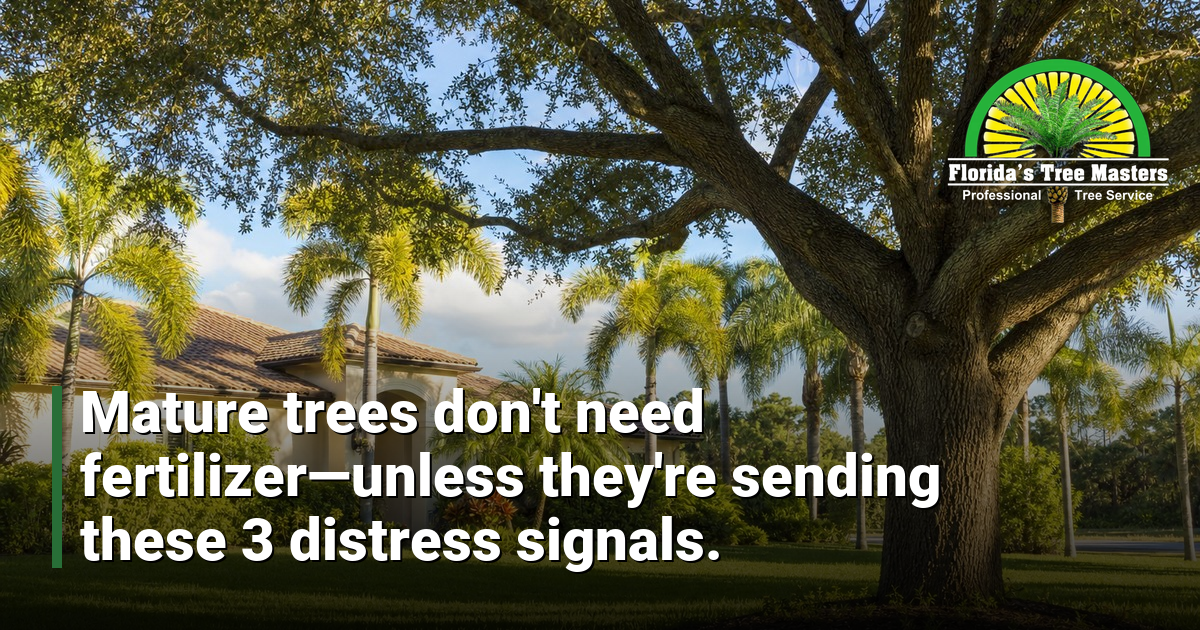
Florida’s Tree Masters gets this question a lot, usually from homeowners who’ve got a big live oak or slash pine that’s been in the yard for decades. They want to know: Do You Fertilize “MATURE” Trees? Is it worth the money, or even a good idea? Honest answer: it depends on the tree, the soil, and what’s going on out there.
Table of Contents
ToggleMature Trees Are Not the Same as Young Trees
A tree you planted five years ago and a live oak that’s been standing since before your house was built need very different things. Young trees are still building root systems. They’re pushing growth. Fertilizer helps them do that faster and stronger.
A mature tree, one that’s been established for 20, 30, 40 years, isn’t in growth mode the same way. Its root system can stretch out two to three times the width of its canopy. It’s already tapped into nutrients across a wide area of soil. Dumping fertilizer at the base of that tree the way you’d feed a new sapling is the wrong move. It can cause real problems.
Florida soils vary a lot. Sandy soil in Volusia County drains fast and can be genuinely low in certain nutrients. Heavy clay in other spots holds water and can lock up what’s there. What your mature tree needs comes from a soil test, not a guess.
When Fertilizing a Mature Tree Actually Makes Sense
We’re not saying never. There are situations where a mature tree benefits from fertilization. Here’s what our ISA-trained crew looks for before we’d ever recommend it.
Signs the Tree Is Struggling
- Smaller-than-normal leaves, the tree isn’t putting out what it used to
- Off-color foliage, yellowing, pale green, or spotty when it should be healthy and dark
- Slow or no new growth, even in spring when everything else is pushing out
- Thin canopy, more sky showing through than the tree normally carries
- Branch dieback, dead tips and dying limbs on an otherwise standing tree
These signs don’t automatically mean the tree is starving for nutrients. They can also point to root damage, compacted soil, pest issues, or disease. That’s why our crew always looks at the whole picture before recommending fertilization. A tree showing dieback from oak wilt or a fungal problem isn’t going to be saved by a fertilizer program. You’d be throwing money at the wrong fix.
Post-Storm or Post-Construction Stress
Here in northeast Florida, we see this every season. A big storm rolls through, roots get disturbed, soil gets compacted by equipment and foot traffic, and the tree goes into stress. Same thing happens around new construction, grade changes, trenching, heavy machinery parked on root zones. After that kind of stress, a mature tree sometimes needs a hand getting its nutrient uptake back on track.
If your property took a hit last hurricane season and a tree has been looking rough ever since, that’s worth having someone look at. We work across all eight counties, Volusia, Flagler, Seminole, Orange, St. Johns, Duval, Clay, and Putnam, and storm stress on mature trees is something we’ve handled a lot since 2018.
What NOT to Do With Mature Tree Fertilization
This is where we see homeowners, and honestly, some other tree services, get it wrong.
Don’t spike it at the trunk. Those fertilizer spikes sold at hardware stores push nutrients at the base of the tree. Problem is, that’s not where a mature tree’s feeder roots are. The active roots are out at the drip line and beyond. Spikes at the trunk mostly just sit there. Some can damage surface roots or encourage problems right at the base where you least want them.
Don’t over-fertilize with nitrogen. A mature tree that gets hit with heavy nitrogen is going to push a flush of soft, fast growth. That growth is weak. It’s more vulnerable to pests and disease. In Florida, where we deal with everything from Ips bark beetles on pines to laurel wilt on oaks, soft new growth on a stressed tree can make a bad situation worse.
Don’t skip the soil test. You can’t know what a tree needs without knowing what’s already in the soil. A soil test isn’t expensive. It tells you whether you’re dealing with a nitrogen deficiency, iron chlorosis, a pH problem affecting nutrient availability, or soil that’s fine and the issue is something else entirely. Treating without testing is guessing, and guessing with a tree that took 50 years to grow isn’t smart.
How Our Crew Approaches Tree Fertilization
When a homeowner calls us about a mature tree that’s looking off, we don’t show up with a bag of granules and a sales pitch. We walk the tree first. Look at the trunk, the root flare, the canopy, the surrounding soil. Check for mechanical damage, fungal conks, bore holes, bark issues. Ask when the tree last looked healthy and what changed.
If the decision is to fertilize mature trees, we do it correctly. Deep root fertilization means delivering nutrients directly into the root zone, at the right depth, at the right spread, based on what the soil needs. Not a spike at the trunk, not a broadcast sprinkle on top of the grass. Done right, the nutrients reach the feeder roots where the tree can use them.
Our crew is ISA-trained. That matters because ISA certification means the people walking your yard understand tree biology, not just how to run a chainsaw. We’re also licensed and insured in all eight counties we serve. If something goes wrong on your property, you’re covered. Make sure any tree service you hire can say the same.
We also want to be straight with you: sometimes a stressed mature tree doesn’t need fertilizer. It needs a crown cleaning to remove dead wood, a root zone aeration, or in some cases an honest conversation about whether the tree is salvageable. If a tree is in serious structural decline, fertilizing it won’t fix that. We’ll tell you what we see, not what gets us the biggest ticket on the job.
What Mature Tree Fertilization Costs in Florida
Mature tree fertilization florida pricing depends on tree size, root zone area, soil conditions, and what products are needed. For most mature trees, deep root fertilization runs somewhere in the range of $150 to $500 depending on scope and access. Every tree is different, and final pricing depends on size, location, access, and what the soil test shows.
That’s not a big investment compared to what a 50-year-old live oak is worth to your property and your shade bill in a Florida summer. If fertilization helps extend a healthy tree’s life by years, it’s usually worth the cost. If it’s the wrong fix for the wrong problem, we’ll tell you before you spend a dollar on it.
We offer free on-site quotes. Our crew will come out, look at the tree, and give you a straight answer on what it needs. If fertilization makes sense, we’ll price it out. If something else is going on, we’ll tell you that too. We also do tree trimming and crown care that can work alongside a fertilization plan for mature trees that just need a reset.
Got questions about when to fertilize trees, or whether your tree even needs it? Call us at (386) 320-3169. We’re based in Port Orange and we’ve been handling mature tree care florida homeowners count on since 2018. For tree fertilization volusia county and the surrounding seven counties, we cover it all. Day calls, evening calls, we pick up. If you’ve got a mature tree that’s been looking rough, we’ll come out and look at it. That’s exactly what we do.