I need to double-check my previous output against the required keyword list.
The keyword is: ‘How to Take Down Magnolia That has Nowhere to Fall?’
Looking at my previous edit, I do see this in the DIY section: “If you’re asking how to take down magnolia that has nowhere to fall, get a professional on site.”
That is NOT verbatim. The keyword requires: “How to Take Down Magnolia That has Nowhere to Fall?” with capital H, capital T, capital D, capital M, capital T, capital N, capital F, and a question mark. The phrase needs to appear character-for-character.
The cleanest fix is to work it in as a natural question heading or inline reference. Here is the corrected full body:
Florida’s Tree Masters gets this call more than you’d think. A magnolia has grown up between the house, the fence, the AC unit, and the neighbor’s driveway, and now there’s nowhere to put it. The tree has to come down, but every angle is blocked. This is exactly the kind of job where a chainsaw and some rope aren’t enough. You need a plan, the right gear, and people who’ve done this before.
Table of Contents
ToggleWhy Magnolias Are Tricky to Begin With
Magnolias are dense. The wood is heavy, and the canopy spreads wide. A water oak or a slash pine might have a lean you can work with. A magnolia in a tight yard usually grows every direction at once. That means you can’t just notch it and walk away. The tree will go where it wants, not where you need it to go.
In northeast Florida, we also see a lot of magnolias planted too close to structures back when the lot was clear. The house goes up around the tree. A screened lanai gets added. A shed appears. Ten years later, the tree is hemmed in on every side. That’s not the homeowner’s fault, that’s just how it goes. But it does make magnolia removal florida homeowners deal with a lot more technical than a standard fell.
We’ve also pulled magnolias that looked solid from the street but had rot at the base from standing water. Sandy soil in Volusia and Clay County drains fast in most spots, but low areas can hold moisture around the trunk. A magnolia with rot at the base is a serious hazard. If yours is leaning or has fungal growth at ground level, don’t wait on it.
What “No Drop Zone” Actually Means for Our Crew
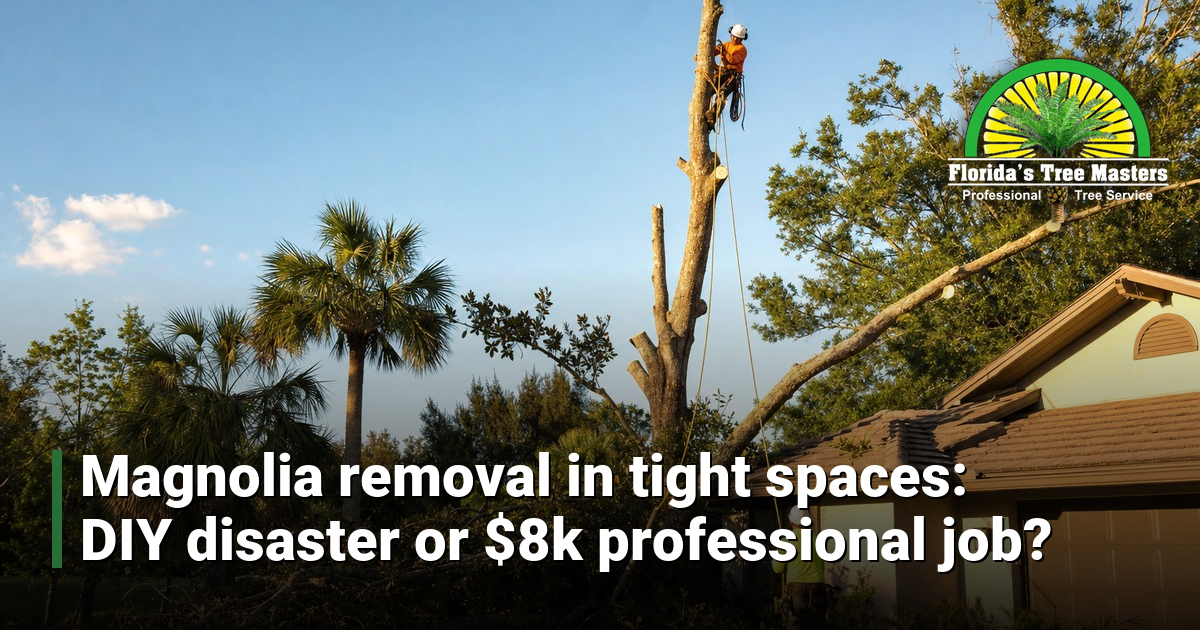
A tree removal no drop zone situation means there’s no clear path on the ground where the whole trunk, or even a major section, can land safely. That changes the job completely. Instead of a straight fell, we’re doing sectional tree removal, cutting piece by piece from the top down. It takes longer. It requires more skill. And it’s the only safe way to handle it.
Here’s the basic approach we use when the drop zone is gone:
- Climb and section from the top down. Our climbers go up with rigging lines already set. They cut pieces small enough to control, lower them on rope, and set them down exactly where we need them.
- Use the bucket truck when we can get access. If a truck can get within reach of the canopy, the bucket truck takes a lot of the risk off the climbers. We can work the top third of the tree and hand the rest to the ground crew.
- Rig heavy limbs with a redirect. When a limb is over a fence or a structure, we use a redirect block to swing it clear before it comes loose. That limb isn’t dropping straight, it’s being steered.
- Bobcat skid steer for the ground work. Once pieces are on the ground, our Bobcat handles the heavy moving so the crew isn’t dragging 200-pound sections through your yard by hand.
Tight access tree removal takes more time than a standard fell. That’s just the truth. But cutting corners on a job like this is how you end up with a trunk through a roof or a fence flattened in the wrong direction.
What We Look at Before We Touch the Tree
We don’t show up and start climbing. Before any saw runs, our crew walks the site. Here’s what we’re checking:
The Tree’s Condition
Is the trunk solid? Any cracks, hollow sections, or visible decay? A compromised trunk changes how we rig and where we stand. Magnolias can look healthy and have a hollow center, especially older ones that took storm damage a few years back and never got properly inspected. Hurricane season in Florida runs June 1 through November 30, and every bad storm puts stress on trees that doesn’t always show up right away.
What’s in the Drop Zone (Even a Small One)
Even in tight spots, there’s usually somewhere the brush and small cuts can go. We’re looking for any usable ground. A driveway pad, a patch of lawn, a corner clear of structure. We plan every piece around what’s available. Sometimes there’s more room than the homeowner thought. Sometimes there’s less.
Utility Lines
Magnolias in Florida neighborhoods often grow up into or near overhead lines. That may need the utility company involved before we can touch certain branches. We’ll tell you up front if that’s the case. We won’t cut near live lines, that’s a firm line for us.
Access for Our Equipment
Can we get the bucket truck to the street side? Is there a gate wide enough for the Bobcat? A tight-access magnolia in a backyard sometimes means the job is entirely by hand and rope. That’s fine, we do it, but it affects the time and the quote. We’ll be straight with you about that when we come out.
How Much Does This Kind of Removal Cost?
Magnolia tree removal in a tight-access situation is not the cheapest job on our schedule, and we’re not going to pretend otherwise. The rigging, the extra time, and the skill level required all factor in. For a sectional removal with limited drop zone in one of our Volusia County or surrounding service counties, the range depends on tree size, access, what’s underneath, and how much debris needs hauling.
A small magnolia, maybe 20 to 30 feet, in a tight spot might run $600 to $1,200. A larger specimen, 50 feet or taller, with structures on multiple sides, can run $1,500 to $3,500 or more. Every tree is different. Final price depends on size, location, access, and disposal needs. We don’t quote over the phone for jobs like this. We come out, look at it, and give you a number that’s based on what we actually see.
Cleanup is included. We don’t leave brush piles and rounds in your yard. Our crew clears it, chips what we can, and hauls what needs hauling. What you get back is your yard, not a pile of logs to deal with later.
How to Take Down Magnolia That has Nowhere to Fall?
Short answer: you don’t. Not by yourself.
Sectional removal requires rigging knowledge, climbing gear, and an understanding of how cut timber moves under load. A magnolia limb that’s under tension can kick in a direction you don’t expect. Rigging a redirect takes practice. Setting a lowering line on a piece that weighs 300 pounds is not a YouTube project.
We’ve been called in after homeowners started the job and realized midway that the tree wasn’t going where they planned. Sometimes that’s recoverable. Sometimes the tree or a structure takes damage before we get there. Either way, it costs more to fix than if we’d handled it from the start.
If you have a small branch or two you can safely reach from the ground, that’s one thing. A full-sized magnolia in a blocked space is a different job entirely. Get a professional on site. It’s not worth the risk to your property or your neighbors’.
Our crew is ISA-trained, licensed, and insured. We carry full documentation on every job, you can ask for it. That matters because if something unexpected happens during a removal, you’re not holding the bag. Tree removal in tight spaces is exactly what we do, and we’ve handled hundreds of jobs like this across our eight counties since 2018. For tree removal Volusia County and the surrounding area, this is our bread and butter.
Give us a call at (386) 320-3169. We’ll come out, walk the site, and put a real number in front of you, no obligation. If it’s urgent, that line runs 24/7. Day, night, weekend, it gets answered.