Florida’s Tree Masters gets calls about Large White Oak Decay at Base more than most people realize. It looks manageable from the outside, a little soft wood, maybe some fungus near the roots, but it turns into a serious safety issue fast. If you’ve got a large white oak showing decay at the base, this post is for you. Here’s what we look for, what it means, and what you need to do next.
Table of Contents
ToggleWhat’s Actually Happening Inside That Base
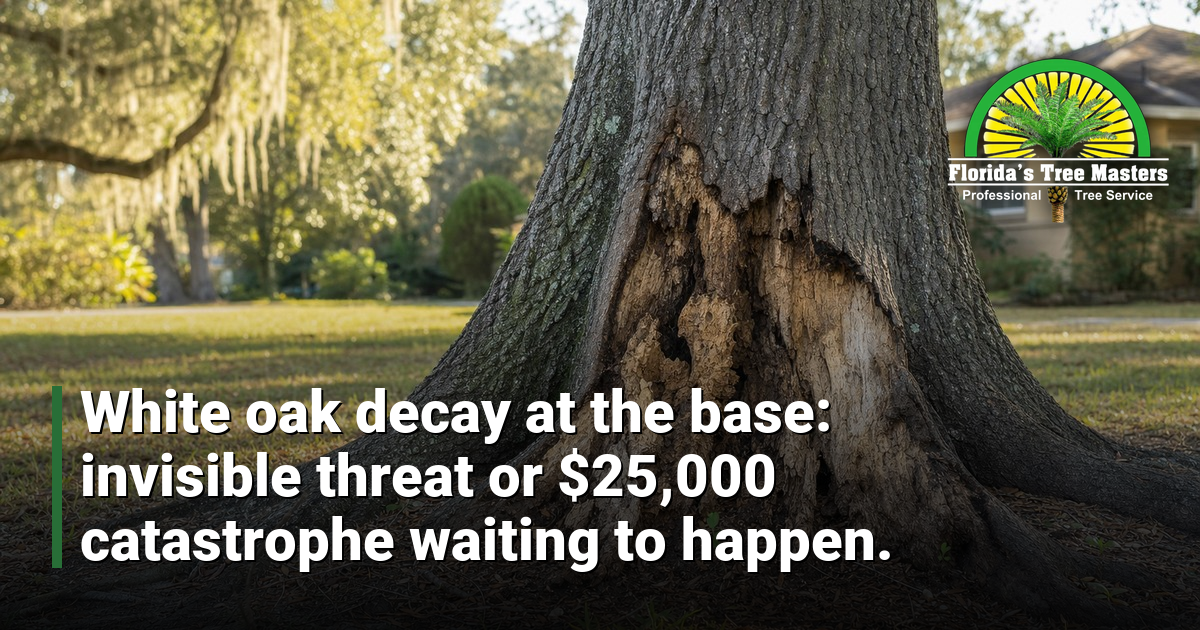
White oaks are tough trees. Dense wood, deep roots, and they handle Florida’s heat and sandy soil better than a lot of species. But they’re not immune to oak fungal decay, especially at the base and root flare. That’s where moisture collects. That’s where old wounds from lawn equipment or storm damage leave openings. That’s where rot gets a foothold.
Once a fungal pathogen gets into the heartwood, it starts breaking down the structural wood from the inside out. The outside of the tree can look mostly fine while the interior is hollowing out. By the time you see obvious signs at ground level, soft spongy wood, bracket fungi growing from the base, bark pulling away, dark staining, the decay has usually been there for a while.
The tree isn’t dead yet. But its structural integrity is already compromised. That’s what matters most when you’ve got a large white oak near a house, a driveway, or a fence line.
Signs You Should Not Ignore
We’ve looked at a lot of oaks in Volusia County and across our eight-county service area. Here’s what tells us a tree needs immediate attention.
- Conk or bracket fungi at the base. These shelf-like mushrooms are the fruiting bodies of wood-decay fungi. Seeing them means the fungus is already well established inside the wood.
- Soft or punky wood. Press on the base of the trunk near the soil line. If it gives, if it feels spongy or crumbles, that’s structural wood that’s already gone.
- Hollow sound when tapped. A solid tree sounds solid. A decayed one sounds duller, more hollow. Not a perfect test, but worth doing.
- Bark separation or deep cracks at the base. The bark is usually the last thing holding things together when the interior is failing.
- Leaning that wasn’t there before. New lean on a mature oak is a red flag. Combined with white oak decay at base, it moves the tree into dangerous territory fast.
- Soil lifting or root movement near the base. When the root system is compromised, the ground around the tree can shift. You might see cracking soil or roots that look unhealthy.
Any one of these on its own is worth a closer look. Multiple signs at the same time means you need a professional assessment, not a wait-and-see approach.
Can the Tree Be Saved?
Honest answer: sometimes. It depends on how far the decay has spread and where it sits in the root flare and trunk.
If the decay is limited to a small portion of the base and the rest of the root system and trunk wood is sound, the tree may still have years of safe life left. Our ISA-trained crew can assess the damage. We’ll probe the wood, look at the root zone, and give you a straight answer.
What we won’t do is tell you a tree is fine when it isn’t. We’ve seen too many situations where a homeowner was told the tree would be okay, a storm came through, and the tree came down on a structure. Base decay doesn’t fix itself. Oak fungal decay doesn’t stop spreading once it’s established. The question is always how far along it is and whether enough sound wood remains to support that canopy in storm winds.
When Removal Is the Right Call
If the decay has spread significantly around the base or into the root system, white oak tree removal is the safest option. We know that’s not what most people want to hear. These are good trees. But a hollow base cannot support a 60-foot tree in a Florida thunderstorm, let alone a named storm. A cracked base can fail without warning. At that point, the risk to your house, your family, and your neighbors outweighs keeping the tree.
Florida storm season runs June 1 through November 30. If you’ve got a large white oak with base decay heading into that window, don’t put the assessment off. Act before a storm, not after.
What About Pruning or Bracing?
Reducing the canopy through selective pruning can lessen the load on a weakened base. It’s not a cure, but it can extend the safe life of a tree that still has enough sound wood to stand. Cabling and bracing can help in specific situations too, but only when the structural wood supporting those cables is still intact. We’ll tell you if that applies to your tree.
What Happens When Our Crew Shows Up
We come out and look at the tree. No charge for that. We’re not going to quote you an oak base rot removal before we’ve assessed the situation. Our guys will check the base, probe the wood, walk the root zone, and look at the canopy for signs of decline that match up with what’s happening below.
If removal is needed, we bring the right equipment. For a large white oak close to a house or with limited access, that usually means our bucket truck for upper canopy work and our Bobcat skid steer to move sections once they’re on the ground. Big logs, tight spaces, sandy soil, our crew handles that combination regularly in this part of Florida.
Stump grinding is a separate service we can add on. Our Vermeer stump grinder takes the stump down well below grade so it won’t be a trip hazard or an eyesore. We haul off the debris and chip what we can. When the job is done, the yard is clean. We don’t leave stumps and brush piles behind.
What Does This Kind of Job Cost?
A large white oak removal runs anywhere from $800 to $3,500 or more, depending on the size of the tree, how close it is to structures, and what kind of access our equipment has to the work area. Base decay sometimes means trunk sections have to be handled more carefully. You can’t always rely on compromised wood to behave predictably, and that adds time to the job.
Every tree is different. Final price depends on size, location, access, and disposal. We’ll give you an exact number after we look at it, and that quote is free.
We’re licensed, insured, and ISA-trained. We carry full documentation on every job. If a contractor can’t hand you proof of insurance before they start, that’s your problem to carry when something goes wrong on your property. We make sure it doesn’t come to that.
Don’t Wait on This One
Tree decay Florida homeowners deal with is different from what you see up north. The heat, the humidity, and the storm season accelerate everything, and a large white oak with a compromised base can fail in ways that are hard to predict. We’ve handled enough of these, including ones that came through after storms, to tell you plainly: the earlier you get eyes on it, the more options you have.
If the tree fails on its own, you’re dealing with emergency removal, potential structural damage, and no control over timing or cost. Getting ahead of it now keeps you in charge of the situation.
Our crew handles tree removal Volusia County and throughout Flagler, Seminole, Orange, St. Johns, Duval, Clay, and Putnam counties. We’re based in Port Orange and we’ve been doing this work since 2018. Call us at (386) 320-3169 to schedule a free look. We’ll come out, assess the tree, and give you a straight answer about what’s going on and what it’ll take to fix it. No pressure, no runaround, just a real quote from people who know Florida trees.