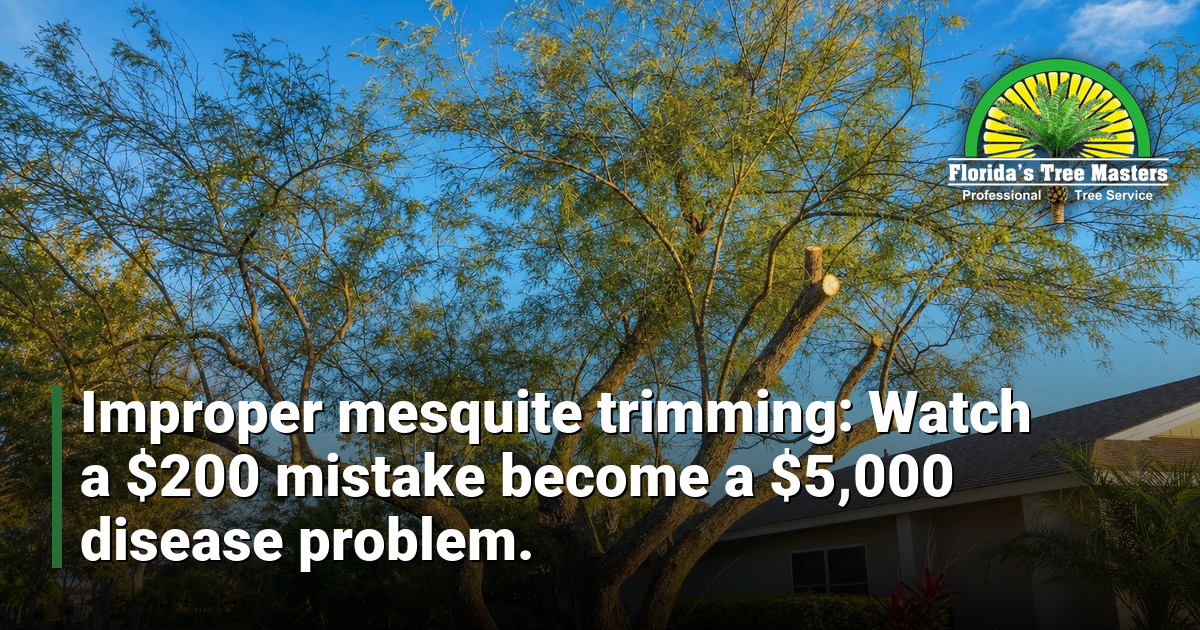
Florida’s Tree Masters gets calls about bad pruning jobs more often than you’d think. Mesquite trees aren’t the most common tree in our eight-county service area, but they’re out there, and when someone trims one wrong, the damage can follow that tree for years. If you’ve got a mesquite that was topped, hacked back too hard, or pruned at the wrong time of year, here’s what you need to know and what you can do about it.
Table of Contents
ToggleWhat “Improper Trimming” Actually Means
Bad trimming isn’t just about looks. It’s about what happens inside the tree after the cuts are made. Mesquites are tough trees, drought-tolerant, deep-rooted, and built for hot, dry conditions. But even tough trees can’t recover from certain kinds of damage.
The most common tree trimming mistakes we see on mesquites:
- Topping, cutting the main leader or large branches back to stubs. We never top trees. Ever. Topping creates massive wounds the tree can’t seal properly.
- Flush cuts, cutting too close to the trunk and removing the branch collar. That collar is where the tree’s natural defense tissue lives.
- Lion-tailing, stripping all the interior growth and leaving foliage only at the branch tips. This throws the tree off balance and makes it more likely to snap in a storm.
- Over-trimming, removing more than about 25% of the canopy at one time. That puts serious stress on the tree’s energy system.
- Wrong timing, pruning during active growth or right before a heat event stresses the tree at the worst possible moment.
Any one of these can set a mesquite back. All of them together, and you’re looking at a tree that may never fully recover.
Signs Your Mesquite Is Struggling After a Bad Trim
After an improperly trimmed mesquite tree takes damage, stress doesn’t always show up right away. Sometimes it takes a full growing season to see the real impact. Here’s what to watch for.
Short-Term Warning Signs
- Heavy suckering, lots of thin, weak shoots sprouting around the cut sites
- Wilting or yellowing leaves on trimmed branches
- Dead stubs that aren’t sealing over
- Unusual bark cracking near large pruning wounds
Long-Term Warning Signs
- Decay or soft spots developing at old cut sites
- Structural imbalance, the tree leaning or growing lopsided
- Repeated dieback on the same branches each season
- Fungal growth or discoloration on the trunk near wounds
If you’re seeing any of these, the tree needs a real look from someone who knows what they’re doing. Our ISA-trained crew can walk your property, assess the damage, and tell you straight whether the tree is salvageable or a liability waiting to happen.
Can a Badly Trimmed Mesquite Be Saved?
Sometimes yes. Sometimes no. It depends on how bad the cuts were, how long ago they happened, and how the tree has responded since.
Mesquites are resilient. If the mesquite tree pruning damage isn’t too deep into the structure, corrective tree pruning over one or two seasons can help redirect the tree’s growth back toward something healthy and stable. The key is making proper cuts, clean angles, correct placement relative to the branch collar, and not taking too much off at once while the tree is already stressed.
What we can’t fix is advanced decay. If rot has moved into the trunk through an old topping cut, that wood is compromised. A tree with a hollow or soft spot in a major structural limb is a falling hazard. Florida’s sandy soil doesn’t anchor root systems the way dense clay soils do, and a structurally weak tree here has less holding it upright than it might somewhere else in the country. That matters especially during storm season, which runs June through November and brings the kind of wind loads that expose every weakness a tree has.
We’ll be straight with you. If the tree can be corrected safely, we’ll tell you what that looks like and what it costs. If it can’t, we’d rather tell you now than have you find out during a tropical storm.
Corrective Pruning vs. Removal: How We Think About It
Our crew approaches every damaged tree the same way. First, we look at the structure. Is the trunk sound? Are the main scaffolding branches intact, or are they stubs and regrowth? Is the root zone healthy, or is there evidence of root damage from previous work?
If the bones of the tree are still good, corrective tree pruning is worth trying. That means removing the watersprouts and sucker growth, making clean reduction cuts where stubs exist, and giving the tree some time to respond. We don’t rush this. Over-correcting a stressed tree compounds the problem.
If the structure is too far gone, tree removal is the safer and more economical choice. A mesquite left to slowly decline takes up space, can drop limbs, and eventually has to come down anyway, often after it’s already caused damage. Getting it out cleanly now, with our Bobcat skid steer to clear debris and our Vermeer stump grinder to take care of what’s left in the ground, is a better outcome than waiting.
We handle both options across our service area. If you’re in Volusia County, or anywhere else in our eight counties, Flagler, Seminole, Orange, St. Johns, Duval, Clay, Putnam, we’ll come out and take a look at no charge.
How to Avoid This Problem in the Future
Bad tree trimming Florida homeowners hire out is often the root of these problems. If your mesquite survived a bad trim and you want to keep it healthy going forward, here are the basics.
- Hire someone who knows what they’re doing. That means licensed, insured, and ISA-trained. Ask to see proof before anyone touches your tree. Our guys carry that documentation on every job.
- Don’t let anyone top it. No exceptions. Topping isn’t a pruning technique, it’s damage. If a company suggests topping your tree to control its size, that’s your cue to send them home.
- Time it right. For mesquites in Florida, late winter or early spring, before new growth pushes hard, is generally the safest window. Avoid trimming during drought stress or right before high heat.
- Keep cuts small relative to the tree. A cut larger than a few inches in diameter on a mesquite is going to be slow to seal. The bigger the wound, the more entry point you’re giving disease and insects.
- Don’t over-trim for clearance. If you need a branch raised for clearance under a structure or over a driveway, a good crew raises it correctly, not strips it. There’s a right way to create clearance without gutting the tree’s interior growth.
We’ve handled plenty of cleanup jobs after other companies left a mess. We’re not here to lecture anyone, but bad pruning costs the homeowner money twice, once when the bad work is done, and again when someone like us has to fix it or remove the tree entirely.
Get a Free Quote From Our Crew
If you’ve got Improper trimmed Mesquite Trees on your property, don’t just hope they grow out. Some do. Some don’t. The faster you get eyes on one, the more options you have.
Our crew is based in Port Orange and covers all eight counties in our service area. We’re licensed, insured, and ISA-trained. We’ll come out, look at the tree, and tell you exactly what we’re seeing, no charge for the visit, no pressure on the quote. Corrective pruning on a mesquite typically runs in the range of a few hundred dollars depending on the size of the tree, how much corrective work is needed, and site access. Mesquite tree removal Florida pricing works the same way, it varies by tree size, location, and what needs to come out. Every tree is different, and we price it after we see it.
Call us at (386) 320-3169. We answer day or night, including weekends. If a limb looks like it could come down before we get there, tell us that when you call, we’ll prioritize accordingly.