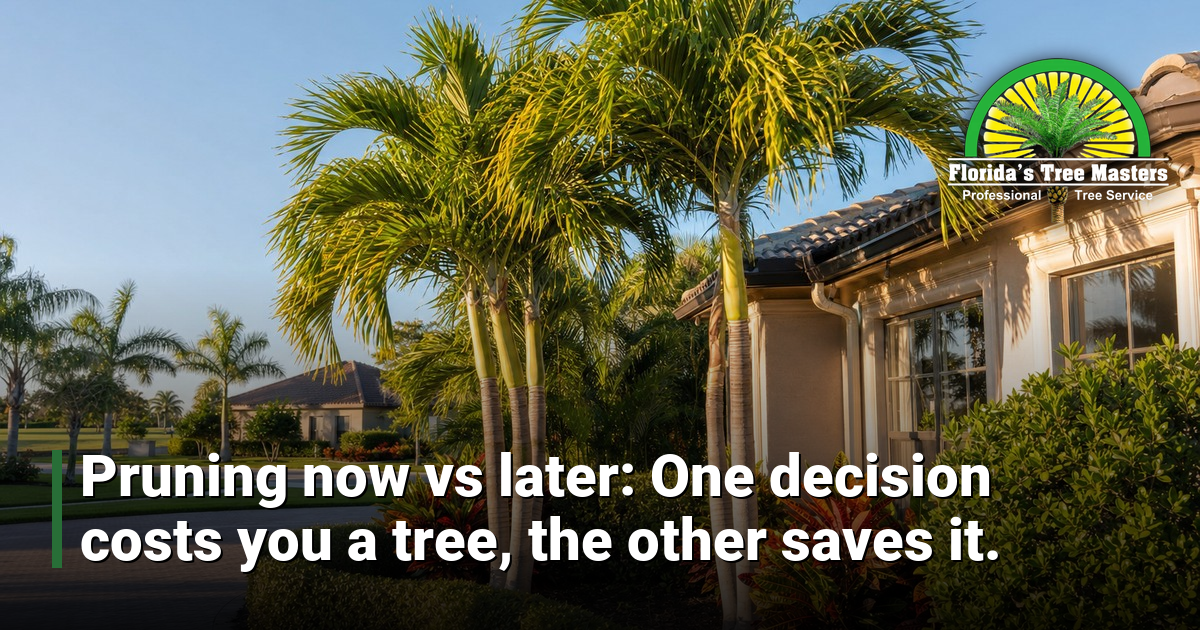
Florida’s Tree Masters gets this question a lot. Homeowners standing in their yard, looking up at an oak or a palm, trying to figure out where to even start. “Can you help me figure out the best way to prune these?” We hear it every week. Pruning looks simple from the ground. Get up there with a saw and take off what looks wrong. But done badly, it causes more damage than doing nothing. We’ve cleaned up after bad pruning jobs more times than we can count.
Table of Contents
TogglePruning Is About the Tree, Not the Look
A lot of people prune for shape. That’s fine as a side effect. But the real goal is health, structure, and safety. A well-pruned tree has good airflow through the canopy. No crossed branches rubbing each other raw. No dead wood waiting to fall on something. In Florida, afternoon storms can roll through without much warning from June through November. A structurally sound tree is the difference between a cleanup call and an insurance claim.
Our crew starts every pruning job by walking the tree. We look at the branch structure, the lean, any signs of decay or pest damage, and where the root flare meets the soil. That walk takes ten minutes and saves a lot of mistakes. You can do the same thing before you ever pick up a tool.
The Four Cuts Worth Making
If you’re trying to figure out how to prune trees in Florida, start here. There are really only four reasons to cut a branch. Stick to these and you won’t go wrong.
- Dead or dying branches. Take them off. Dead wood is a liability in any wind event, and it can harbor beetles, fungus, and other problems that spread to healthy wood.
- Crossed or rubbing branches. Two branches grinding against each other create wounds that don’t close properly. Pick the one with better structure and remove the other.
- Branches growing toward the house, roof, or power lines. If a limb is over your roofline, it needs to come off or be pulled back. Don’t wait for a storm to make that call for you.
- Interior congestion. Dense canopies hold more wind load during a storm. Thinning the interior lets wind pass through instead of pushing the whole tree like a sail.
Everything else, cutting for shape, cutting because a branch looks odd, cutting because a neighbor said so, usually isn’t necessary and sometimes does real harm.
What to Know About Specific Tree Types
Live Oaks and Water Oaks
Oak tree pruning is some of the most common work we do in Volusia, St. Johns, and Clay County yards. Live oaks are tough but they don’t like hard pruning. Never strip the canopy down heavily. You want to remove specific problem branches, not go after the whole crown. Water oaks are faster-growing and tend to develop weak branch attachments. Look for branches with a narrow V-shaped crotch. Those are the ones most likely to fail in a storm. If you’re not sure what you’re looking at, have someone ISA-trained take a look before you cut.
Timing matters too. Tree pruning Florida-wide follows the same rule on this: avoid heavy oak work during peak beetle activity, which runs roughly spring through early summer. Freshly cut oak wood attracts ambrosia beetles and other borers. Late summer through winter is a safer window for bigger cuts.
Palms
Palms are not trees in the traditional sense, but palm tree pruning follows its own set of rules. The main one: only remove fronds that are already brown or yellow and hanging below a horizontal line from the trunk. Green fronds pull nutrients back into the palm as they age. Cutting green fronds, especially the ones pointing straight up or outward, weakens the palm and makes it more vulnerable to disease.
We also see a lot of “hurricane cuts” on palms around here. That’s where someone removes nearly every frond before storm season thinking it’ll help the palm survive. It doesn’t. It stresses the palm badly and doesn’t make a measurable difference in how it handles wind. Leave the green fronds alone. Pull the dead boots if you want a cleaner look, but go easy.
Pines
Slash pines and longleaf pines are common in our area. They don’t need much canopy pruning. The main work on pines is removing lower dead branches and watching for signs of pine bark beetle activity, usually small pitch tubes on the trunk or reddish sawdust at the base. If you see those signs, the problem isn’t a pruning issue. Call us.
How Not to Prune, And Why Topping Is Never the Answer
We have a hard rule: no topping, ever. Topping means cutting the main trunk or primary scaffold branches back to stubs. Some companies still do it. We won’t. Here’s why.
When you top a tree, you remove most of its leaf surface all at once. The tree panics and sends out a flood of fast-growing, weakly attached sprouts called epicormic shoots. Those shoots grow fast but they’re not structurally sound. They break easier, they grow back denser than before, and the wounds from topping rarely close properly. Instead they rot inward over years. We’ve taken down trees in Flagler and Putnam County that were topped years earlier and were hollow from the cut points down by the time we got to them.
If a tree is too tall or too wide for the space it’s in, the answer is proper crown reduction. Strategic cuts back to lateral branches that can take over as the new lead. It takes more skill than topping. It looks better. The tree stays healthier. That’s the work we do.
Also watch out for flush cuts. A flush cut removes a branch so close to the trunk that it takes out the branch collar, that slightly swollen ring of tissue where the branch meets the trunk. The collar is how a tree closes over a wound. Remove it and the wound stays open, sometimes for decades. Cut just outside the collar, not flush to the bark.
When to Call Us Instead of Doing It Yourself
We’re not going to tell you never to prune your own trees. If you’ve got a small branch you can reach from the ground, the right tool, and you know what you’re cutting and why, go ahead. But there are situations where calling a crew is the smarter move.
- Anything that requires a ladder or climbing. Falls from trees are a real risk. Don’t underestimate it.
- Any branch over a roof, a car, a fence, or power lines. Wrong cut, wrong drop, and you’re looking at damage that costs more than the tree work would have.
- Trees that show signs of decay, soft spots in the trunk, mushrooms at the base, cracks along major limbs. A compromised tree can shift or drop unexpectedly when you start cutting. That’s dangerous.
- Oaks or large pines where the work requires a tree removal bucket truck or rigging to control where branches fall.
- Any tree work you’re unsure about. We come out, take a look, and tell you what we see. Free quote, no pressure.
We handle tree trimming Volusia County homeowners rely on, plus seven other counties across northeast Florida: Flagler, Seminole, Orange, St. Johns, Duval, Clay, and Putnam. Our crew is ISA-trained, licensed, and insured. We bring our own equipment including a Bobcat skid steer for cleanup and a Vermeer stump grinder if you need the stump gone after the work is done.
Good florida tree care starts with knowing what a tree actually needs before you pick up a saw. If you’ve got a tree you’re trying to figure out, give us a call before you start cutting. Reach us at (386) 320-3169. We’ll come out, take a look, and give you a free quote on whatever the tree needs, pruning, removal, or just a straight answer on what’s going on with it.