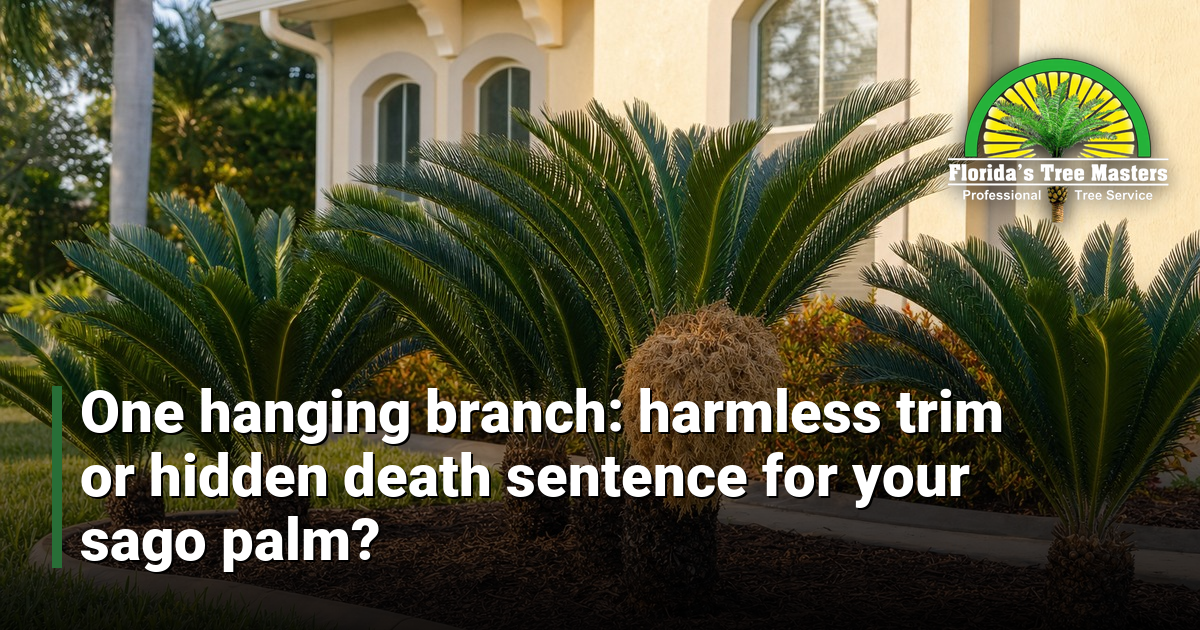
Florida’s Tree Masters gets this question a lot. Someone has a row of sago palms lining their driveway or property line, one of them looks rough, and they want to know if pulling it will mess up the rest. Short answer: no. To remove one sago palm from a grouped planting will not hurt the others. But let’s talk through the full picture so you can make the right call for your yard.
Table of Contents
ToggleSago Palms Don’t Grow in Colonies Underground
Sago palms look like they belong together, especially when you’ve got a matched set of seven. It’s easy to assume they’re connected somehow, sharing roots, sharing nutrients. They’re not. Each sago is its own plant with its own root system. Taking one out leaves a gap in the visual line, but it doesn’t stress or starve the ones next to it.
Sago palms aren’t true palms. They’re cycads, one of the oldest plant families on earth. That matters because cycads spread through offshoots called pups. If your seven plants started from one original mother plant, those pups were already growing independently by the time they got established. Removing one doesn’t pull the rug out from under the others.
So if your concern is “will this hurt the six I want to keep”, it won’t. Not in any way we’ve ever seen on a job.
What “Hanging On Only One” Usually Means
Folks ask us, ‘Would it hurt to remove this thing hanging on only 1 of my 7 Sago palms?’ We hear it all the time. Before we touch anything, we want to know what’s actually wrong with it.
- Is it leaning hard to one side? Sago palms in sandy Florida soil can lean when the root system gets shallow or when the caudex (the trunk base) starts to rot from the inside.
- Are the fronds yellow, brown, or drooping? That can signal a nutrient deficiency. Magnesium and manganese are common culprits in Volusia and Flagler counties. Or it can mean crown rot, which spreads from the inside out.
- Is there a white or gray fuzzy scale coating on the fronds? That’s cycad scale florida homeowners are dealing with more and more. Cycad aulacaspis scale is an invasive pest that has wiped out entire sago plantings across northeast Florida. It spreads fast.
- Is the caudex soft when you press on it? Soft or hollow spots in the trunk usually mean the plant is already dying from root rot or fungal infection.
If the problem is scale or a fungal issue, waiting too long to remove the sick plant can put the other six at risk. That’s the one scenario where pulling the struggling sago isn’t just fine, it’s the right move to protect the rest.
When to Remove Versus When to Wait
Not every sago that looks rough is a goner. We’ve seen plants bounce back from nutrient deficiencies after a proper fertilization schedule. We’ve seen plants survive a light scale infestation after treatment. Removal isn’t always the first step.
Here’s a simple way to think about it.
Remove it now if:
- The caudex is soft, rotted, or caving in
- You see heavy cycad scale infestation and it hasn’t responded to treatment
- The plant is more than 50% brown fronds and showing no new growth
- It’s leaning toward a structure, walkway, or fence line
- A certified arborist has called it a loss
Watch it a few weeks if:
- It went through a cold snap and looks stressed but the caudex feels firm
- Fronds are yellowing but the center spear is still green and upright
- You recently changed irrigation and it might just be adjusting
We’re not here to push unnecessary removals. If a sago has a shot, we’ll say so. But if it’s done, leaving it in the ground near six healthy plants is a gamble, especially with a sago palm dying from scale that can jump to the others.
What Sago Palm Removal Actually Looks Like
Sago palms are dense and heavy for their size. The caudex holds a lot of moisture and that makes it surprisingly hard to work with. A small sago, say two feet of trunk, can weigh several hundred pounds when you factor in the root mass.
Our crew typically brings the Bobcat skid steer for sago palm removal when the plant is in a spot with any kind of access. We can use the stump bucket attachment to pop smaller sagos out in one piece. Bigger ones with deep root systems, we’ll cut the caudex down, then grind what’s left with the Vermeer stump grinder so nothing is left to resprout.
Sagos resprout from root tissue if you leave chunks in the ground. Worth knowing. If you want the one removed and don’t want a new one coming back in that same spot, grinding is the right call. We’ll talk through that before we start.
We also haul everything off. Fronds, caudex, root mass. The spot where your sago was will be clean when we leave. If you want the space replanted with a matching sago or something else, that’s a separate conversation, but at least you’ll have options.
Scale and Disease: The One Risk Worth Taking Seriously
We mentioned cycad scale florida properties have been dealing with, and we want to come back to it because it’s the real reason you shouldn’t ignore a struggling sago.
This scale insect has devastated sago plantings across the state, including properties right here in northeast florida palm removal crews work in every week. The insects are tiny and white. They coat the fronds and work down into the caudex. By the time a sago looks obviously sick, the infestation is usually well established.
Scale can crawl. It spreads on wind, on tools, on hands. If your sick sago has active scale, leaving it in the ground while you try to save it gives the pest more time to reach the six healthy plants nearby. A licensed applicator can treat scale on healthy plants, but treatment works a lot better as a preventive than as a rescue once the insects are already on the other plants.
Get eyes on a struggling sago before you make any decision. Not because removal is automatically the answer, but because knowing what’s wrong tells you how fast you need to move. Our crew can take a look and give you a straight read on what’s going on with the plant.
Get a Free Quote, We’ll Come Look at It
If you’ve got one sago out of seven that looks like it’s on its way out, the call to make is simple. Have someone who knows what they’re looking at come take a look. We’re based in Port Orange and we cover Volusia County and seven other counties across northeast Florida, Flagler, St. Johns, Duval, Clay, Putnam, Seminole, and Orange.
We’ll walk the property, look at all seven plants if you want, and give you our honest read on whether the struggling one needs to come out now or if you’ve got some time. If it needs to come out, we’ll quote the tree removal on the spot. No obligation, no pressure.
Sago palm removal cost runs somewhere in the $200-$800 range for most jobs, depending on size, how deep the root system goes, and how tight the access is. Every plant is different. Final price depends on size, location, access, and disposal. But we don’t guess. We look at it first.
Call us at (386) 320-3169. We answer day and night, including weekends. If scale is involved and it’s spreading, you don’t want to sit on this one. We’ll tell you what we actually see, not what makes us more money.