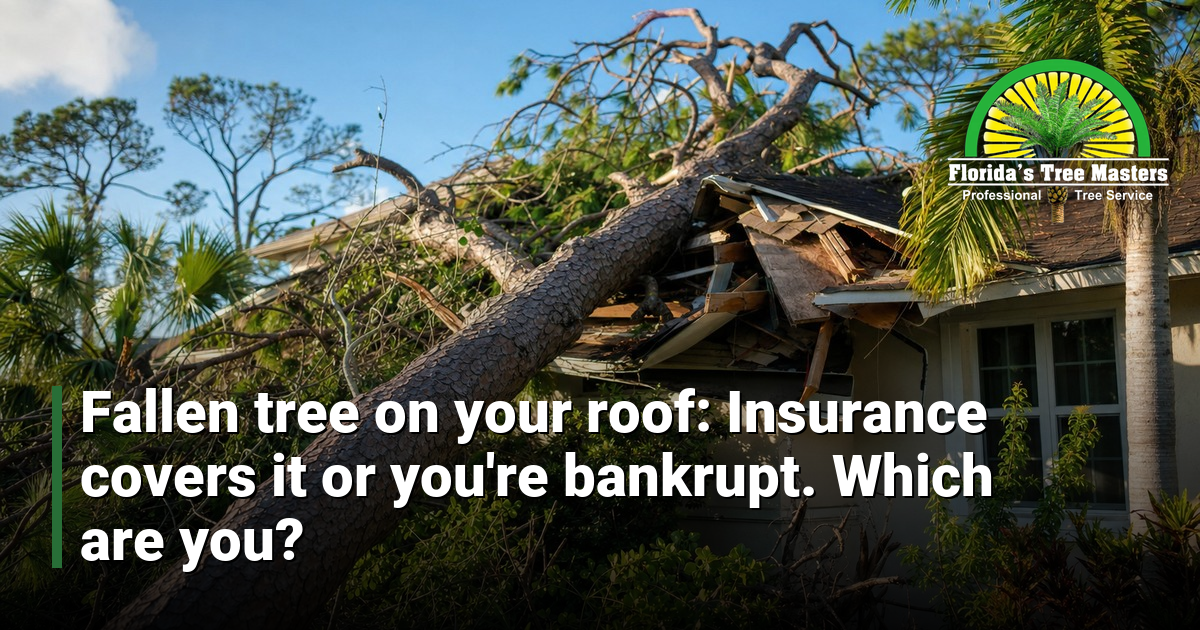
Florida’s Tree Masters gets calls like this every storm season. A tree comes down on the roof at midnight, someone grabs their phone, types “fallen tree on house” into Reddit, and starts reading a thread from Ohio. That’s not going to help you. This article will. If a tree is on your house right now, call us at (386) 320-3169, we run a 24/7 emergency line. If you’re reading this to prepare, keep going.
Table of Contents
ToggleFirst Five Minutes: What Actually Matters
Get everyone out of the affected room. If the tree came through the ceiling or a wall, that section of the house is not safe to stand under. A cracked roof truss can let go without warning. Don’t go back in to grab things. Don’t stand under the tree trying to assess it yourself.
Check for gas. If you smell anything, get everyone outside and call the gas company before you call anyone else. Leaking gas after storm damage moves fast inside a house.
Once people are clear and there’s no gas smell, do these things in order:
- Call your insurance company and open a claim
- Take photos and video from a safe distance, don’t get under the tree
- Call a tree service to get the tree off the structure
- Call a roofer or contractor once the tree is removed
That order matters. The tree has to come off before anyone can assess the roof damage underneath. Don’t let a roofer go up on a roof with a tree still on it.
Why You Shouldn’t DIY This One
We’ve seen it plenty of times. A homeowner gets on the roof with a chainsaw to cut the limb pinning the shingles. They cut the wrong piece. The tree shifts. Everything gets worse fast. Trees under tension, a branch or trunk that’s bent and loaded, move unpredictably when you cut them. That’s not something you want to learn hands-on at 2 a.m. on a wet roof.
The other issue is the roof itself. You don’t know what’s holding the tree in place until someone trained looks at it. Sometimes a trunk is resting on a ridge beam and the only thing keeping it from sliding is friction. Cut the wrong section and it rolls. Our crew reads that before we make the first cut. That’s what ISA-trained means in a real situation, not a certificate on a wall.
There’s also the liability question. If you’re cutting and something goes wrong, you’re on your own. When we’re on the job, we carry full insurance and our crew is covered. That matters for your homeowner’s claim too. Adjusters want to see a licensed, insured company on the work order, not a neighbor with a Stihl.
How We Remove a Tree from a Structure
Every job is a little different, but the general process is the same. We show up, walk the site, and figure out how the tree is loaded before anyone touches it. On most residential jobs in Volusia, St. Johns, or Flagler County, we section the tree from the top down, cutting smaller pieces off one at a time instead of dropping a big trunk section onto your roof.
For larger oaks or pines, we’ll bring the bucket truck. It lets us work from above and control where each piece goes. We use our Bobcat skid steer to move debris off the property once the tree is sectioned and on the ground. If there’s a stump left after the removal work, our Vermeer stump grinder can take that out on the same visit or a follow-up, depending on what else is going on that day.
Cleanup is included. We don’t leave a pile of limbs next to the driveway and hand you a bill. The job isn’t done until the debris is loaded and the area is cleared. Your insurance adjuster and your roofer need a clean look at the damage, that’s easier when we’ve done our part right.
What About the Tarping?
We can tarp an exposed roof section after the tree is removed. It’s not a permanent fix, that’s the roofer’s job, but a tarp keeps additional rain out while the repair is being scheduled. If a storm hit overnight and your roof is open, don’t leave it exposed through another rain event.
What the Insurance Process Looks Like
Most homeowner’s policies cover tree removal when the tree damages a structure. If the oak landed on your garage or your roof, removal is typically covered. If the tree fell in the yard and missed everything, coverage is less certain and depends on your specific policy.
Document everything before anyone moves anything. Photos of the tree on the structure, the damage point, and the surrounding area. If the tree was dead or leaning before the storm, document that too. The adjuster may ask about it.
Get the tree service invoice with our license number and insurance certificate on it. Adjusters want proof the work was done by a legitimate contractor, not a cash job. We provide that paperwork on every job as standard, it’s not something you have to ask for.
The insurance company may send their own adjuster out before approving a fallen tree insurance claim. That can take a day or two. In the meantime, the tree still needs to come off the roof. You may pay out of pocket first and get reimbursed. We can walk you through what documentation helps with that process.
Neighbor’s Tree Fell on My House, Who Pays?
This comes up a lot in those “fallen tree on house reddit” searches. The short legal answer: your insurance typically covers your own structure, even if the tree came from next door. Neighbor liability usually only applies if you can prove they knew the tree was dead or hazardous and didn’t act on it. That’s a harder case to make than most people think.
Either way, the tree still has to come off your house first. Sort the liability question out with the insurance companies after. Don’t let a dispute about who pays turn into three days with a tree on your roof.
How Much Does Emergency Tree Removal Cost?
On a fallen tree that’s hit a structure, most jobs run somewhere in the $800 to $3,500 range depending on the size of the tree, how much of it came down, how it’s resting on the structure, and how easy it is to access with equipment. A big laurel oak draped over a two-story hip roof is going to be on the higher end. A small pine that clipped a porch overhang is going to be lower.
After-hours emergency calls carry a higher rate than standard daytime work, that’s true of any legitimate service. We’ll be straight with you about that on the phone before we come out.
Every tree is different. Final price depends on size, location, access, and disposal. The only way to get a real number is to have eyes on the job. We’ll come out, look at it, and quote it free. Call us at (386) 320-3169, day or night.
We Cover Eight Counties and We Answer the Phone
Florida’s Tree Masters is based in Port Orange. Our crew works across all eight counties, Volusia, Flagler, Seminole, Orange, St. Johns, Duval, Clay, and Putnam. If you’re in any of those counties and a tree just hit your house, we can get someone out to you. Our emergency line runs 24/7, including weekends and holidays, because storms don’t care about schedules.
If you need to know what to do when a tree fell on roof, the answer isn’t to wait. We’ve been handling emergency tree removal florida homeowners count on since 2018. Licensed, insured, and ISA-trained. We bring real equipment, bucket trucks, our Bobcat skid steer, the Vermeer stump grinder, not a pickup and a handsaw. And we clean up after ourselves.
If you’re searching “tree on house what to do” or need storm tree removal volusia county and the surrounding area, don’t keep scrolling. If you’re in Volusia County or anywhere else in our service area and need help right now, call (386) 320-3169. We’ll pick up.