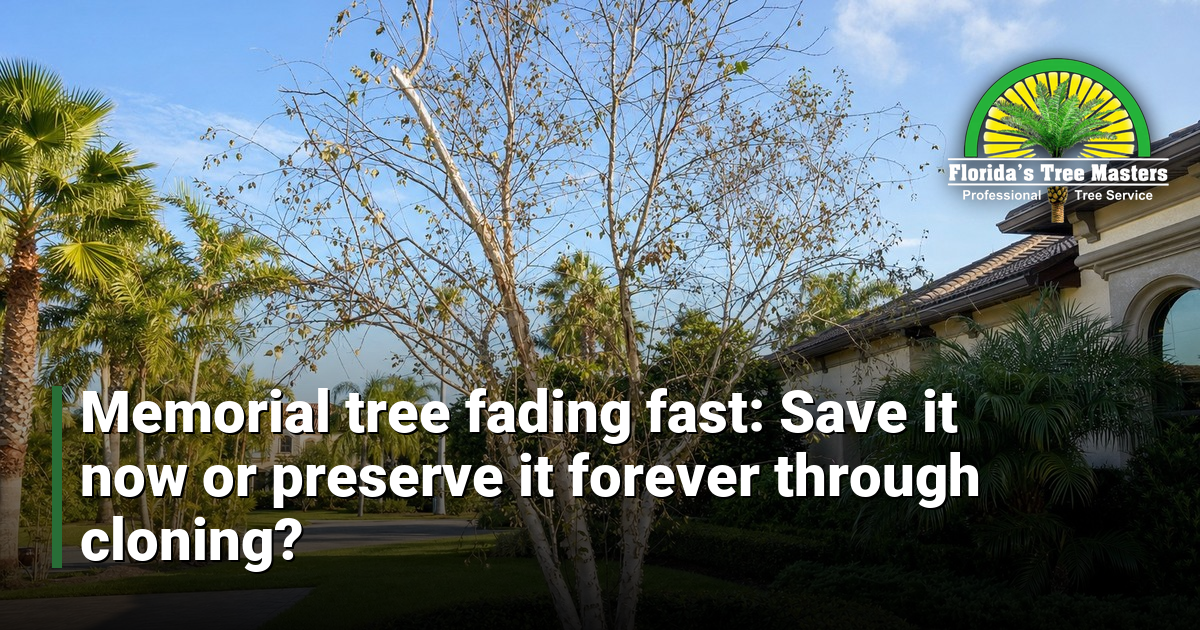
Florida’s Tree Masters gets calls like this more than you’d think. Someone planted a silver birch to remember a person they loved, and now the tree is struggling, yellowing leaves, die-back at the tips, bark peeling in the wrong way, or just a general look of a tree that’s losing the fight. They want to know if it can be saved. And if it can’t, they want to know if there’s any way to keep a piece of it alive. We’re going to give you a straight answer on both questions.
Table of Contents
ToggleWhy Silver Birch Trees Struggle in Northeast Florida
Silver birch, Betula pendula if you want the Latin, is a cool-climate tree. It evolved in northern Europe and the northern United States where summers are short and soils stay moist and cool. Northeast Florida is not that. Our summers run long, hot, and brutal. The soil in most of our 8-county area is sandy, drains fast, and holds almost no moisture. Volusia County and Clay County soils especially can turn into dry powder under a tree’s root zone during a dry stretch.
That puts silver birch in a tough spot almost from the day it goes in the ground. The tree didn’t fail because someone did something wrong. It’s fighting conditions it wasn’t built for. That’s the honest starting point when you’re trying to figure out if it can be saved.
The most common problems we see on declining silver birch down here are root stress from heat and drought, bronze birch borer beetle damage, and fungal issues that move in once the tree is already weakened. Sometimes it’s all three at once. Each one looks a little different, and that matters when you’re deciding what to do next.
How to Tell What’s Actually Killing It
Before you do anything, you need to know what you’re dealing with. Here’s what to look for.
- Yellowing or scorched leaves starting at the top: Usually means root stress, heat, drought, or compaction. The top of the tree is the last place water reaches, so it shows symptoms first.
- D-shaped exit holes in the bark: Bronze birch borer. This is a flat-headed beetle that bores into the cambium layer under the bark. Once it’s established, it moves fast and can kill a tree in one to two seasons.
- Cankers or dark wet spots on the bark: Fungal disease. Often a secondary problem, meaning something else weakened the tree and the fungus moved in after.
- Die-back starting at branch tips and working inward: Could be borer, could be root rot, could be drought stress. The pattern matters, if it’s random across the crown, lean toward disease. If it’s top-down, lean toward vascular stress.
- Bark lifting or peeling abnormally: Not the normal white papery peel that healthy birch does. Look for dark discoloration underneath where the bark separates.
If you’re not sure, that’s fine. A trained eye can sort it out. Our ISA-trained crew has seen plenty of struggling birch in this part of Florida, and we can tell you on the spot what you’re looking at.
Can a Declining Silver Birch Be Saved?
Honest answer: sometimes yes, sometimes no. It depends on how far the decline has gone and what’s causing it.
When there’s still a real chance
If the tree still has a majority of its canopy intact and the problem is drought stress or early-stage fungal disease, you can often stabilize it. Deep watering two to three times a week during dry stretches makes a real difference. Mulching the root zone, a four-inch ring of mulch pulled away from the trunk, helps the soil hold moisture and stay cooler. If a certified arborist confirms the problem is borer damage caught early, targeted insecticide treatment into the vascular system has saved trees. Not always, but it’s a real option worth discussing with someone licensed to make that call.
What won’t help: topping the tree. We won’t do it and we’ll tell you why if you ask. Topping stresses an already weak tree and opens wounds that fungus loves. No exceptions on that one.
When the tree is past saving
If borer damage has gone through most of the trunk, if the canopy die-back is more than half the tree, or if root rot has undermined the structure, the honest answer is that the tree is not coming back. Keeping it standing at that point is a safety issue. A structurally compromised tree doesn’t give you much warning before it comes down. If it’s near your house, a fence, or a spot where people walk, that’s not a risk worth taking.
That’s a hard conversation when the tree means something. We get that. But the right call is still the right call.
Cloning or Propagating a Memorial Tree, Is It Possible?
This comes up a lot with memorial trees, and it’s worth taking seriously. The short answer is yes, silver birch can be propagated, but it takes some planning and it’s not guaranteed.
The two main methods are hardwood cuttings and collecting seed. Hardwood cuttings work best taken in late winter before the tree pushes new growth. You cut a section of stem from young, healthy wood, not old bark, not a dying branch, and root it in a controlled environment. Success rates vary. Silver birch doesn’t root from cuttings as easily as some other trees, but it can work. If you know someone with greenhouse space or a passion for propagation, this is worth trying before the tree declines further.
Seed collection is more reliable from a germination standpoint. Silver birch produces catkins in spring. The seeds are tiny and need cold stratification to germinate well. In Florida that means you’re mimicking a cold winter artificially, sealed in a damp paper towel in the refrigerator for four to six weeks before planting. It’s doable.
Here’s the important part: do this now, not later. If the tree is declining, take cuttings or collect seed while there’s still healthy material to work with. A dead tree gives you nothing to propagate from. Don’t wait to see how the season goes. Act while you still have options.
One more thing, the propagated tree is going to face the same Florida climate the original did. If you plant it back in the same spot with the same conditions, it’ll hit the same wall eventually. Talk to a nursery or extension agent about the best microclimate on your property, or consider a species that honors the memory without fighting the Florida heat every summer.
What We Can Do to Help
If you’ve got a declining silver birch and you’re not sure what’s going on, we’ll come out and take a look. Our crew serves Volusia County and the surrounding seven counties, Flagler, Seminole, Orange, St. Johns, Duval, Clay, and Putnam. We’ll tell you what we see, give you an honest read on whether the tree has a realistic chance, and if it doesn’t, we’ll talk through your tree removal options carefully, because we know this one isn’t just a tree.
If the tree does need to come down, our Bobcat skid steer handles the heavy lifting and our Vermeer stump grinder can take care of the stump so the area is clean. We haul everything off. The quote is free and the conversation costs you nothing.
Call us at (386) 320-3169. Day or night, we pick up. We’re based in Port Orange and we’ve been doing this work since 2018. We’re licensed, insured, and we’ll give you a straight answer, not the answer that makes us the most money, but the one that actually helps you figure out what to do with a tree that matters.