Florida’s Tree Masters gets this question a lot, usually from a homeowner standing in the yard staring at a big oak and trying to figure out which bill is going to hurt less. The honest answer: trimming is almost always cheaper than removal, but cheaper isn’t always the right call. Sometimes the tree forces your hand. Let’s walk through how the pricing actually breaks down and how to figure out which way to go.
Table of Contents
ToggleWhat Trimming Costs vs. What Removal Costs
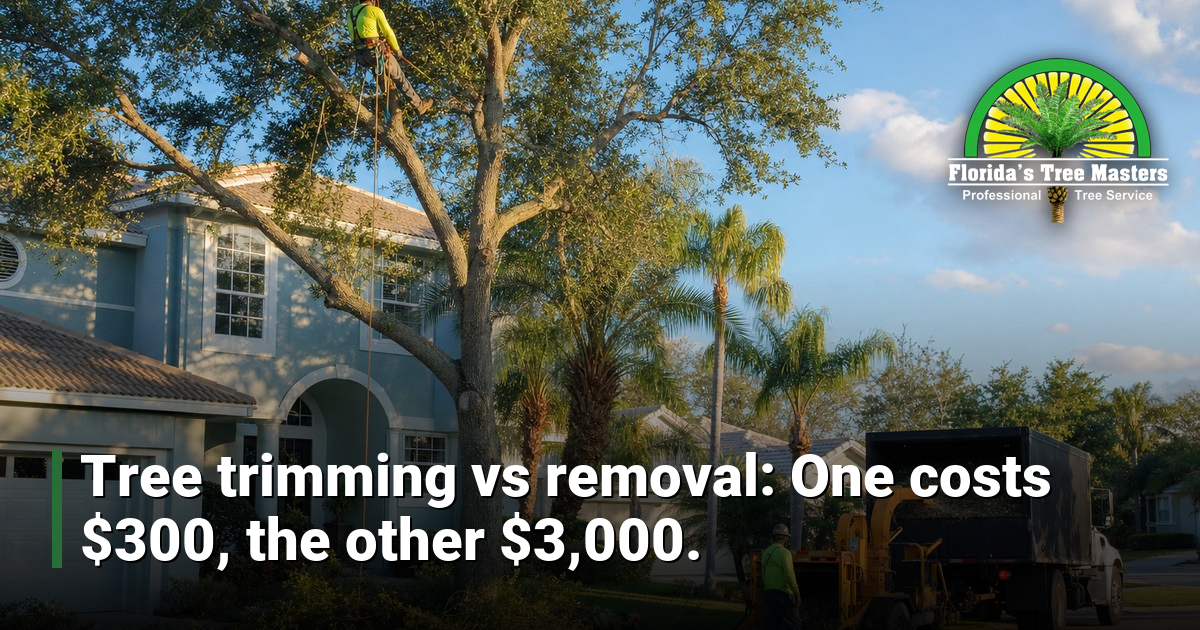
If you’re wondering how much does tree trimming cost in our service area, Volusia, Flagler, St. Johns, Duval, and the rest of the eight counties we cover, the typical range is $200 to $900 for a single tree. That range covers a lot of ground. A small crape myrtle that needs a cleanup is on the low end. A large live oak with limbs hanging over a roof takes more time, more equipment, and a bucket truck to do it safely. That pushes the number up. Tree trimming cost florida varies by job, but those numbers are a solid starting point.
Tree removal costs more. Most removals we quote run between $400 and $2,500 depending on the size of the tree, how close it is to a structure, and how tight the access is for our equipment. A 60-foot pine in an open backyard is a different job than a 40-foot water oak wedged between a fence and a pool screen. Every job is priced on what we see when we get there, no two are the same.
So yes, trimming is cheaper up front. But that math only works if trimming solves the problem.
When Trimming Makes Sense
Trimming is the right call when the tree is healthy and the issue is about size, clearance, or shape. Here’s when our crew usually recommends a trim over a removal:
- Limbs are growing too close to the roofline or gutters but the tree structure is solid
- The canopy is blocking light or views and the homeowner wants to keep the tree
- Dead wood or crossing branches need to come out before storm season
- The tree is a protected species or a large live oak that adds real value to the property
- Palm fronds have gotten out of hand and the boots need clearing, common around here with Sabal palms and queen palms
A good trim can add years to a tree’s life. It also reduces the sail effect during a hurricane. Less canopy catching wind means less chance the whole thing tips over. We always look at storm risk when we’re assessing any tree, especially between June and November when Florida storm season is active.
One thing we will never do: top a tree. Some companies still offer it. We don’t. Topping removes the main structure of the tree and leaves behind wounds that rot out fast. A topped tree is usually a removal job within a few years anyway. No topping, ever.
When Removal Is the Right Move
For tree removal vs trimming, the question is simple: is trimming fixing the problem or just delaying it? If any of these apply to your tree, removal is probably the smarter spend, even if it costs more now.
The Tree Is Already Dying or Dead
A dead tree doesn’t benefit from a trim. It’s just standing there waiting to fall. Dead pines are especially bad for this. They dry out, the root system stops holding, and one good wind event puts them on the ground. We’ve seen plenty of dead trees come down on fences, cars, and rooftops here in northeast Florida. If the tree is dead, take it down before it decides when to fall on its own.
The Structure Is Compromised
Rot at the base, a cracked trunk, or a major lean that wasn’t there a year ago, these are signs the tree’s structural integrity is gone. Trimming the top doesn’t fix a rotted root system. Our ISA-trained crew can spot the difference between a healthy lean and a tree that’s heading for the ground. If the trunk is hollow or the roots are lifting on one side, that’s a safety issue. A cracked trunk can fall without warning.
It’s In the Wrong Place
Sometimes a tree is healthy but planted too close to the foundation, the septic system, or the house. Roots from water oaks and laurel oaks are notorious for finding their way into sewer lines and cracking slabs in Florida’s sandy soil. Trimming the canopy doesn’t stop the root system from doing damage underground. In that case, removal plus stump grinding is the real fix.
Storm Damage Has Taken Half the Tree
After a bad storm, we see trees that have lost major structural limbs, sometimes half the crown. At that point the tree is unbalanced, stressed, and more vulnerable to disease and pests. Trimming what’s left might buy you a season, but a heavily storm-damaged tree rarely recovers well. We’ll give you an honest read when we come out.
The Hidden Costs People Forget
Homeowners comparing tree removal vs trimming usually look at the one-time job cost. But there are a few other numbers worth thinking about.
If you trim a tree that really needs to come down, you’ll likely be calling us again in a year or two. You pay for the trim, then you pay for the removal anyway. That’s two bills instead of one. Removal done once is often cheaper in the long run than repeated trims on a tree that’s on borrowed time.
Stump grinding is a separate line item from removal. When we take a tree down, the stump stays unless you add grinding. Our Vermeer stump grinder takes care of it and we haul the grindings away. Most homeowners want it done at the same time. It’s easier on the yard and cheaper than coming back for a second mobilization later.
Cleanup is included in every job we do. Some tree services drop the debris in a pile and leave. Our crew loads it, chips what can be chipped, and hauls the rest. You shouldn’t have to deal with a mountain of wood after paying someone to do the job right.
Insurance matters too. If an uninsured crew drops a limb on your roof, the repair bill comes to you. Every job Florida’s Tree Masters runs carries full liability insurance and workers’ comp. We bring documentation to every job. That’s not a bonus, it’s the baseline.
So, Is It Cheaper to Trim a Tree or Cut It Down?
People ask us all the time: is it cheaper to trim a tree or cut it down? Trimming costs less up front, full stop. But the right answer depends on what the tree needs. A healthy tree with overgrown limbs? Trim it. A dying tree leaning toward your roof? Take it down now and save yourself the emergency call later. The question “Is it cheaper to trim a tree or cut it down?” really comes down to this: cheaper today, or cheaper over time? We’ll help you figure out which one applies to your situation.
For tree trimming northeast florida, knowing when to remove a tree is half the battle. A tree that’s dead, structurally compromised, or damaging your foundation isn’t going to get better with a trim. Catching it early saves money and keeps your property safe.
How to Get an Honest Answer for Your Tree
The only real way to know whether to trim or remove your tree, and what it’ll cost, is to have someone who knows trees take a look at it. Not a phone quote based on a Google Maps screenshot. An actual set of eyes on the tree, the yard, the access, and whatever’s nearby that could be in the drop zone.
Our crew covers Volusia County and seven other counties across northeast and Central Florida. We come out, look at the tree, and give you a straight quote. No pressure, no upsell, no charge for the visit. If trimming is the right answer, we’ll say so. If it needs to come down, we’ll tell you that too and explain why.
Call us at (386) 320-3169. We answer day and night, including weekends and holidays. If you’ve got a storm-damaged tree or something that looks like it’s leaning more than it did last week, don’t sit on it. We’ll take a look and give you a free quote on whatever it needs.