Florida’s Tree Masters gets calls about this more than most people expect. A homeowner notices a crack in the driveway, a lifted sidewalk slab, or a door that won’t close right, and then someone points to the big oak sitting 15 feet from the house. Root damage to foundations is real, but it’s also misunderstood. The good news: if you catch it early, you have options. The bad news: if you wait, those options get fewer and more expensive.
Table of Contents
ToggleDo Tree Roots Actually Break Foundations?
It depends on the tree, the soil, and the foundation type. In northeast Florida, we’re working with sandy, loose soil in most areas. That soil shifts easily, which means roots don’t always have to push hard to cause movement. Water oaks and laurel oaks are the biggest offenders we see. Their roots spread wide and shallow. A mature water oak can push roots 2 to 3 times the width of its canopy.
Live oaks are actually more forgiving. Their roots tend to go deeper before they spread. But any large tree planted too close to a structure is worth watching.
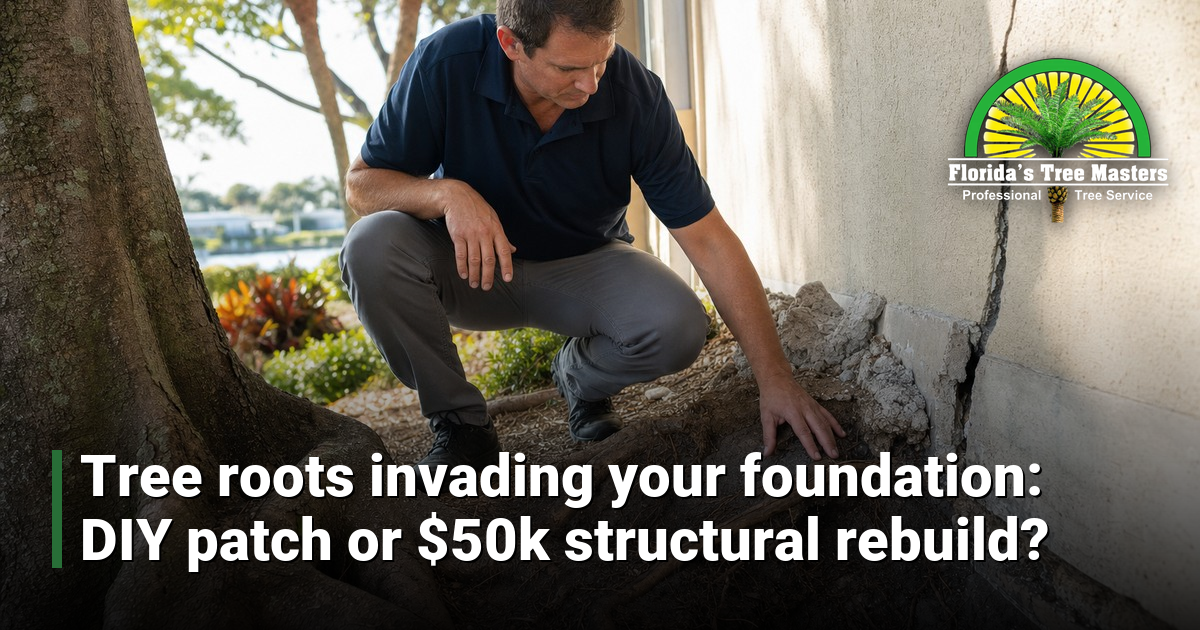
What roots mostly do is this: they absorb water from the soil under and around your foundation. When that moisture gets pulled out unevenly, the soil settles in patches. That uneven settlement is what cracks slabs and shifts walls. The root itself cracking through a concrete foundation is less common than people think, but it does happen with older block foundations and aggressive species.
The short answer: yes, tree roots can damage your foundation. But the mechanism is usually soil disruption and moisture loss, not a root physically bulldozing through concrete.
Signs You May Have a Root Problem
Not every crack means roots. Florida’s soil moves with rain and dry spells on its own. But there are warning signs worth paying attention to.
- Cracks running diagonally from the corners of doorways or windows
- Doors or windows that stick or won’t latch the way they used to
- Uneven floors, especially in a slab home
- Visible surface roots within 10 feet of the foundation
- Raised or cracked concrete around the perimeter of the house
- Gaps appearing between the wall and the ceiling or floor
If you’re seeing two or more of these, it’s worth getting eyes on the tree and the foundation both. We can tell you what the tree looks like. A foundation contractor can tell you what’s happening below grade. Both pieces matter.
What Your Options Are
This is where a lot of homeowners get frustrated because there’s no single answer. What you do depends on how close the tree is, how big it is, what species it is, and how bad the damage already is. Here’s how we walk through it with customers.
Option 1: Remove the Tree
If the tree is within 10 feet of the foundation and it’s a fast-growing, shallow-rooted species, water oak, laurel oak, camphor, removal is usually the right call. These trees don’t get better with age. They get bigger. A 12-inch trunk today becomes a 24-inch trunk in ten years, and the root spread doubles with it.
Our crew handles tree removal start to finish. That means the tree comes down, we chip the brush, haul the logs, and grind the stump. Leaving the stump in place when roots are the problem doesn’t make sense, the roots are still there, still in the soil, still connected to that stump. Our Vermeer stump grinder takes it down well below grade so there’s nothing left to rot and settle.
Option 2: Root Pruning
If the tree has real value, a large live oak providing shade, a tree that’s been there 40 years and is otherwise healthy, you may not want to remove it. Root pruning is a middle option. A trench is cut between the tree and the structure, the invasive roots are severed, and a root barrier gets installed to redirect future growth.
We want to be straight with you on this: root pruning is not a permanent fix. Roots grow back. You’ll likely need to redo it every several years, and it doesn’t repair damage that’s already happened. But for a tree worth keeping, it buys time and slows the problem.
Option 3: Watch and Wait, With a Plan
Sometimes the tree is far enough away that the roots haven’t reached the foundation yet, and the cracks you’re seeing have another cause. In that case, we’ll tell you that. We’re not going to push a removal job on a tree that isn’t causing the problem. But we will tell you which direction those roots are headed and whether to have us come back in a season or two.
What Happens After the Tree Comes Down
Removing the tree stops future root growth. It does not automatically fix the foundation. The soil still needs to restabilize, and existing damage still needs to be addressed by a foundation specialist. We see homeowners assume that once the tree is gone, the cracks will close up. That’s not how it works.
What removing the tree does is stop the problem from getting worse. That matters. Foundation repairs in Florida can run well into the thousands. Stopping the source of the damage is step one. Repairing what’s already happened is step two, and that’s a different contractor.
After we remove the tree and grind the stump, the area will need some time to settle. Don’t pour new concrete right over a fresh stump grind. Give it a season. The ground will shift as the remaining root material breaks down. We’ll let you know what to expect before we leave the job site.
How Much Does Tree Removal Cost Near a Foundation?
Jobs near a structure are always a little more involved. We’re working in a tighter space, which affects how we rig the tree and what equipment we bring. Our bucket truck gives us clean, controlled cuts above the roofline. The Bobcat skid steer helps move wood and debris without tearing up the yard.
For most residential tree removals in Volusia County and the surrounding area, you’re looking at a range of $400 to $2,500 depending on the size of the tree, how close it is to the structure, and whether access is easy or tight. A 15-inch water oak with clear access costs less than a 30-inch oak wedged between a fence and a pool cage. Every tree is different, final price depends on size, location, access, and disposal.
We don’t quote jobs over the phone. We come out, look at it, and give you a number before anything happens. That assessment is free. Call us at (386) 320-3169 and we’ll get someone out to take a look.
Don’t Let This One Sit Too Long
Foundation problems in Florida move fast once they start. The soil here doesn’t behave the way it does up north. We get heavy rain, then dry spells, then heavy rain again. That cycle is hard on any foundation, and a nearby tree makes it worse every season. If you’ve got a large tree within 15 feet of your house and you’re already noticing cracks or shifts, this isn’t something to put off until next year.
Our crew is licensed, insured, and ISA-trained. We’ve handled hundreds of removal jobs near foundations, pools, driveways, and outbuildings across Volusia, Flagler, St. Johns, Duval, Clay, Putnam, Seminole, and Orange counties. We’ll come out, assess the tree, tell you what we think, and give you a straight quote, no pressure, no guesswork. Call (386) 320-3169 to set up your free estimate.