Florida’s Tree Masters gets calls every week from homeowners staring out their window at a tree that doesn’t look right. Maybe it’s leaning toward the roof. Maybe there’s a crack running up the trunk. Maybe the last storm left a big limb hanging at a bad angle. Whatever tipped you off, your instincts are probably right. A dangerous tree near house Florida situations don’t wait, and neither should you.
Table of Contents
ToggleHow to Tell If a Tree Is Dangerous
Not every beat-up tree is a hazard. Florida trees take a beating: sandy soil, salt air, tropical storms from June through November. Most of them handle it fine. But some trees cross a line, and when they do, the risk is real. A cracked trunk can fall without warning. A root plate that’s already lifting is not going to hold in the next storm. Here’s what our crew looks for when we assess a tree next to a structure.
- Trunk cracks or splits. Vertical cracks down the main trunk are serious. So are co-dominant stems, two trunks growing up together, where the union has started to fail.
- A tree leaning toward house. A tree that leaned its whole life is usually fine. A tree that started leaning after a storm or after prolonged rain is a different story. That’s a root system telling you something.
- Root plate lifting. If you can see the roots near the base starting to pull up on one side, the tree is already failing. That’s not a warning sign. That’s an emergency.
- Dead limbs over the structure. A dead tree near house or dead limb doesn’t fall on a schedule. It falls when wind hits it or when it gets heavy enough. If one is hanging over your roof, your car, or a play area, treat it like a loaded spring.
- Rot at the base or in cavities. Fungal growth around the base, shelf mushrooms, bracket fungi, is a flag. It means internal decay. The tree may look fine from ten feet away and be hollow inside.
- Storm damage that wasn’t cleaned up. A broken limb that’s still attached but hanging down, what we call a widow-maker, is one of the most common causes of injury on residential properties in Florida.
If you’re seeing one or more of these, stop watching. Call someone who can assess it properly.
Why Florida Trees Fail Near Houses
Florida soil is different. A lot of it is sandy, which means shallow root systems. When we get a soaking rain followed by high winds, which is basically every summer around here, root plates give out faster than they would in denser soil. We see this constantly with water oaks and laurel oaks, which are common in yards across Volusia County and the surrounding area.
Live oaks are stronger, but even they have limits. Root damage from construction, lawn equipment, or soil compaction can weaken a tree that looks healthy for years before it finally gives. Age and appearance don’t always tell the whole story.
Palms behave differently. They flex in wind rather than breaking, which is why they handle hurricanes better than most people expect. But palm trees that aren’t maintained, boots left on, dead fronds piling up, root rot setting in, can fall too. A leaning palm with soft tissue at the base is not safe near a structure.
Pines are another one we see a lot. Slash pines and longleaf pines are common in yards across Clay, Putnam, and St. Johns counties. They have deep roots but a high center of gravity, and a dead or dying pine near a house needs attention before storm season, not after.
What Happens If You Wait
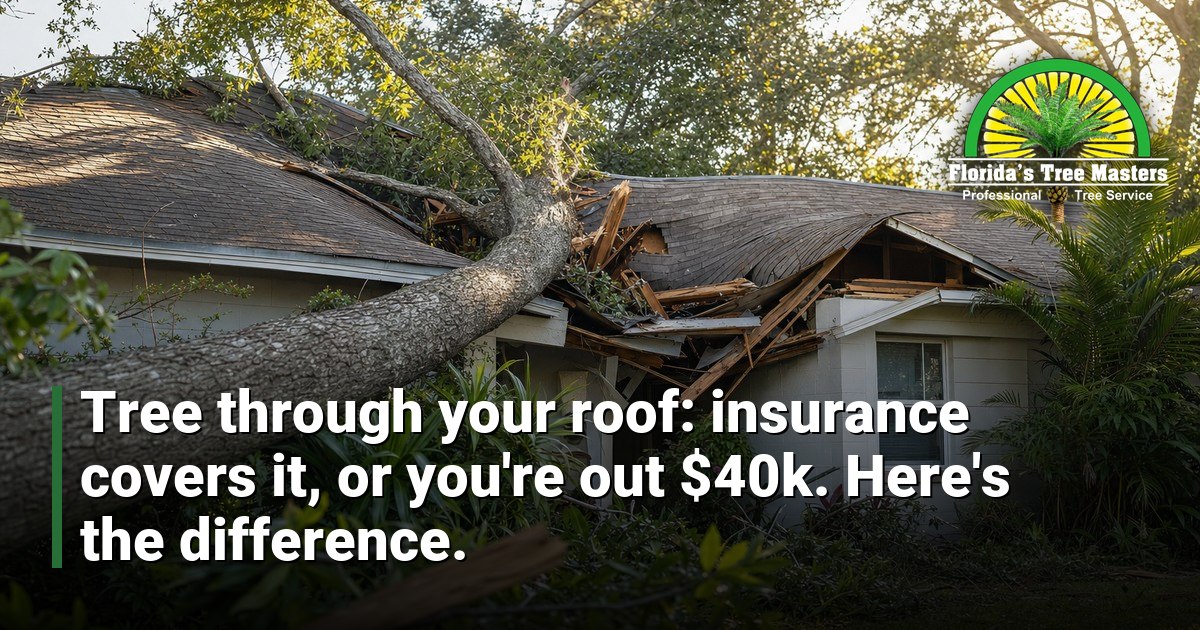
We’re not here to scare you. But we’ve pulled enough trees off rooftops to be direct about this. A tree falling on house Florida isn’t just a bad day. Roofing repairs after a tree strike run well into the thousands. If the tree comes down on a car or a fence, that’s more money. If it hits a person, there’s no price tag.
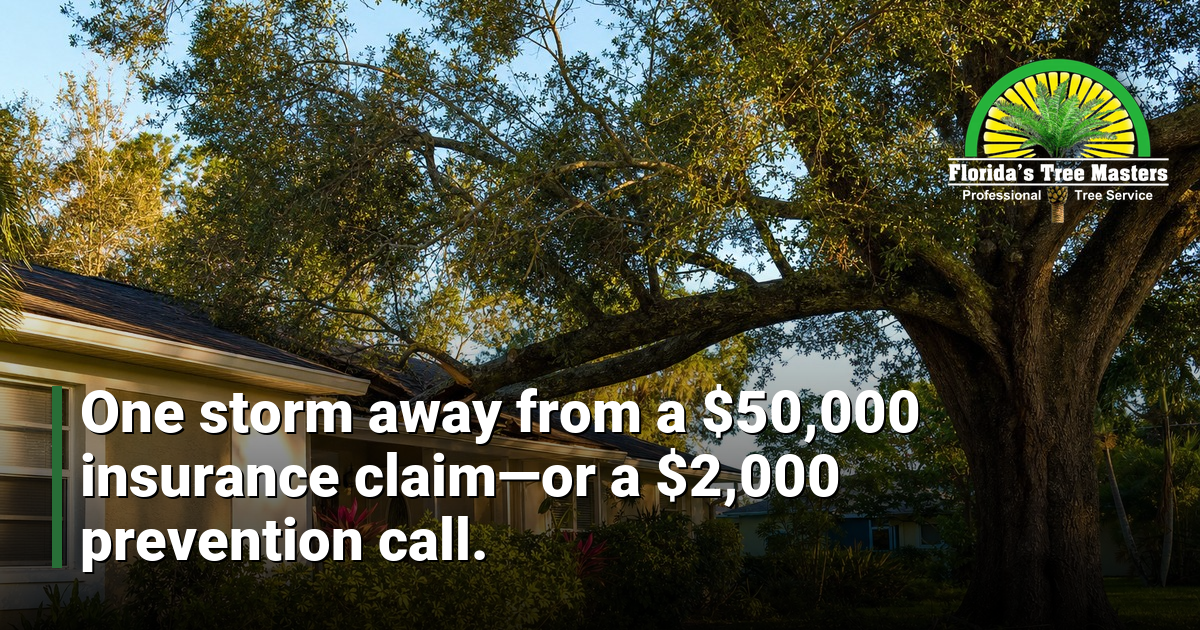
There’s another thing people don’t think about: homeowner’s insurance. If your insurer can show the tree was visibly hazardous before it fell, neighbors noticed it, it was reported, the signs were obvious, you may have a coverage problem. Documenting a hazardous tree and taking action protects you on that front too.
Florida storm season runs June 1 through November 30. If you’re reading this in the spring, you have a window to get a tree assessed and handled before the first real storm rolls through. If you’re already in storm season, the window is shorter. Don’t let the calendar make the decision for you.
What We Do When We Come Out
Our ISA-trained crew will walk the property, look at the tree from the ground, check the base, look for signs of decay, assess the lean, and look at what’s underneath the canopy: your roof, your fence line, your neighbor’s property. We’ll tell you straight what we think.
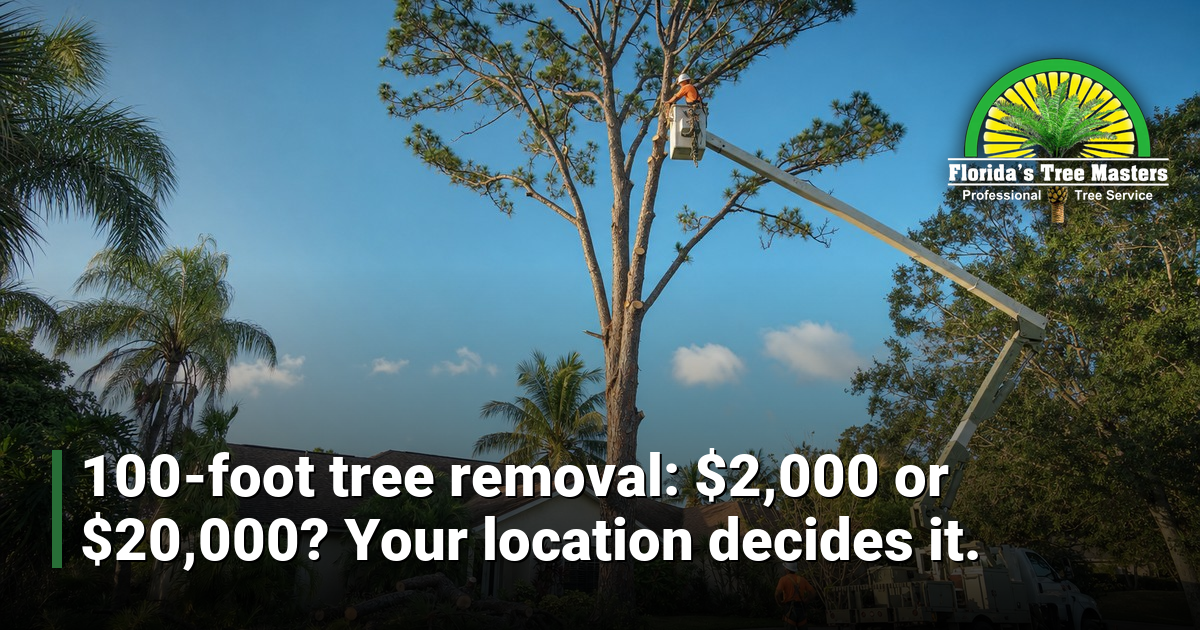
Sometimes the answer is full hazardous tree removal Florida homeowners need. That’s the right call when the tree is too far gone or the risk to the structure is too high. We bring the bucket truck and the Bobcat skid steer if access allows, and the Vermeer stump grinder if you want the stump gone too. We clean up completely. Debris hauled away, yard raked. Our crew doesn’t leave a mess.
When Trimming Solves It
Not every dangerous tree needs to come down. Sometimes the trunk is sound but the canopy is loaded with dead wood, or there’s one large limb extending over the structure that’s doing all the damage. Selective trimming can be the right answer. We’ll tell you honestly which situation you’re in. If trimming is enough, we’ll say so. If it’s not, we’ll say that too.
Emergency Situations
If a limb is on your roof right now, or a tree has already fallen and is leaning against the house, call our emergency line. We run emergency tree removal Florida service 24/7, nights, weekends, holidays. A crew will come out. Don’t try to manage a compromised tree yourself. Don’t go under it, don’t try to prop it, don’t let anyone stand near it until someone who knows what they’re doing has assessed the situation.
Get a Free Quote Before It Becomes an Emergency
The best time to deal with a dangerous tree is before it moves. We come out, look at it, and give you a free quote. No pressure, no hard sell. You’ll know what the job involves, what it costs, and what we recommend.
Tree removal cost in Florida depends on size, location, and how tight the access is. A mid-size tree in an open backyard is a different job from a large oak leaning over a screened-in porch with a fence on three sides. Most residential jobs we handle run somewhere between $400 and $2,500. Large removals near structures can run higher. Every tree is different, and the final price depends on size, location, access, and what you want done with the debris and stump.
We’re licensed, insured, and ISA-trained. We carry full insurance documentation on every job. We’ve been handling tree work across Volusia, Flagler, Seminole, Orange, St. Johns, Duval, Clay, and Putnam counties since 2018, and we’ve seen what happens when a hazardous tree doesn’t get addressed. We’d rather come out and tell you the tree is fine than have you find out the hard way that it wasn’t.
Call us at (386) 320-3169. Day or night. We’ll come out, take a look, and give you a straight answer.