Florida’s Tree Masters gets calls every week from homeowners asking about tractor tree removal, what it costs, when you actually need one, and whether it’s worth it compared to other methods. Fair questions. Let’s cut straight to it.
Table of Contents
ToggleWhat People Mean When They Say “Tractor Tree Removal”
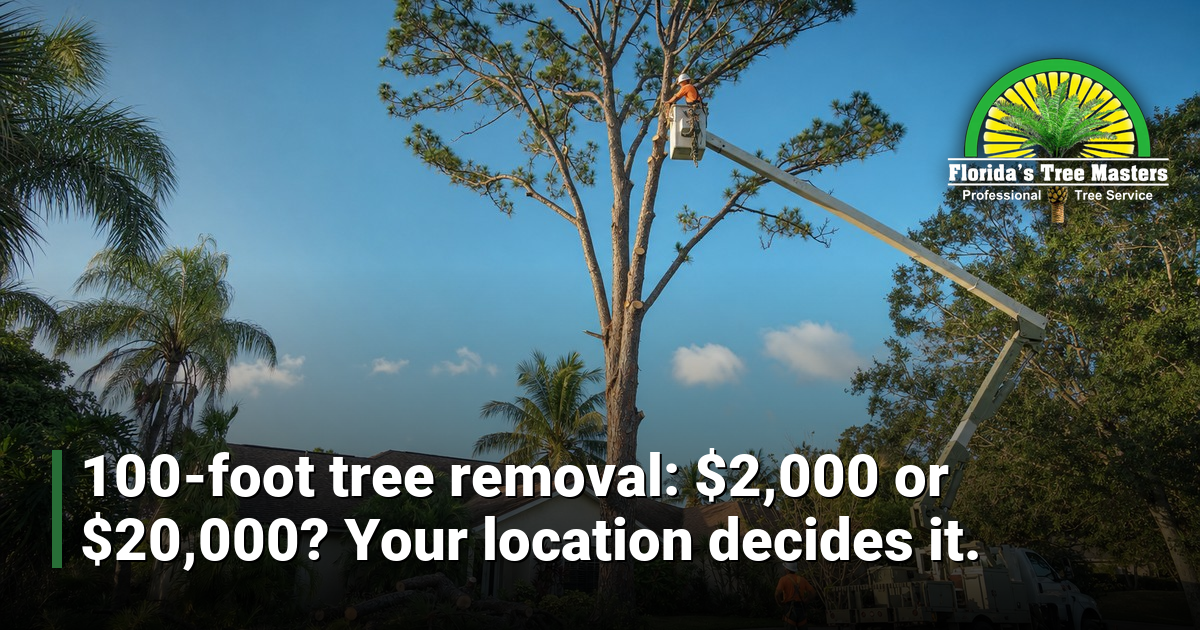
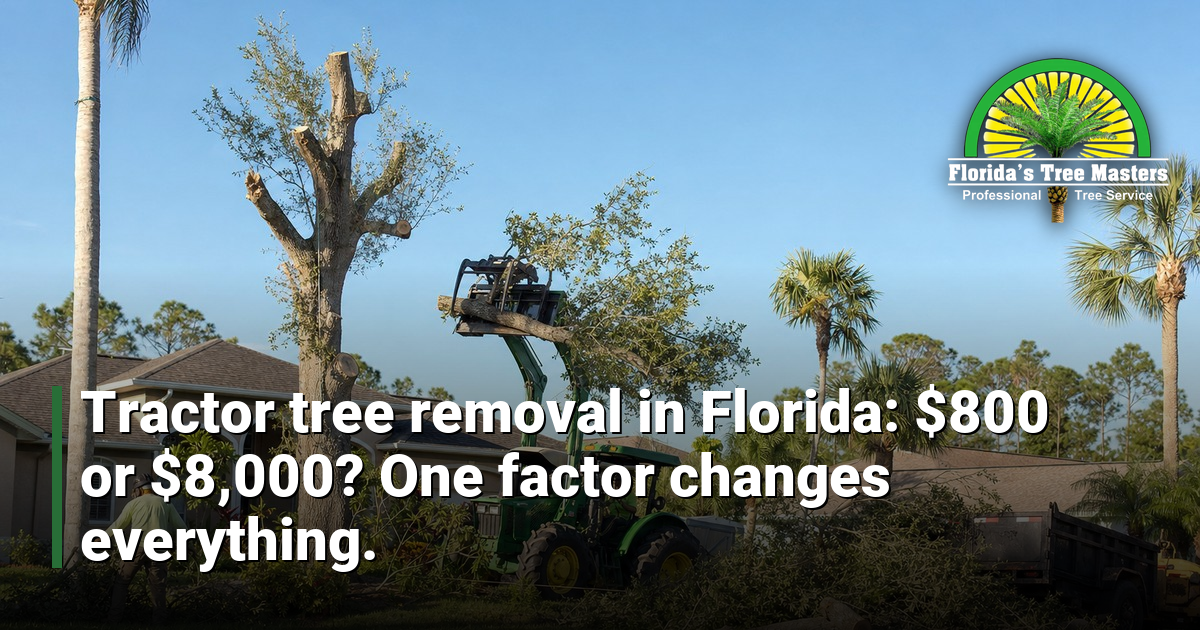
Most folks use “tractor” as a catch-all for any big piece of equipment on a job site. What they’re usually picturing is a skid steer, specifically a Bobcat skid steer, or sometimes a bucket truck. These machines handle the heavy lifting when a tree is too big, too tangled, or in a spot where hand-cutting alone won’t get it done.
We run Bobcat skid steers on jobs where we need to drag out large sections of trunk, clear wide debris fields, or move serious weight across a yard. The bucket truck puts our guys up in the canopy safely when the tree is tall and the drop zone is tight. These aren’t optional upgrades. That’s just how you do the job right when the job calls for it.
A “tractor” in the true farm sense, like a John Deere with a front loader, doesn’t have a place in residential tree removal. It can’t maneuver in a tight backyard, and it tears up a lawn something awful. Bobcat skid steers are built for this kind of work. That’s why we use them.
What Does Tractor Tree Removal Cost in Florida?
Straight answer: most residential tree removal cost florida homeowners run into falls between $400 and $2,500. Jobs that require heavy equipment like a skid steer or a bucket truck usually land toward the higher end of that range, for good reason. You’re paying for trained operators, fuel, equipment transport, and the time it takes to do the job without putting a scratch on your fence or a rut in your yard.
Here’s what pushes the price up or down:
- Tree size. A 15-foot palm and a 60-foot water oak are completely different jobs. The oak may need the bucket truck and the skid steer both on site.
- Location on your property. A tree in an open backyard with wide gate access costs less to remove than one wedged between your house and your neighbor’s fence.
- Access for equipment. If our Bobcat can’t get through your gate, we’re doing more by hand, and that takes longer.
- How many pieces the tree needs to come down in. A hazardous lean or a cracked trunk over a roof means slower, more careful rigging. That’s labor time.
- Debris disposal. We haul everything off. Some outfits quote cheap and leave the logs in your yard. We don’t do that.
- Stump grinding. Usually a separate line item. Our Vermeer stump grinder runs $150-$400 depending on stump size and root spread.
Every tree is different. Final price depends on size, location, access, and disposal. That’s why we always come out and look before we quote anything. The free quote takes about 15 minutes and gives you a real number, not a ballpark pulled from thin air.
When Does a Job Actually Need Heavy Equipment?
Not every tree removal needs a skid steer on site. Some jobs are a chainsaw, a rope, and two guys with good instincts. But there are situations where equipment isn’t optional.
Large Oaks and Water Oaks
Northeast Florida is full of live oaks and water oaks. These trees get massive, and they drop heavy. A mature water oak can have a trunk three feet across and root flare that goes in every direction. Getting that trunk out of your yard in pieces requires something with horsepower. Our Bobcat skid steer handles the dragging and loading so the guys aren’t hand-rolling 400-pound sections across your lawn.
Storm-Damaged Trees
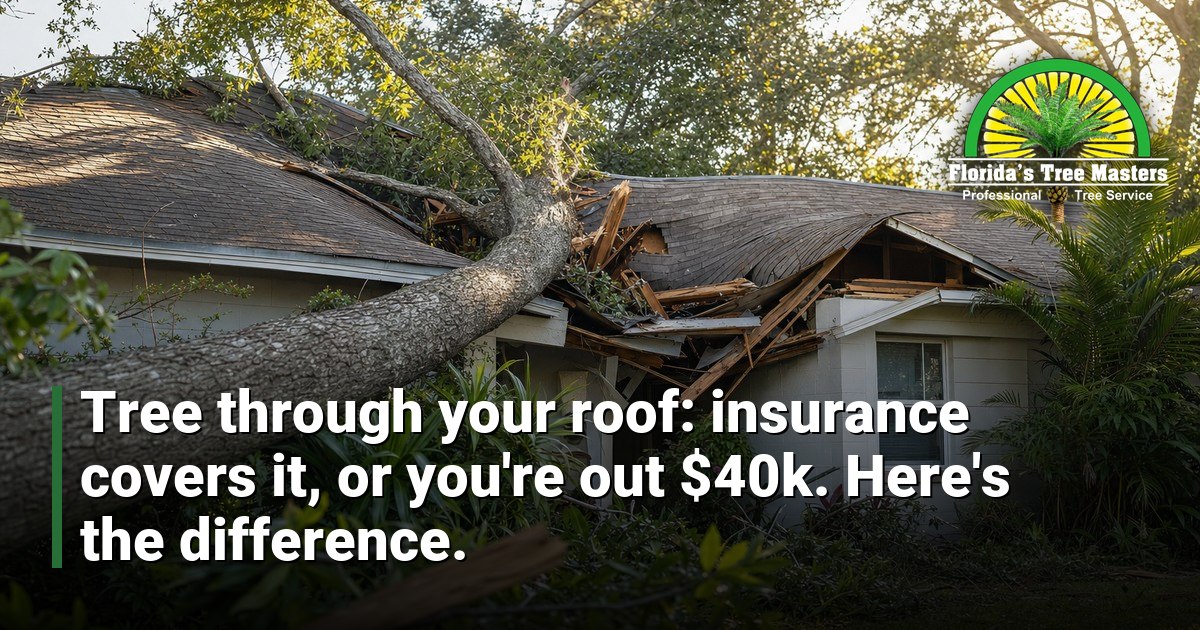
After a tropical storm or hurricane, we see trees that are partially uprooted, leaning hard, or cracked at the base. These are unstable. A cracked trunk can fall without warning. Working around an unstable tree takes equipment that keeps our crew out of the drop zone as much as possible. If you’re in Volusia County or anywhere else in our 8-county area and you’ve got a storm-damaged tree, call us before you try to deal with it yourself. This is not a chainsaw-and-a-friend situation.
Acreage and Land Clearing
If you’ve got more than just one or two trees to take down, maybe you’re clearing a lot in Clay County or opening up a back section of your property in Putnam County, the job almost always involves a skid steer. Moving stumps, pushing brush piles, loading debris into a dump trailer. That’s a full equipment day, and the cost reflects it. Larger clearing jobs can run well above the residential range, sometimes $3,000 to $10,000 or more depending on acreage and tree density.
Florida-Specific Factors That Affect the Price
Tree work in Florida isn’t the same as tree work in Georgia or the Carolinas. Our sandy soil means root systems spread wide and shallow. That’s good for pulling stumps, but it also means trees topple faster in a storm than they would somewhere with clay soil. We’ve pulled over trees in St. Johns County after storms where the root ball came up like a dinner plate. No taproot, just a wide mat of shallow roots that let go all at once.
Palm trees are their own category. Most palms aren’t structurally complex to drop, but they’re dense and heavy, and old palm boots (the base of old fronds left on the trunk) can hide rot. We check every palm before we work on it. A rotted palm trunk can behave unpredictably when you cut it. That’s not us being cautious for the sake of it, it’s just true.
Hurricane season runs June 1 through November 30. If you’ve got a tree that’s borderline right now, leaning, cracked, showing dead limbs, deal with it before a storm, not after. After a named storm, our schedule fills up fast and emergency rates apply. Getting on the books in spring or early summer is just smarter planning.
What You’re Really Paying For
We’re licensed, insured, and ISA-trained. That matters more than most people realize until something goes wrong on a job. If an uninsured crew drops a limb on your roof, you’re the one filing the homeowner’s claim. With us, that’s not your problem. We carry full liability coverage and workers’ comp on every job.
Our crew also cleans up completely. Every trunk section, every branch, every bit of debris goes with us. The tree removal equipment florida contractors rely on is only as good as the crew running it. We use a Vermeer stump grinder for stumps, a Bobcat skid steer for the heavy move-and-load work, and our Ram trucks haul it all off. You don’t come outside the next day and find half a tree stacked against your back fence.
Some outfits quote a low number and leave the mess. Some show up without the right equipment and improvise in ways that put your property at risk. We’ve been doing this since 2018 and we’ve seen what that looks like. Ask any crew for proof of insurance. Ask what they do with the debris. Ask whether a bucket truck is in the quote if the tree is over 30 feet tall.
We’ll answer all of those questions before we ask you to sign a thing. And the quote itself is always free.
Understanding florida tree removal pricing starts with knowing what the job actually involves. Whether it’s skid steer tree removal on a big oak, heavy equipment tree removal florida crews use after a storm, or a straightforward tractor tree removal cost florida estimate on a single palm, the process is the same. We come out, look at the tree, and give you a straight number. We serve Volusia, Flagler, Seminole, Orange, St. Johns, Duval, Clay, and Putnam counties. For tree removal estimates or emergency work, reach us at (386) 320-3169, day or night.