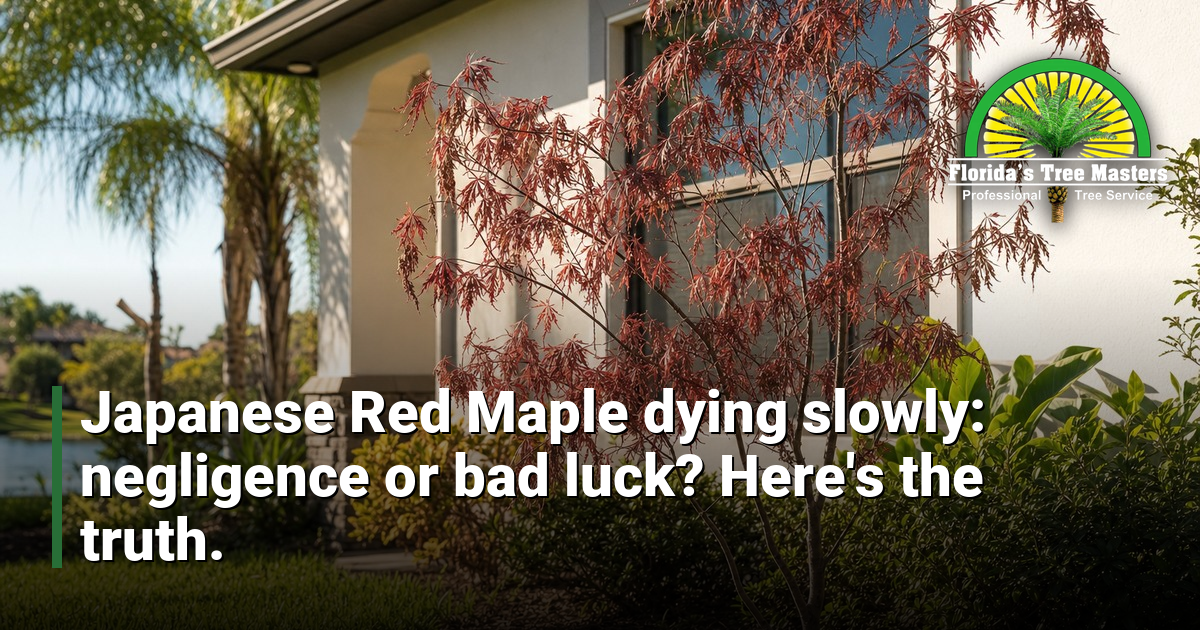
Florida’s Tree Masters gets calls about Japanese Red Maples pretty often. People plant them, love the way they look, and then watch them struggle. Yellowing leaves, dead branches, weird spotting, or just a tree that looks beat-up and tired. Here’s the thing: Japanese Red Maples can grow in northeast Florida, but they’re not native. They need extra attention to stay healthy in our heat, our sandy soil, and our humidity. If your tree is showing signs of trouble, this article walks you through what to look for and what to do about it.
Table of Contents
ToggleWhy Japanese Red Maples Struggle Here
Japanese Red Maples love cool nights and well-draining, slightly acidic soil. Florida gives them the opposite. Daytime heat pushes past 90 degrees most of the summer. The nights stay warm. The humidity sits heavy. And our sandy soil in Volusia, Flagler, and St. Johns counties drains fast, sometimes too fast to hold the moisture these trees want.
That stress shows up in the tree. Leaves may scorch on the edges and turn brown even when the tree is getting watered. The canopy may thin out on the south or west side where afternoon sun hits hardest. Root systems can get shallow and weak because the tree never quite settles in.
None of that means you have to give up on the tree. It means you have to manage it more actively than you would a live oak or a native maple. We’ve looked at a lot of these trees over the years. Most of them have fixable problems, if you catch them early.
Common Japanese Red Maple Problems Florida Homeowners Run Into
Before you call anyone, take a slow walk around the tree. Here’s what to look for.
Leaf Scorch
Brown, crispy edges on the leaves, especially June through September, usually mean the tree is heat-stressed or underwatered. It’s the most common complaint we hear. The tree looks like it’s dying, but often it’s just struggling with our summer. The fix is consistent deep watering, a thick layer of mulch around the base (keep it off the trunk), and afternoon shade if you can manage it.
Fungal Leaf Spots
Small dark spots on the leaves, sometimes with a yellow halo, are usually fungal. Our humidity creates perfect conditions for this. Anthracnose and tar spot are both common in Red Maples here. A licensed arborist can confirm the type and recommend treatment. Raking and removing infected leaves helps slow the spread.
Dead or Dying Branches
If you’re seeing branches that are brown all the way through with no green under the bark, those branches are dead. Dead wood needs to come out. It’s a path for insects and decay to get deeper into the tree. A clean removal cut made just outside the branch collar helps the tree seal the wound and stop the problem from spreading.
Don’t try to guess where to cut on your own if the branch is large or over a structure. That’s where our crew comes in.
Root Problems and Planting Depth
A lot of Japanese Red Maples in Florida were planted too deep. When the root flare is buried, the tree can’t breathe properly. It slowly declines. You’ll notice the trunk goes straight into the ground with no visible flare at the base. That’s a problem. In some cases we can expose the root flare and give the tree a real shot at recovering. In bad cases, the decay is already in the roots and the tree can’t be saved.
Japanese Red Maple Pruning Florida: Timing Matters
Prune at the wrong time and you make things worse.
The best window for japanese red maple pruning florida homeowners can plan around is late winter, January through early March. The tree is dormant, or close to it. Wounds close faster. You can see the branch structure without leaf cover. And you’re not cutting right before a stressful Florida summer.
Avoid heavy pruning in late spring or summer. The tree is already under heat stress. Taking significant live wood off during that window can set it back hard.
Light cleanup, removing dead twigs or crossing branches, can happen any time. Structural pruning and shaping should wait for that late-winter window.
One thing we never do: top a tree. Topping a Japanese Red Maple destroys its natural form, creates large open wounds that rot fast, and sends the tree into a stress spiral it may never recover from. If someone suggests topping your Red Maple, say no. There’s always a better approach.
What Our Crew Does on a Japanese Red Maple Job
When we come out to look at a stressed Japanese Red Maple, we start at the roots and work up. We check the root flare, the trunk for cracks or soft spots, and the overall branch structure. Our ISA-trained guys know what decay looks like, what fungal issues look like, and what heat stress looks like. Those things need different responses.
If the tree needs pruning, we use proper cuts. We clean tools between trees to avoid spreading disease. We don’t leave stubs. The goal is to help the tree seal the wound on its own. That’s how a healthy tree works.
If there’s dead wood over your house or a structure, we’ll tell you plainly. Dead branches on a Japanese Red Maple over a roof are a real risk, especially during a storm. We run storm work all through hurricane season, June through November, and we’ve seen what a dead limb can do to a shingle roof in a fast-moving squall. We’re not trying to scare you. We’re just telling you what we see.
After the work is done, the guys clean up. Branches, chips, everything. We haul it off. Your yard looks like we were never there.
Can the Tree Be Saved, or Does It Need to Come Out?
This is the real question most homeowners are asking when they call us. The answer depends on what we find when we look at the tree in person.
A Japanese Red Maple with leaf scorch and a few dead branches? Usually saveable. Proper pruning, better watering, mulch, maybe a soil amendment. A lot of these trees bounce back with some care.
A japanese red maple dying from a cracked trunk, soft wood at the base, and root decay from years of being planted too deep? That tree is a hazard. A cracked trunk can fail without warning. At that point, the right call is tree removal before it becomes an emergency.
We’ll be straight with you about what we find. We’re not going to tell you to remove a tree that can be saved, and we’re not going to tell you a dangerous tree is fine just to avoid an uncomfortable conversation. That’s not how we work.
Pricing for pruning on a Japanese Red Maple typically runs in the $150-$600 range depending on size, access, and how much dead wood needs to come out. Full removal, if it comes to that, generally runs $400-$1,500. Every tree is different. Final price depends on size, location, access, and disposal. We don’t quote jobs over the phone without seeing the tree. Too many variables.
Get a Free Look from a Local Crew
If your Japanese Red Maple needs help, don’t wait until after a storm makes the decision for you. Scorched leaves, dead branches, soft spots at the base, a canopy thinning out. Any of those signs are worth a call. For red maple tree care northeast florida, we serve Volusia County and seven other counties across the region, and we come out for free quotes with no pressure.
Our crew is based in Port Orange. We’re licensed, insured, and ISA-trained. We’ve handled Japanese Red Maples, live oaks, water oaks, slash pines, sabal palms, all of it, all across our service area since 2018. We know what these trees go through in Florida soil and Florida heat because we live here too.
If you’re searching for japanese red maple help or need tree pruning volusia county, give us a call at (386) 320-3169. We’ll come out, take a look, and give you a straight answer on what the tree needs and what it’s going to cost. No runaround, no upsell, no pressure. Just a real assessment from guys who know trees.