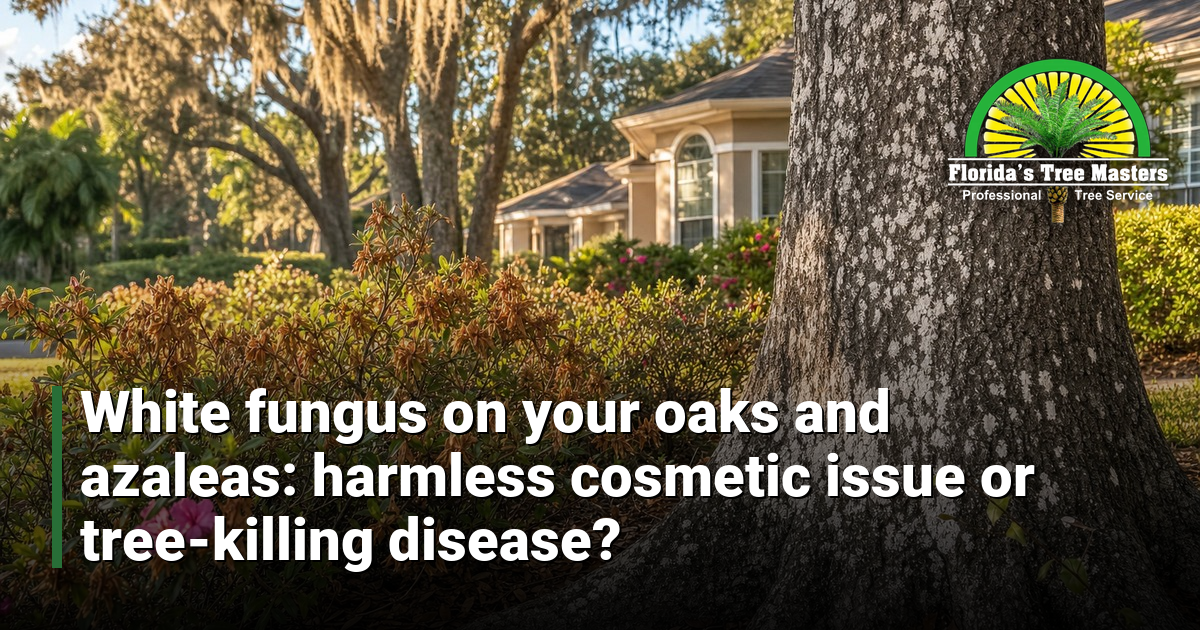
Florida’s Tree Masters gets calls about white fungus every season. Homeowners see a white crust on the bark, a powdery white coating on the leaves, or white threads spreading through the soil around the roots, and they want to know if their oak or azalea is already a lost cause. Sometimes it is. Sometimes it’s not. Either way, you need a straight answer before you decide what to do next.
Table of Contents
ToggleWhat Kind of White Fungus Are You Actually Looking At?
Not all white fungus is the same disease. In northeast Florida we see several types, and they behave differently. Getting this wrong means treating the wrong problem, or doing nothing when you should be acting fast.
Powdery Mildew
This one looks like someone dusted flour on the leaves. It’s a surface fungus. Powdery mildew azaleas florida homeowners grow are especially vulnerable, particularly during spring and fall when cool nights follow warm, humid days. You’ll see white or grayish powder on the tops of the leaves, sometimes the undersides too. New growth tends to go first.
Powdery mildew rarely kills a healthy azalea outright, but it weakens the plant. Repeated infections over a few seasons can do real damage. It spreads through airborne spores, so if one shrub has it, the ones nearby are next.
Armillaria Root Rot (Mushroom Root Rot)
This is the one that kills oaks. Armillaria root rot florida crews like ours deal with is a soil-borne fungus that attacks the roots and the base of the trunk. You may see white or cream-colored fungal mats, flat and sheet-like, under the bark at the root collar. Pull back some loose bark near the base of the tree and look. If you find white or yellowish mycelial fans that smell musty, that’s Armillaria.
Honey-colored mushrooms sometimes cluster around the base of the tree in fall. That’s another sign. By the time you see those, the root system is already compromised. This disease is serious in our sandy Volusia and Flagler soils because stressed trees can’t fight it off. Drought, compacted soil, and past root damage all give Armillaria a foothold.
White Rot and Southern Blight
White rot breaks down the wood inside a trunk or branch. The wood turns white and spongy instead of staying hard. You might not see it from the outside until a branch or the whole tree starts leaning or cracking. Southern blight shows up more on azaleas and other plants at the soil line, with white cottony growth and small tan to brown round bodies mixed in. Both are serious and both spread fast in Florida’s heat and humidity.
Why Oaks and Azaleas in Northeast Florida Get Hit Hard
We’re in the right climate for fungal problems. Hot summers, afternoon thunderstorms, heavy clay in some spots and bone-dry sand in others, it all creates conditions where fungus thrives. Our storm season runs June 1 through November 30, and every year we see trees that took root damage from flooding or wind. Damaged roots can’t keep a tree healthy, and an unhealthy tree is exactly what fungal pathogens want.
Live oaks and water oaks are all over St. Johns, Clay, and Duval counties. They’re tough trees, but they’re not invincible. Oak tree disease florida property owners should watch for closely is Armillaria, because it can move from a dead stump through the soil to an adjacent live tree. If you had a tree removed and didn’t grind the stump, that stump can become a source of ongoing infection.
Azaleas are everywhere in our part of Florida. Most homeowners plant them in mulched beds, and that’s usually fine, but too much mulch piled against the base traps moisture and creates perfect conditions for fungal growth at the crown.
How to Tell If the Tree or Shrub Can Be Saved
Honest answer: it depends on how far the infection has spread and how much of the root system is still intact.
For white fungus on azaleas caused by powdery mildew, most plants can be treated and saved. Remove the most affected growth. Thin the shrub to improve airflow. Avoid overhead watering. Fungicide sprays with sulfur or potassium bicarbonate work if you apply them correctly and consistently. One spray won’t hold it, repeat applications matter.
For azaleas with Southern blight, act fast. Remove infected plants and the soil immediately around the roots. Don’t compost that material. Solarizing the soil in summer can help knock back the fungal bodies in small areas.
For white fungus on oak trees caused by Armillaria, we have to be straight with you. There is no cure. No fungicide available to homeowners or even licensed applicators eliminates Armillaria from the root system. What you can do is improve tree health to slow the disease, proper watering, no soil compaction near the roots, removing dead stumps that could spread the fungus. But if the root collar is heavily infected and the crown is already thinning, the tree is likely declining and it needs to come down before it becomes a hazard.
A tree with compromised roots from root rot can fail with no warning. A cracked trunk or a sudden lean after a wet spell is not something to wait on. We’ve seen healthy-looking oaks drop in light wind because the root system was gone underneath.
What Our Crew Looks For On a Site Visit
When we come out, here’s what we’re checking. Bark color and texture at the base. Any lifting or cracking at the root flare. Crown density, are there dead branches above? Is the leaf canopy sparse compared to neighboring trees of the same species? We’ll also look at the soil condition and what’s growing around the base.
For an azalea bed, we’re looking at the root crown, checking for white mycelial growth or signs of crown rot, and asking about your watering and mulching habits. A lot of the azalea problems we see in Orange and Seminole counties come down to mulch piled too deep or irrigation hitting the base of the plant night after night.
If the tree needs to come down, we’ll tell you why. We’ll explain the risk in plain terms, give you a quote, and let you decide. We use a bucket truck for large oak removal and our Bobcat skid steer for moving debris and sections of trunk. Stump grinding with our Vermeer stump grinder is the most important step after removal when Armillaria is in the soil. Leaving a stump means leaving a fungal reservoir.
If the tree is treatable and the risk is manageable, we’ll say that too. Our ISA-trained crew doesn’t push for removal when it isn’t needed. But we won’t tell you a dying oak is fine just to avoid a hard conversation.
Next Steps and How to Get a Free Quote
If you’re seeing white fungus on an oak or azalea, start by taking a few photos. Get a close-up of the growth on the bark or leaves, and a wider shot of the whole tree or plant. That helps us know what we’re walking into before we arrive.
Then call us or reach out to schedule a free on-site look. We serve Volusia County and all of our 8-county area, Volusia, Flagler, Seminole, Orange, St. Johns, Duval, Clay, and Putnam. We’ll come out, assess what you’ve got, and give you a straight answer about whether tree fungus treatment northeast florida homeowners need means spraying, pruning, or a full removal.
Tree removal costs vary depending on size, access, and how much root and trunk work is involved. For most residential oaks in a standard yard, you’re looking somewhere in the $600 to $2,500 range. Larger trees with difficult access can run higher. Every tree is different, and we won’t quote you a number until we’ve seen it in person. Cleanup is included. We don’t leave the job until the debris is gone.
Call us at (386) 320-3169. We answer day and night, weekends included. If a limb is cracked over your roof right now, that’s an emergency call, don’t wait. If it’s a slower situation with spreading fungus, we’ll schedule a look and get you a free quote with no pressure.
If you’ve been searching ‘White Fungus Identification/Treatment? – Killing Oaks and Azaleas’ and landed here, you’re in the right place. White fungus on your trees isn’t a death sentence. But it’s not something to ignore either. The sooner you know what you’re dealing with, the more options you have.