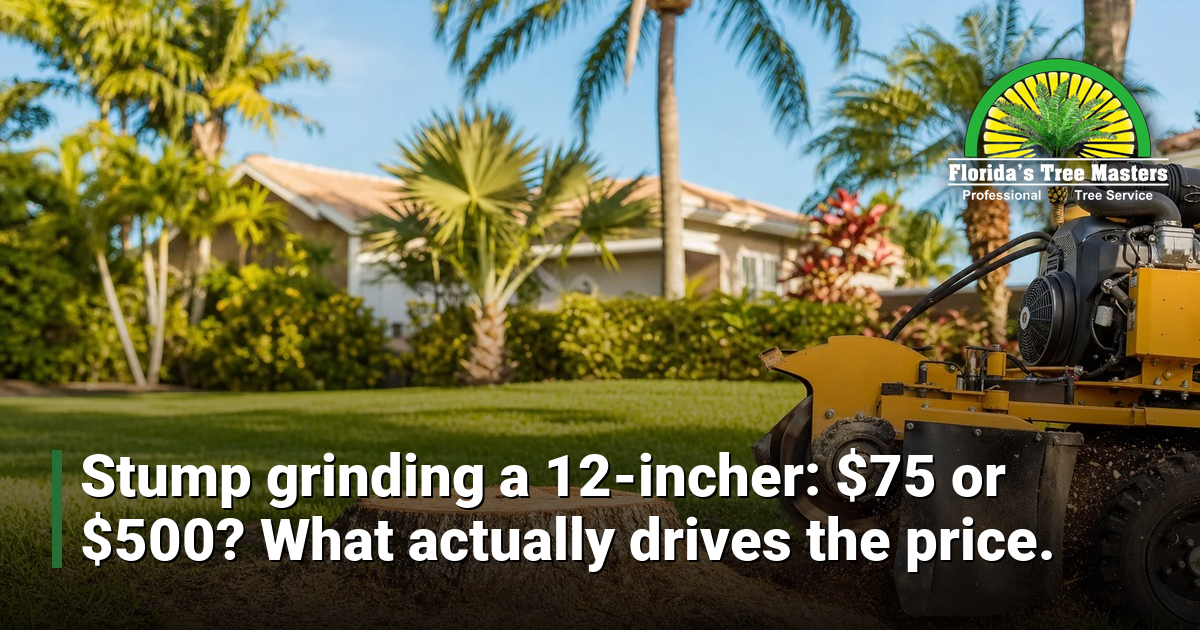
Florida’s Tree Masters gets this question a lot. someone just had a tree cut down, and now there’s a stump sitting in the yard with grass growing around it. They want to know what it costs to make it disappear. Fair question. The short answer for a 12-inch stump is somewhere in the $100 to $300 range, but that number moves depending on a few things we’ll walk through below.
Table of Contents
ToggleWhy Stump Size Isn’t the Only Thing That Drives the Price
The 12-inch measurement usually refers to the diameter of the stump at ground level. That’s a useful number, but it’s only part of the picture. Our crew looks at a handful of other things before we lock in a quote.
- Species. A 12-inch water oak stump grinds differently than a 12-inch palm. Oaks have dense, hard root systems that push our Vermeer stump grinder harder and take longer. Palm stumps are fibrous and tend to go faster.
- Root spread. Some stumps look small up top but the roots run wide and deep. If you want those surface roots ground down too, that adds time and adds to the cost.
- Access. Can our equipment get back there? A stump in an open front yard is straightforward. A stump wedged behind a fence, up against a structure, or on a slope takes more setup time.
- How many stumps. If you’ve got three or four stumps from the same job or from cleaning up after a storm, we can usually work out a better per-stump rate than grinding them one at a time on separate trips.
- Debris and cleanup. Grinding leaves behind a pile of chips and loose debris. We always clean up after ourselves. rake it out, haul what you don’t want, or leave the chips if you want mulch. Either way, cleanup is part of the job.
Every tree is different. Final price depends on size, location, access, and disposal. That’s why we offer free quotes. we come out, look at it, and give you a real number before anyone fires up a machine.
What Stump Grinding Actually Does (and Doesn’t Do)
There’s some confusion about what you’re getting when you book a stump grind. Worth clearing up before you schedule.
Grinding takes the stump down below the soil surface. typically 6 to 12 inches deep, sometimes more depending on what you’re doing with the space afterward. You’re left with a ground-down hole and a pile of wood chips. The main root system is still underground. It’s not removal in the sense that every bit of wood is gone. But the stump is gone, the trip hazard is gone, and in most cases the roots left behind will just rot over a few years without causing problems.
If you’re planning to pour a concrete pad, build a structure, or plant a new tree in exactly that spot, tell us upfront. We can grind deeper, or talk through whether full stump and root removal makes more sense for your project. That’s a different scope of work with a different price, but it’s worth knowing your options.
Do the Roots Grow Back?
For most trees, no. Once the stump is ground down, the tree is done. It can’t push new growth without a root collar to feed it. There are a handful of species that will send up suckers from the lateral roots. chinaberry and some invasive species do this. If you’ve got something like that, we’ll flag it when we look at the job. For your standard live oak, laurel oak, water oak, or pine, stump grinding ends it.
Stump Grinding in Northeast Florida: What Makes It Different Here
We’re based in Port Orange and we work across Volusia County and the surrounding counties. Flagler, Seminole, Orange, St. Johns, Duval, Clay, and Putnam. Florida soil and Florida tree species throw a few curveballs that guys from out of state don’t always know to watch for.
Sandy soil is common in our area. That sounds like it’d make grinding easier, and sometimes it does. But sandy soil also lets roots travel far from the trunk, which means a stump that looks contained can have roots running 10 or 15 feet out. On the flip side, areas with more clay. parts of Clay County and inland St. Johns, for example. can make equipment access trickier after heavy rain.
Live oaks are the big one around here. We grind a lot of live oak stumps. They’re heavy, the wood is dense, and the lateral root structure is serious. A 12-inch live oak stump near the high end of the price range is common. That said, we’ve handled hundreds of them. Our Vermeer stump grinder is built for this kind of work and our operators know how to run it efficiently without tearing up the surrounding lawn.
Storm season runs June through November. After a named storm, we see a surge in stump grind requests because trees that came down during the storm were cut flush and left. If you’ve got leftover stumps from hurricane cleanup, don’t let them sit for years. They attract pests, create tripping hazards, and take up space in your yard that you could actually use. We can knock out a batch of post-storm stumps in one trip.
Stump Grinding vs. Stump Removal: Which One Do You Need?
These terms get used interchangeably but they mean different things. It matters when you’re getting quotes.
Stump grinding uses a rotating carbide-tipped wheel to chip the stump down below grade. It’s faster, less invasive, and works for most residential situations. The roots stay in the ground and break down on their own.
Stump removal. sometimes called full extraction. means pulling the whole root ball out of the ground. It requires heavier equipment, leaves a bigger hole, and costs more. You’d want this if you’re grading the lot, doing significant landscaping, or building something directly over the old tree’s footprint.
For a standard 12-inch stump in a residential yard, grinding is almost always the right call. It handles the problem, the price is reasonable, and your yard looks clean when we’re done. If you’re not sure which one your project needs, just ask us when we come out. We’ll give you a straight answer.
How to Get a Real Quote on Your Stump
We don’t quote stumps over the phone by diameter alone. Too many other factors come into play. What we will do is come out, look at the stump, check the access, and give you a firm number before any work starts. No pressure, no fee for the estimate.
Here’s what to have ready when you call:
- Rough location of the stump on your property (front yard, back, near a fence or structure)
- What kind of tree it was, if you know
- Whether you have gate access for equipment
- How many stumps total. we’ll look at all of them while we’re there
For most single stumps in the 12-inch range, you’re looking at $100 to $300. Larger stumps, tighter access, or harder species push that number up. Multiple stumps at once can bring the per-stump cost down. Every job is priced after we see it. that’s the only honest way to do it.
We’re licensed, insured, and our operators are ISA-trained. When the job is done, the stump is gone, the chips are raked out, and the yard looks like the tree was never there. That’s what you’re paying for.
If you’ve got a stump in Volusia County or any of our other seven service counties, give us a call. We’ll come out, take a look, and get you a free quote. Reach us at (386) 320-3169. we answer during the day, after hours, and on weekends.