Florida’s Tree Masters gets this question a lot, usually from a homeowner standing in the yard staring at a pine or oak that stopped putting out leaves two seasons ago. The short answer is: sometimes yes, sometimes no. Dead tree removal can cost more than taking down a live tree, but it can also cost less. It depends on a handful of things our crew looks at before we ever start a saw. Here’s what actually drives the price.
Table of Contents
ToggleWhy Dead Trees Can Cost More to Remove
The biggest factor is wood condition. A dead tree that’s been standing for a year or two in Florida’s heat and humidity doesn’t just dry out, it starts to rot. Fast. Our sandy soil, the afternoon rains, the palmetto bugs working through the heartwood, all of it breaks the wood down faster here than up north.
Rotten wood is unpredictable. When our guys make a cut and the wood doesn’t respond the way sound timber does, the whole job slows down. They have to reposition. Add rigging. Use the bucket truck at angles they wouldn’t need on a healthy tree. That extra time and equipment adds to the price.
There’s also a safety issue worth naming plainly. A dead tree with a compromised trunk can shift or drop a limb without warning. Our ISA-trained crew knows how to read the signs, cracks running up the bark, fungal growth at the base, hollow spots you can hear when you tap the trunk. But working safely around that kind of instability takes more care, and more care takes more time.
Bark slippage is another thing. On a severely dead tree, the bark can slide right off when you run a line or try to set a rigging point. That changes how we climb and how we secure sections before we cut them. Again, slower, more involved, sometimes pricier.
Why Dead Trees Can Sometimes Cost Less
Not every dead tree is a rotten mess. A tree that died recently, say, in the last few months, may still have solid wood. In some cases it’s actually easier to work with than a live tree full of flexible, springy branches that want to kick back.
Dead trees also don’t have leaves. No leaves means less debris. Less debris means faster cleanup. If the canopy has already dropped on its own and the trunk is still sound, our crew can move through a job like that efficiently. Faster job, lower final cost.
Location matters more than whether the tree is alive or dead, honestly. A dead 40-foot water oak sitting 10 feet from your house in a tight St. Johns County backyard is a harder job than a dead 50-foot pine in an open Putnam County field with good truck access. We’ll always walk the site before quoting anything.
What We Look at When We Quote a Dead Tree
When we come out for a free quote, here’s what our crew is actually looking at, not just whether the tree is dead or alive.
- Height and trunk diameter. Bigger tree, more work, more haul-away. Simple.
- Wood condition. Is the wood still solid or has decay started? We’ll check the base, the crotches, and any visible wounds.
- Proximity to the house, fence, or utility lines. A dead tree leaning toward your roof is a different job than one leaning into open yard.
- Access for equipment. Can we get the bucket truck close? Is there room to run the Bobcat skid steer for debris? Tight access adds labor.
- Stump situation. Do you want the stump ground out too? We run a Vermeer stump grinder for that and it’s a separate line item, but we can bundle it.
- Number of trees. If you’ve got three dead pines and an oak all going at once, we can usually work a better rate than four separate trips.
Every tree is different. Final price depends on size, location, access, and disposal. That’s not a dodge, that’s just the reality of tree work. Two dead oaks in Volusia County can be completely different jobs.
Don’t Wait Too Long on a Dead Tree
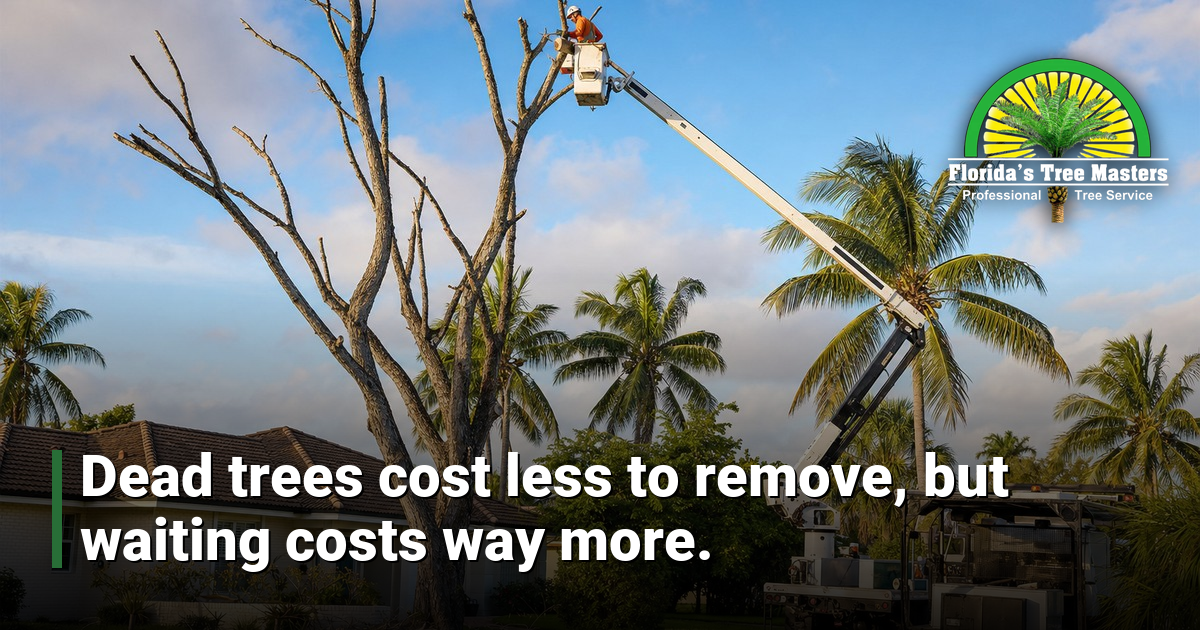
Here’s the part most people don’t think about until it’s too late. A dead tree doesn’t stay standing forever. Florida storm season runs June 1 through November 30, and a dead tree is the first thing to fail when a tropical system comes through. The roots that held it upright are dying too. The wood that kept it rigid is softening.
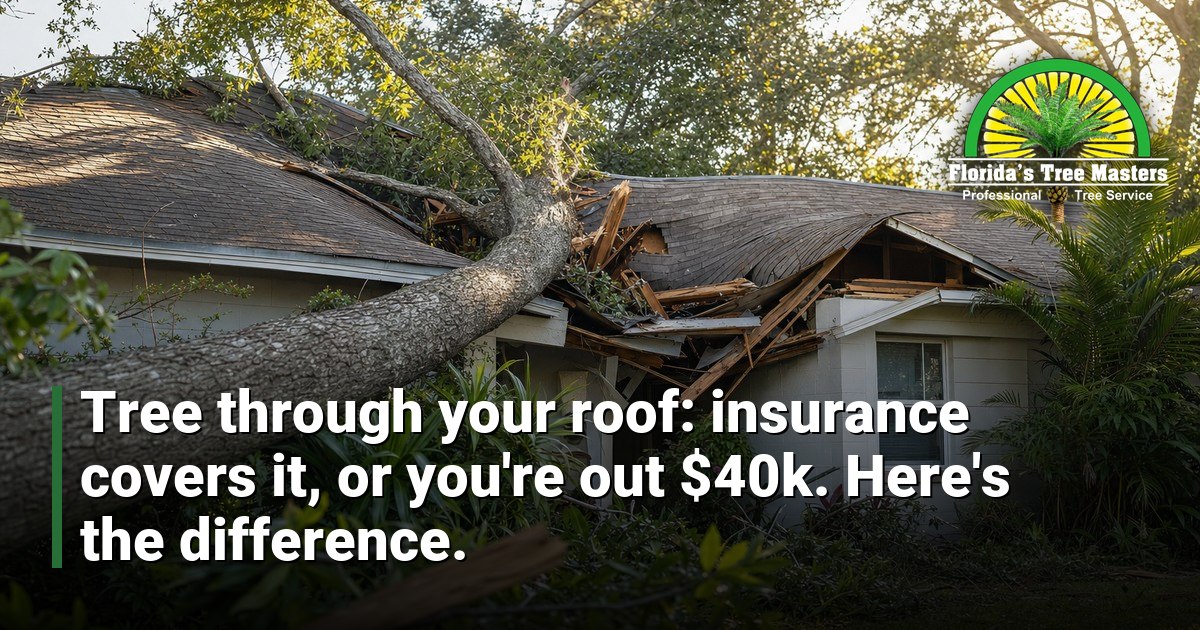
We’ve seen plenty of trees that homeowners figured they’d deal with “next year.” Then a squall line came through in September and the tree came down on a fence, a car, or worse, a roof. At that point you’re not just paying for tree removal, you’re also dealing with insurance claims and repair contractors.
If a dead tree is within falling distance of your house, your neighbor’s house, a vehicle, or a power line, don’t treat it as a low-priority item. That’s not us manufacturing urgency. That’s just the physics of a heavy dead tree in hurricane country.
We run a 24/7 emergency line for exactly this reason. If a dead tree comes down on your property in the middle of the night, call us. Day, night, weekend, holiday, we answer.
What Dead Tree Removal Typically Costs in Northeast Florida
We won’t give you a number that means nothing without seeing the tree. But here’s a realistic range based on jobs we handle across our eight-county area.
Most dead tree removals in Volusia, Flagler, Clay, Duval, St. Johns, Seminole, Orange, and Putnam counties run somewhere between $300 and $1,800 depending on size, condition, and access. A small dead crape myrtle in an open yard? Low end. A dead 60-foot water oak leaning toward a house in a fenced backyard with no gate wide enough for the Bobcat? High end. Stump grinding adds to both.
We’re licensed, insured, and ISA-trained. Our quote includes full cleanup, we haul the wood and debris off your property. You won’t be left with a pile of logs on the lawn.
Some homeowners go with cheaper options and end up with exactly that, a pile of logs, a half-ground stump, and a company that’s suddenly hard to reach. We’re not in that business. We do the whole job.
If you want to know what your specific dead tree will cost, the only way to get a real number is to have someone look at it. We’ll come out, walk the property with you, and give you a straight quote at no charge. No pressure, no surprise fees when the job starts.
For Volusia County and all of our service area, call 386-320-3169 to set up your free quote. We’ll take a look and tell you exactly what you’re dealing with.