Florida’s Tree Masters gets calls like this every storm season. A tree comes down in the middle of the night, lands on the roof, and the homeowner is standing in the living room not sure what to do next. If you’re searching for what to do if a tree falls on your house during a storm, you’re in the right place. Here’s the short version: get everyone out of the affected area, call your insurance company, then call us. The rest of this article walks through each step so nothing gets missed.
Table of Contents
ToggleStep One: Get Safe First
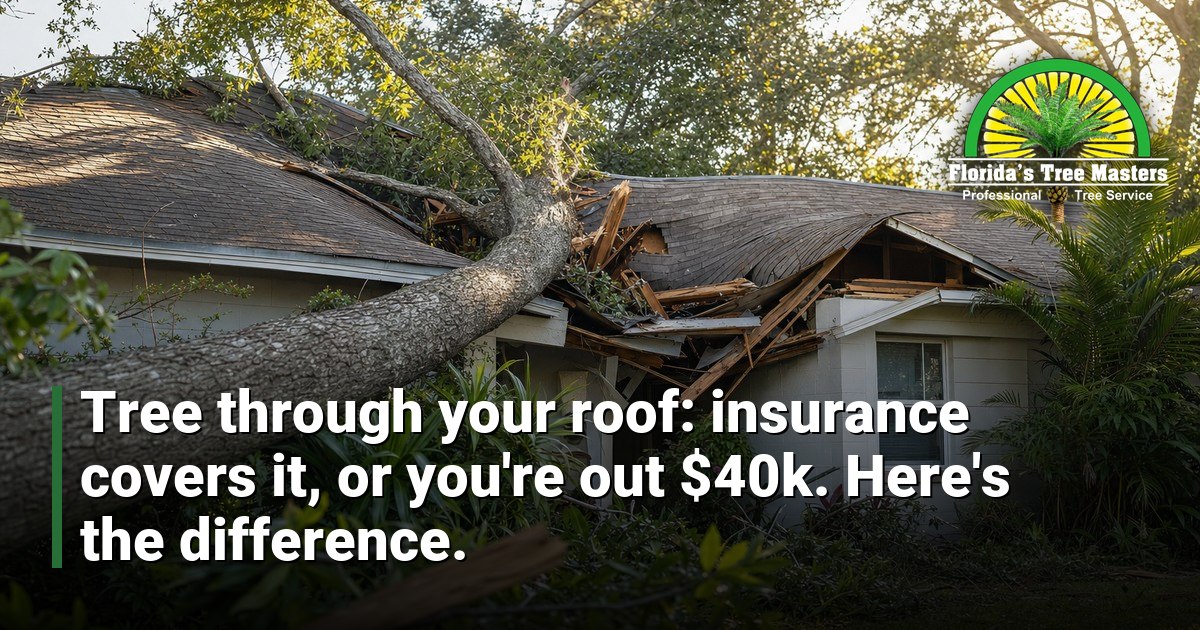
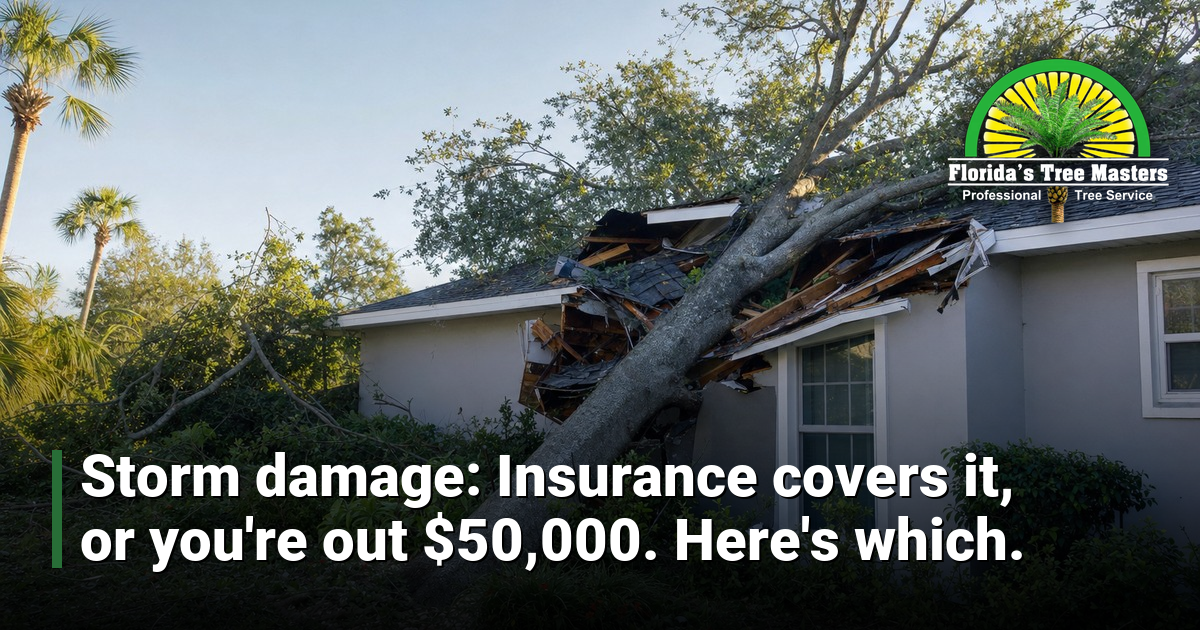
Before you do anything else, move your family away from the part of the house where the tree hit. Don’t go up into the attic to check the damage. Don’t stand under a sagging ceiling. A tree on a roof puts stress on the entire structure, beams, walls, everything. What looks stable might not be.
If the tree took out a wall or the roof is visibly compromised, get out of the house entirely. Take your pets. Grab your medications and important documents if you can do it in under two minutes. Then stay out until a professional tells you it’s safe to go back in.
Watch for downed power lines too. If a line is on the tree or near it, stay at least 30 feet away and call your utility company before anyone touches anything. Electricity and wet wood after a storm are a bad combination. Don’t eyeball it and guess.
Step Two: Call Your Insurance Company
Do this fast. Most homeowners policies cover emergency tree removal when the tree has caused structural damage. Some cover partial removal, meaning enough to get the tree off the house, but not full removal and stump grinding. Read your policy or just call them and ask directly.
Before the adjuster comes out, document everything. When a tree on roof storm damage is involved, photos and video are your best protection. Shoot the damaged area and anything inside that got wet or hit before anyone moves anything. Insurance adjusters need to see the storm tree damage as it happened, not after a cleanup crew rearranged it.
If your policy has emergency provisions, your insurer may want to send their own contractor. You have the right to hire your own licensed tree service as long as you document the damage first. Know your policy. Ask questions. And don’t sign anything from a cleanup crew that showed up uninvited on your street after the storm.
Step Three: Cover the Opening, But Don’t Go on the Roof
If rain is still coming in, you need to protect the interior from further water damage. Call a roofing company or general contractor who does emergency tarping. Tarping is different from tree removal. Don’t wait on the tarp until the tree is gone. In some cases, we can help coordinate with a roofer, but tarping is not our work.
Don’t climb up there yourself. The roof is wet, the tree shifted the structure, and footing is unpredictable. We’ve seen people get hurt trying to assess damage that our crew handles with proper equipment. Leave the roof to professionals.
Step Four: Call a Licensed Tree Service, Fast
Once safety is handled and insurance is on the line, it’s time to get the tree off the house. This is where we come in. Our crew runs emergency calls day and night, including weekends and holidays. A tree sitting on a damaged roof gets heavier every hour it rains, and the longer it sits, the more structural damage builds underneath.
When we show up, here’s what the process looks like:
- We assess the tree and the damage before we touch anything.
- We document our work for your insurance file if needed.
- We remove the tree in sections to avoid adding more force to the roof.
- We use our bucket truck or rigging equipment to control how each piece comes down.
- We clear the debris from your yard and driveway.
This is not a job for a guy with a chainsaw and a pickup. Removing a tree off a structure requires controlled cuts, rigging lines, and experience reading how the weight is distributed. One wrong cut and a section drops straight through the roof instead of off to the side. We’ve handled emergency tree removal Florida homeowners have needed all across Volusia, Flagler, Duval, and St. Johns counties, and we take these jobs seriously.
If you need tree removal after storm damage, call us at (386) 320-3169. We answer around the clock.
What Not to Do After a Tree Hits Your House
A few things we see homeowners do that make the situation worse:
- Trying to cut the tree themselves. A tree pinned under tension can kick a chainsaw bar back hard or spring when a cut releases the load. Leave it alone.
- Hiring the first person who knocks on your door. After any big storm in northeast Florida, unlicensed crews roll through neighborhoods offering cheap cleanup. Ask for their license number and proof of insurance before anyone picks up a saw on your property. If something goes wrong and they’re not covered, it comes back on you.
- Waiting too long to call insurance. Most policies have a reporting window. Don’t assume you have weeks.
- Removing the tree before documenting damage. Insurance adjusters need to see what happened. Photograph everything before work begins.
- Ignoring smaller damage. A limb through a window or a branch on the roof that looks minor can hide rot, cracked rafters, or water intrusion. Get it checked.
How Much Does Emergency Tree Removal Cost?
That’s always one of the first questions we get after a storm, and it’s a fair one. Emergency tree removal off a structure typically runs between $800 and $3,500 depending on the size of the tree, where it landed, how much of the roof it’s touching, and how difficult access is. A big water oak through the center of a hip roof costs more than a pine that clipped a corner of the garage. Every tree is different.
What’s included in our price: cutting, rigging, removal, and hauling debris. We don’t leave logs stacked in your yard and call it done. If you want stump grinding after the job, we can quote that separately. Check with your insurance carrier. Some or all of the removal cost may be covered.
We won’t quote you an exact number until we see the tree. That’s not a runaround, it’s just honest. Call us and we’ll come out, look at it, and give you a real number. No pressure, no surprise fees. Reach us at (386) 320-3169 any time.
After the Tree Is Gone: What Comes Next
Once the tree is removed and the roof is tarped, you’re in repair mode. Get a roofing contractor out to assess structural damage. Get an interior inspection if any ceiling or wall got wet. Water moves fast inside a house, and mold follows moisture in Florida’s heat.
Also think about what caused the tree to fall. Was it a rotted trunk? A shallow root system in our sandy northeast Florida soil? A tree that was too close to the house to begin with? If you’ve got other trees that are leaning, showing dead branches at the top, or have bark that’s soft and spongy near the base, those need a look before the next storm. Storm season runs June 1 through November 30. What came down last night wasn’t necessarily the only tree you had to worry about.
Our crew does Volusia County and the surrounding area year-round. We can come back out after the emergency work is done, walk your property with you, point out anything that looks like a risk, and quote trimming or removal before the next system rolls through. That conversation is free. The call is free. The quote is free.
If a tree fell on my house is the search that brought you here, or you’ve got a tree leaning toward the roofline and you’d rather not wait for the next storm to settle it, call Florida’s Tree Masters right now at (386) 320-3169. We’re the emergency tree service northeast Florida homeowners have counted on for years. Licensed, insured, and ISA-trained. Our crew will come out, take a look, and tell you straight what needs to happen. And when a tree falls on house, fast response is what limits the damage. Call us any time.