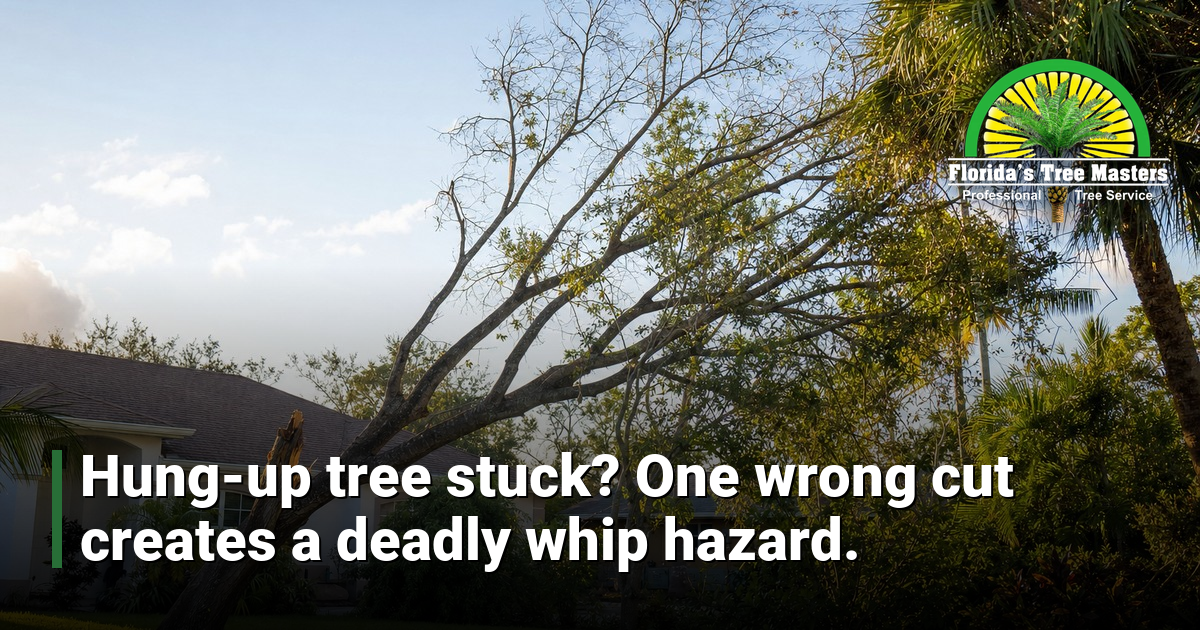
Florida’s Tree Masters gets calls about hung trees more than most people would expect. A tree comes down in a storm, or someone’s cutting a pine in the backyard, and the top catches in the branches of a neighboring tree. Now you’ve got a loaded, unstable log suspended in the air and a saw in your hand. That’s one of the most dangerous situations in tree work. We’re going to walk through what’s safe, what isn’t, and when to put the saw down and call a crew.
Table of Contents
ToggleWhat Makes a Hung Tree So Dangerous
A hung tree, sometimes called a widow maker, isn’t just sitting there. It’s under tension. The trunk and limbs are storing energy, and that energy releases the second you cut the wrong place. A log can kick back toward you faster than you can step away. It can roll, drop straight down, or swing like a pendulum depending on how it’s lodged. We’ve seen guys take serious hits from wood moving in directions nobody expected.
The other problem is the supporting tree. Its branches are bent and loaded too. Cut the hung tree free and those branches snap back hard. If you’re standing anywhere near that zone, you’re in the path of a spring-loaded limb.
Hung trees cause a disproportionate number of chainsaw fatalities in this country. A wrong cut on a hung tree doesn’t give you a second chance to correct it. Go in with your eyes open.
When You Should Not Attempt This Yourself
Not every hung tree is a DIY job. Widow maker tree safety starts with knowing when to walk away. Here’s when to step back and make a phone call:
- The hung tree is over a structure. A house, shed, fence, or vehicle underneath changes everything. If it drops wrong, the damage compounds fast.
- You can’t tell where it will fall. If there’s no clear escape route that’s clear for real, not just clear in your head, don’t cut.
- The hung tree is large diameter. A small-diameter pine leaning into a scrub oak is different from a 16-inch water oak caught 30 feet up in a live oak. The bigger the wood, the more stored energy, the less predictable the movement.
- You don’t have a second person on site. Never work alone on a hung tree. If something goes wrong, you need someone who can call for help or pull you clear.
- There’s been storm damage to the supporting tree. After a hurricane or tropical storm, the tree holding the hung log may have its own compromised branches. You can trigger a cascade. Our crew always checks the holding tree first before we do anything else.
If any of those boxes are checked, the saw stays off. That’s not being overly cautious. That’s being around for the next job.
What Professionals Do to Get a Hung Tree Down Safely
People search “how to get a hung tree down” and find a lot of bad advice. Here’s how it works when a trained crew handles it. When we show up, we don’t just start cutting. The first thing we do is read the tree. Where is it lodged? What’s the angle? What’s the tension? Which direction does it want to go if we release it? That assessment drives every cut we make.
Use a Handline or Rigging to Control Direction
The safest way to bring a hung tree down is to control where it goes before you cut. That means rigging. We run a line from the hung tree to a safe anchor, usually a truck or another tree well outside the drop zone. The line lets us pull the log away from a structure or toward an open area as we release tension with the saw. Without a line, you’re guessing where it goes. With a line, you’re directing it.
For homeowners, a come-along or hand winch attached to a tow strap can work for smaller diameter wood. You need a solid anchor point and enough line to keep you clear of the drop zone. Set the line first. Then cut.
Cut From the Safe Side, Starting at the Butt
On a hung tree that’s under compression on the bottom and tension on the top, you want to cut from the butt end toward the hung section. Not from the middle, and not from directly underneath. Start with relief cuts. If the log is bowed with the middle on the ground and the ends up, cut from the bottom first, just a third of the way through, then finish from the top. That relieves the compression without pinching your bar.
If the log is suspended with both ends off the ground and the middle caught, it’s under tension on the bottom. Cut from the top first, then the bottom. Getting this backward will pinch the bar and leave you stuck, or worse, launch the wood.
The bar getting pinched is the good outcome. The log jumping is the bad one.
Hung Tree Chainsaw Technique: Watch the Bark
Good hung tree chainsaw technique starts before the first cut. Look at the bark along the length of the log. Tension cracks tell you where the wood is stressed and which way it wants to move. Our ISA-trained guys read this the same way a mechanic reads an engine. You learn to see what the wood is telling you before it tells you the hard way.
Equipment That Makes Hung Tree Work Safer
The right equipment matters. Here’s what makes a difference on a real hung tree job:
- A long-enough bar. You want to keep your body away from the cut zone. A longer bar helps you make cuts from a safer position.
- Rigging lines and a friction device. This controls descent and direction. Rope alone without friction can let a log run faster than you expect.
- A Bobcat skid steer with a grapple. On accessible jobs, we use our Bobcat to hold or redirect the hung wood while we cut. That takes the guesswork out of where it falls.
- A bucket truck. If the hang point is high, 25, 30, 40 feet up, we put a climber in the bucket to work the wood from above instead of from the ground. That changes the geometry entirely and gives us control we don’t have from the base.
- Proper PPE. Chainsaw chaps, helmet with face shield, gloves, boots. On a hung tree, there’s no cutting corners on gear. Kickback and flying bark are real.
A homeowner with a Husqvarna and a YouTube video is working with different tools than our crew rolling up with rigging gear, a bucket truck on standby, and guys who’ve handled this specific scenario dozens of times. That’s just the reality of what changes the risk level.
When to Call Florida’s Tree Masters Instead
If you’re in Volusia County or anywhere in our 8-county service area and you’ve got a hung tree that’s making you nervous, call us before you cut. We handle tree removal and storm damaged tree removal florida homeowners deal with every season. Our tree removal northeast florida coverage includes Flagler, St. Johns, Duval, Clay, Putnam, Seminole, and Orange counties.
June through November, our phones run hot because northeast Florida gets hit. A hung tree that looks stable in the morning can shift by afternoon. Sandy soil loses grip when it’s saturated. Roots that looked fine before the rain may have already let go on the side you can’t see.
And if any part of this job doesn’t feel right to you, the size, the position, the lack of a clear escape route, put the saw down. No tree is worth it. We’ve handled hundreds of hung tree situations since 2018, and the ones that go sideways are almost always the ones where someone pushed through the doubt instead of backing off.
So here’s the plain answer to the question we hear all the time: Is there a way to safely get a hung up tree down with a saw? Yes, but only with the right rigging, a clear escape route, a second person on site, and a real read of where that wood wants to go. If any of those pieces are missing, the job belongs to a professional crew.
For hung up tree removal anywhere in our service area, give us a call at (386) 320-3169. We’ll come out, look at the situation, and give you a free quote. We’re licensed, insured, and our crew cleans up completely when the work is done. Most hung tree removals in our area run between $400 and $2,000 depending on size, location, access, and disposal. We’ll tell you exactly where your job lands after we see it.
Day or night, if it’s urgent, that number gets answered. Don’t wait on a loaded tree.